ADR is an international agreement from 1957 that sets out how dangerous goods are carried by road: how to classify and pack them, how to mark the vehicle, which documents and equipment the crew must carry and what training the driver needs. In Poland and across the European Union the same rules also apply to domestic transport. ADR is updated every two years: ADR 2027 applies from 1 January 2027, and goods may still be carried under ADR 2025 until 30 June 2027.
This guide is for shippers sending goods with a UN number for the first time, for carriers and for drivers about to take an ADR course. The rules are stated as of 30 October 2026. Already have a specific load? Describe it in our transport quote form and add the UN number and class.
What is ADR and who does it apply to
The full name is the Agreement concerning the International Carriage of Dangerous Goods by Road (ADR). It was signed in Geneva on 30 September 1957, has been in force since 1968 and, according to the UN Treaty Collection, has 55 contracting parties, including every EU member state. Poland acceded in 1975.
The technical provisions are set out in two annexes. Annex A (Parts 1-7) covers classification, packaging, marking and documents, and Annex B (Parts 8 and 9) covers the crew, equipment and construction of vehicles. In Poland ADR also applies to domestic transport under the Polish Act on the Transport of Dangerous Goods, which implements Directive 2008/68/EC. On domestic journeys, for example, there is no requirement to carry documents in languages other than Polish.
Every party involved in the carriage has obligations. The shipper classifies the goods, packs them in approved packaging and supplies the data for the transport document. The carrier checks the documents, the vehicle and the marking, and does not start the journey if anything is missing. You will find the details and the list of required data in our guide ADR transport: what to prepare as a shipper.
ADR 2025 and ADR 2027: changes from 1 January 2027
ADR 2025 applies until the end of 2026; in Poland it was published on 16 May 2025 (Journal of Laws, Dz.U. 2025 item 642). On 9 October 2026 the depositary of the agreement, the UN Secretary-General, confirmed that no objections had been raised to the new amendments, so ADR 2027 will enter into force on 1 January 2027.
Until 30 June 2027 you may still carry goods under the rules in force until the end of 2026 (provision 1.6.1.1). From 1 July 2027 ADR 2027 applies, except for provisions with longer transitional periods. Four changes matter most to shippers and drivers:
- a new model of the instructions in writing, although the old one may be used until 31 December 2027,
- the initial ADR course may be delivered remotely as live online sessions and the refresher course partly as e-learning; practical exercises remain classroom-based,
- the separate limit for nine UN numbers, including ammonia and chlorine, disappears from the 1.1.3.6 exemption, and the old rules may be applied until the end of 2030,
- orange plates will also be required on the sides of transport units with installed lithium or sodium-ion batteries.
The Polish text of ADR 2027 has not yet been published in the Journal of Laws (as of 30 October 2026), so the changes are given according to the UN list of amendments. Remote courses in Poland may also require an amendment to the national regulation, which currently describes classes held in a lecture room.
ADR classes: the 9 classes of dangerous goods
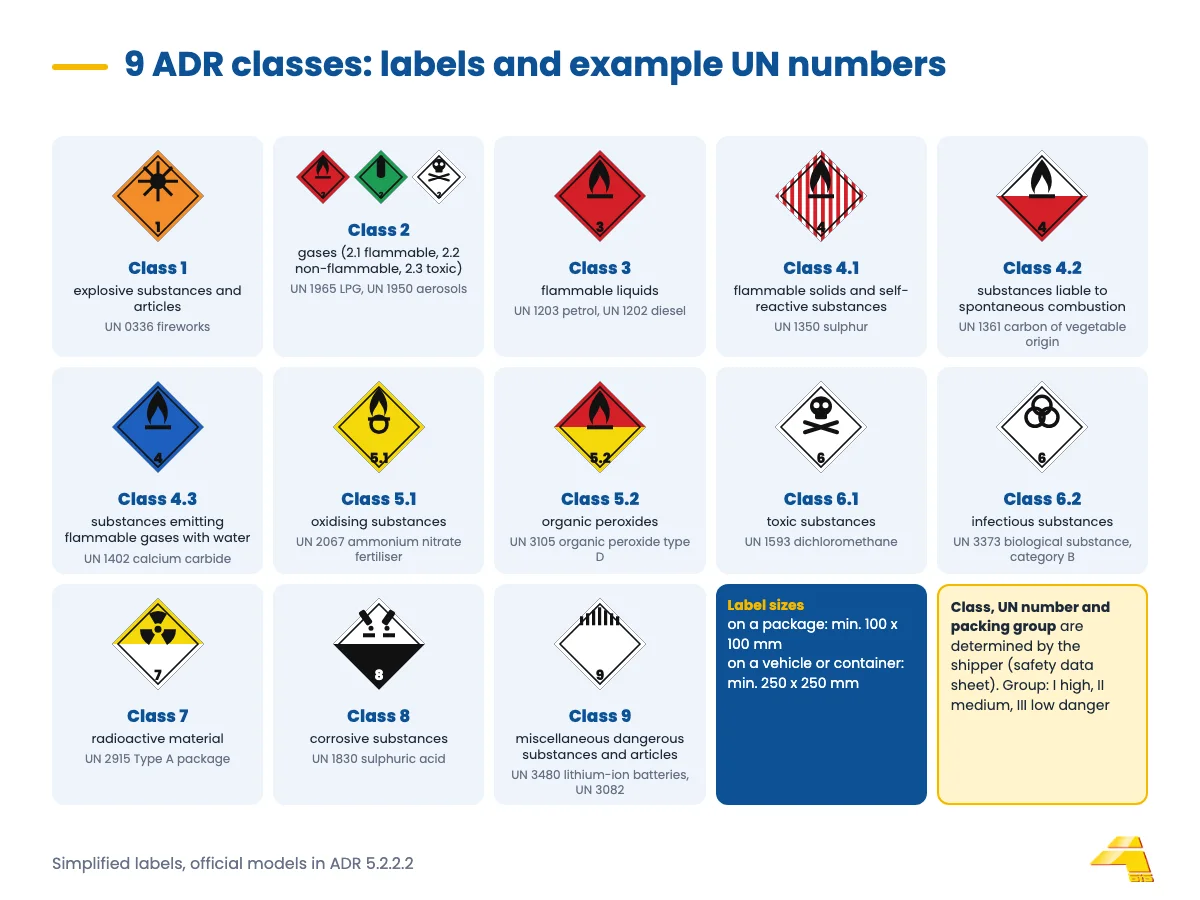
ADR divides dangerous goods into 9 classes according to their main hazard. Classes 4, 5 and 6 have subclasses, which is why the list of classes contains 13 designations. The class, UN number and packing group are determined by the shipper, usually on the basis of the safety data sheet.
| Class | What it covers | Examples from ADR Table A |
|---|---|---|
| 1 | explosive substances and articles | UN 0336 fireworks |
| 2 | gases | UN 1965 LPG, UN 1950 aerosols |
| 3 | flammable liquids | UN 1203 petrol, UN 1202 diesel fuel, UN 1263 paint |
| 4.1 | flammable solids and self-reactive substances | UN 1350 sulphur |
| 4.2 | substances liable to spontaneous combustion | UN 1361 carbon of vegetable origin |
| 4.3 | substances which, in contact with water, emit flammable gases | UN 1402 calcium carbide |
| 5.1 | oxidising substances | UN 2067 ammonium nitrate based fertiliser |
| 5.2 | organic peroxides | UN 3105 organic peroxide type D |
| 6.1 | toxic substances | UN 1593 dichloromethane |
| 6.2 | infectious substances | UN 3373 biological substance, category B |
| 7 | radioactive material | UN 2915 Type A package |
| 8 | corrosive substances | UN 1830 sulphuric acid, UN 2794 lead-acid batteries |
| 9 | miscellaneous dangerous substances and articles | UN 3480 lithium-ion batteries, UN 3082 environmentally hazardous substance |
Hazardous waste is also subject to waste regulations (in Poland: the BDO waste database, the waste transfer note and the ODPADY waste sign), which we describe in our article on hazardous waste transport.
UN number and proper shipping name
A UN number is a four-digit number from the United Nations list, assigned to a substance or group of substances and preceded by the letters UN in documents. In ADR Table A, next to the number you will find the proper shipping name, class, packing group, labels and tunnel restriction code. Goods without an entry of their own fall under a collective N.O.S. entry (not otherwise specified), often with the technical name added.
The packing group indicates the degree of danger: I is high, II medium and III low. It determines the packaging and the exemption limits: UN 1263 paint in packing group I has a limit of 20 l under the 1.1.3.6 exemption, and in packing group III 1,000 l.
ADR plates: what the numbers on the orange plate mean
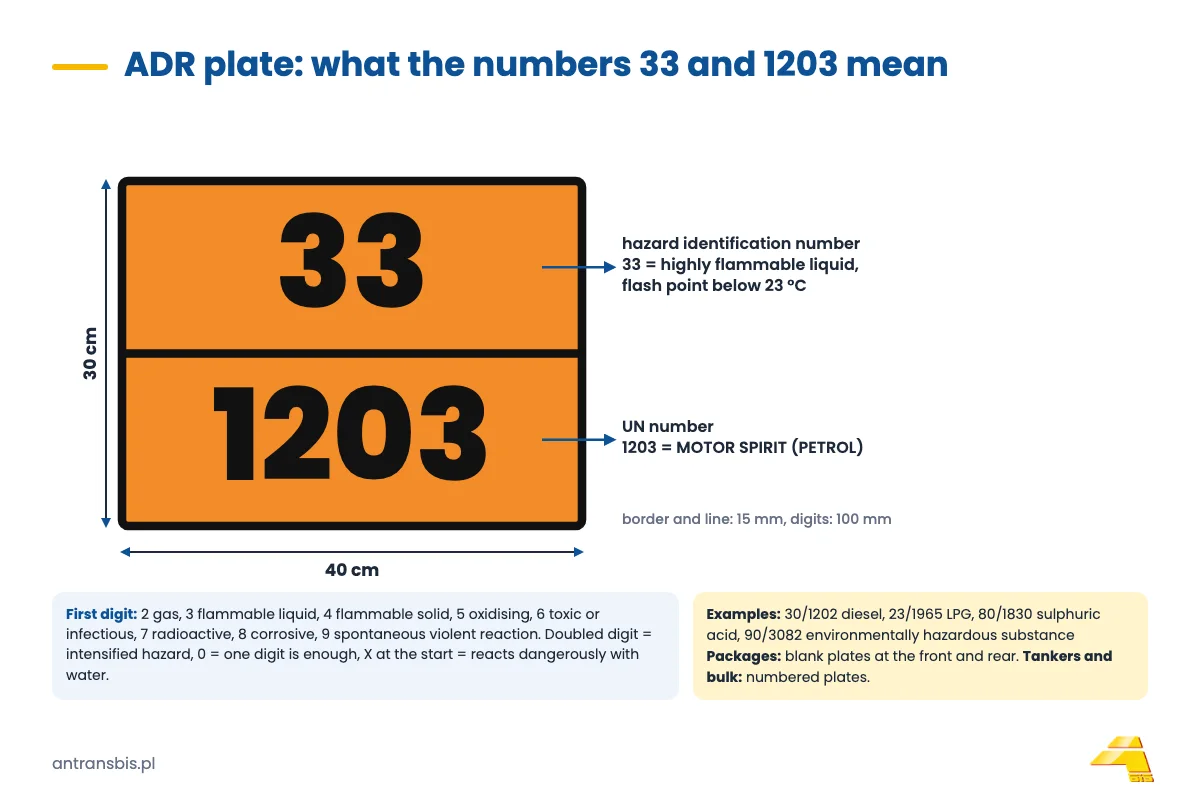
An ADR plate is a reflective orange plate measuring 40 x 30 cm with a 15 mm black border, displayed at the front and rear of the transport unit. If there is not enough space, it can be reduced to 30 x 12 cm.
For packages, such as drums, jerricans or boxes on pallets, blank plates are sufficient. Tankers and bulk loads also need numbered plates on the sides of each tank, compartment or vehicle. If the unit carries just one dangerous substance and nothing else, the side plates can be omitted, provided the front and rear plates bear the numbers.
The top half of the plate shows the hazard identification number of 2 or 3 digits, the bottom half the UN number. The first digit indicates the main hazard: 2 gas, 3 flammable liquid, 4 flammable solid, 5 oxidising effect, 6 toxicity or risk of infection, 7 radioactivity, 8 corrosivity, 9 risk of spontaneous violent reaction. A doubled digit indicates an intensified hazard, a zero is added when one digit is enough, and the letter X warns that the substance reacts dangerously with water. The most common combinations:
- 33/1203: petrol, a highly flammable liquid with a flash point below 23 °C,
- 30/1202: diesel fuel, a flammable liquid with a flash point between 23 and 60 °C,
- 23/1965: flammable gas, e.g. LPG,
- 80/1830: sulphuric acid, a corrosive substance,
- 90/3082: environmentally hazardous substance,
- 268/1005: ammonia, a toxic and corrosive gas.
Once there are no dangerous goods on board, remove the plates or cover them completely. The exception is empty, uncleaned tanks, which are marked as if they were full. In Poland, displaying plates without reason carries a penalty of 500 PLN (as of 30 October 2026).
Hazard labels and other ADR markings
A hazard label is a diamond with the hazard symbol and the class number in the bottom corner, at least 100 x 100 mm on a package. Large labels (placards), at least 250 x 250 mm, are fixed to containers, tanks and vehicles carrying bulk goods, and to vehicles carrying packages only for classes 1 (except 1.4S) and 7. Packages may also bear the environmentally hazardous substance mark (dead fish and tree), orientation arrows and the limited quantity (LQ) mark.
Documents in the driver’s cab
The cab must contain the transport document for all dangerous goods, the instructions in writing, photo identification for each crew member and the driver’s ADR certificate. Where ADR requires it, for example for tankers, the vehicle’s certificate of approval must be carried as well.
The instructions in writing are a four-page template setting out what to do in an emergency. The carrier hands them to the crew before departure, in a language every crew member understands. We explain how to use them in our article ADR instructions in writing: template and page-by-page guide.
ADR course and the driver’s ADR certificate
A driver of a vehicle carrying dangerous goods above the exemption limits must hold an ADR certificate. In Poland you will get one if you are at least 21, meet the requirements for professional drivers, complete an ADR course and pass the exam (Article 20 of the Act).
The basic course consists of at least 18 teaching hours of theory plus practical exercises and covers the carriage of packages and bulk goods. Tankers over 1 m³ require a tank specialisation course (at least 12 hours under ADR), and classes 1 and 7 require separate courses of at least 8 hours each. A teaching hour lasts 45 minutes and you can have no more than 8 a day, so the basic course alone takes at least 3 days.
The exam is a single-choice test: 30 questions in 60 minutes for the basic part and 15 to 18 questions for the specialist parts. You pass with at least 2/3 correct answers, and you must sit the exam within 6 months of the course.
The certificate is issued by the marshal of the voivodeship (the Polish regional authority) within 14 days, for a fee of 50 PLN (as of October 2026). It is valid for 5 years from the date you pass the exam. To renew it, complete a refresher course (at least 14 hours for the basic part) and pass the exam within the 12 months before it expires. The new certificate runs for 5 years from the expiry of the old one, so taking the course in this window does not cost you any validity.
An ADR certificate does not replace the driver’s professional qualification (Code 95). In our job offers for C+E drivers at Antrans, a basic ADR certificate is a plus.
ADR vehicle equipment
The fire extinguishers required depend on the gross vehicle weight (GVW) of the transport unit. Above 7.5 t you need at least 2 extinguishers with a total of 12 kg of powder, including one of at least 6 kg; from 3.5 to 7.5 t, 8 kg in total; and up to 3.5 t, 4 kg. One extinguisher, at least 2 kg, is for fighting engine or cab fires, and each must have a seal and the date of the next inspection.
The vehicle must also carry a wheel chock, two self-standing warning signs and eye rinsing liquid, and for each crew member a warning vest, a hand lamp without metal surfaces that could produce sparks, gloves and eye protection. Labels 2.3 and 6.1 also require an emergency escape mask, and substances with labels 3, 4.1, 4.3, 8 or 9 require a shovel, a drain seal and a collecting container.
Dangerous goods safety adviser (DGSA)
A company that consigns, carries, packs, loads, fills or unloads dangerous goods must appoint a dangerous goods safety adviser (DGSA). The adviser monitors compliance with the regulations, trains staff and prepares accident reports and an annual report. In Poland the adviser’s certificate is issued for 5 years by the Director of the Transport Technical Inspectorate (TDT), and Article 15 of the Act provides for exceptions, including for small quantities.
Small quantities: the 1.1.3.6 exemption
If the quantity of goods on a transport unit is within the 1.1.3.6 limit, you do not need, among other things, orange plates, instructions in writing or an ADR certificate for the driver. You multiply the quantity of each substance by 50, 3 or 1, depending on its transport category, and the total must not exceed 1,000 points. The transport document, a 2 kg fire extinguisher and Chapter 1.3 training are still required. You can check your own load with our ADR 1.1.3.6 calculator.
Penalties for breaching ADR rules
In Poland a party involved in the carriage pays a penalty of 200 to 10,000 PLN for breaches (Article 107 of the Act), imposed by authorities including the Road Transport Inspectorate (ITD). Penalties from a single roadside check cannot exceed 10,000 PLN in total per party, and for an inspection at the company’s premises the cap is 15,000 to 40,000 PLN. The driver also faces a separate fine of up to 1,000 PLN (Article 111). Examples from Annex 1 to the Act (as of 30 October 2026):
| Breach | Penalty |
|---|---|
| carrying goods without a transport document | 800 PLN |
| failing to provide the crew with instructions in writing | 300 PLN |
| allowing a driver without an ADR certificate to carry out the transport | 2,000 PLN |
| vehicle without the required plates, labels and marks | 2,000 PLN |
| displaying orange plates without justification | 500 PLN |
| consigning or carrying goods not permitted for carriage | 10,000 PLN |
How to book ADR transport
For a quote, have ready the UN number, name, class, packing group, number and type of packages, weight or volume, and the safety data sheet. The freight forwarder will check whether the load fits within the 1.1.3.6 exemption or whether you need a driver with an ADR certificate and a marked vehicle. ADR transport costs more than standard freight because it requires a trained driver, equipment and documents.
At Antrans BiS, transport of chemicals and ADR goods is one of the industries we serve. We agree the scope of ADR transport individually on the basis of the load’s safety data sheet, and for dangerous goods we provide a vehicle, marking and documentation that comply with ADR. Chemicals not classified as dangerous travel as standard palletised freight. Read more on our chemical and ADR transport page.
Frequently asked questions
What does ADR stand for?
ADR is the abbreviation of the French name of the agreement on the international carriage of dangerous goods by road, signed in Geneva in 1957. The agreement sets out the classification, packaging, marking and documents for such goods, as well as the requirements for the vehicle and the driver. In everyday use, any road transport of dangerous goods is called ADR transport.
How many ADR classes are there?
ADR has 9 classes of dangerous goods. Classes 4, 5 and 6 are divided into subclasses, so the list of classes contains 13 designations: 1, 2, 3, 4.1, 4.2, 4.3, 5.1, 5.2, 6.1, 6.2, 7, 8 and 9. The class of the goods is determined by the shipper, usually on the basis of the safety data sheet.
What does the 33/1203 plate mean?
The top number, 33, is the hazard identification number: a highly flammable liquid with a flash point below 23 °C. The bottom number, 1203, is the UN number for motor spirit (petrol). You will see this plate on a petrol tanker, for example.
How long does an ADR course take and what is the exam like?
The basic course consists of at least 18 teaching hours of theory, each lasting 45 minutes, plus practical exercises, and you can have no more than 8 teaching hours a day, so it takes at least 3 days. The exam for the basic part is a single-choice test with 30 questions in 60 minutes. You pass if you answer at least 2/3 of the questions correctly.
How long is an ADR certificate valid?
An ADR certificate is valid for 5 years from the date you pass the exam. To renew it, complete a refresher course and pass the exam within the 12 months before it expires. The new certificate then runs from the expiry date of the previous one.
How much fuel can you carry without ADR plates?
Under the 1.1.3.6 exemption you can carry up to 1,000 l of diesel or up to 333 l of petrol in jerricans or drums on a single transport unit. For a mixed load you count points: a litre of diesel is 1 point, a litre of petrol 3 points, and the total must not exceed 1,000. You still need a transport document and a fire extinguisher, and fuel in the vehicle’s own tank does not count towards the limit.
Sources
- Polish Ministry of Infrastructure, Dangerous goods: the ADR agreement, national regulations, ADR certificate (accessed 30 October 2026)
- ADR 2025, Polish government statement of 6 March 2025, Journal of Laws (Dz.U.) 2025 item 642 (accessed 30 October 2026)
- Polish Act on the Transport of Dangerous Goods, consolidated text, Dz.U. 2024 item 643: Articles 3, 20-25, 107-111 and Annex 1 (accessed 30 October 2026)
- Polish regulation on examinations for drivers carrying dangerous goods, Dz.U. 2024 item 964 (accessed 30 October 2026)
- Polish regulation on running dangerous goods transport courses, consolidated text, Dz.U. 2021 item 2150 (accessed 30 October 2026)
Need to ship chemicals, paint, batteries or other goods with a UN number? Describe the load in our quote form, give the UN number, class and number of packages and have the safety data sheet ready, and a freight forwarder will check the ADR requirements for your route. During working hours we usually reply within 60 minutes, and we also take quote requests on +48 666 666 863. To see how we handle transport for chemical manufacturers, visit our chemical and ADR transport page.

Managing Director | Antrans BiS, Olkusz
Sebastian Szklarczyk has led the development of Antrans BiS, a transport company operating throughout Europe, for more than 15 years. He started as Head of the Freight Forwarding Department, gaining practical experience in organising international transport and managing a vehicle fleet on European routes.
As Managing Director, he is responsible for the strategic management of a company handling more than 21,000 transport operations a year on its main routes: Poland-Italy, Poland-Germany, Poland-Austria, Spain, the Benelux countries and Scandinavia. Under his leadership, Antrans BiS has expanded its fleet to 220 vehicles, including its own and partners’ vehicles, and achieved an on-time delivery rate of 98%.
Specialisms: international FTL transport throughout Europe, automotive and FMCG logistics, optimisation of European routes, road traffic regulations and driving bans in the EU, and transport documentation (CMR, VAT-UE, INTRASTAT).
On the Antrans BiS blog, he shares practical knowledge about international freight forwarding, transport regulations and the business aspects of running a transport, freight forwarding and logistics company in different European countries.