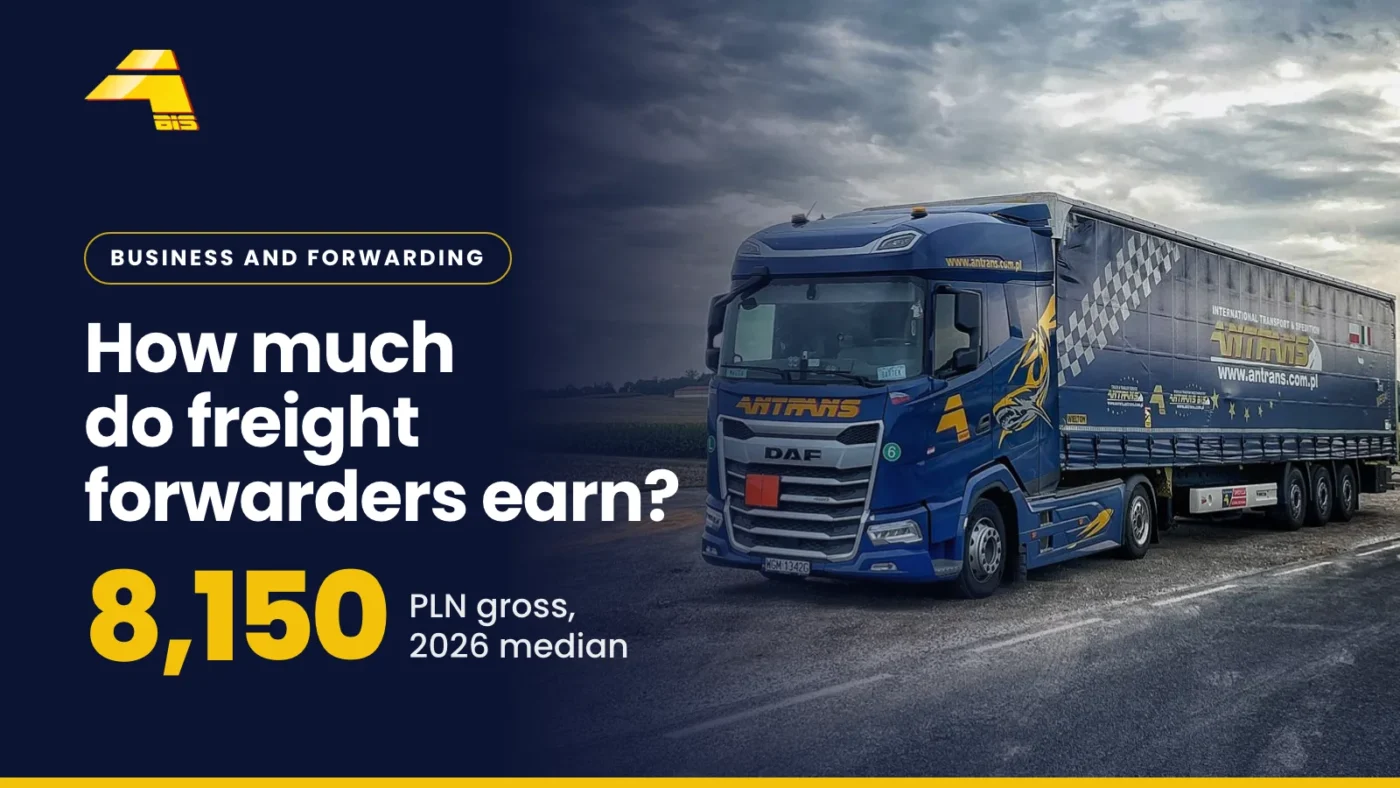
A freight forwarder is the person who organises the movement of goods: they take the order from the client, find a truck and a carrier, agree the route and timings, keep the paperwork in order and step in when something goes wrong on the road. They don’t drive the truck themselves; the work is done on the phone, by email and in a transport management system. According to Sedlak & Sedlak data from January 2026, the median pay of a freight forwarder in Poland is 8,150 PLN gross a month.
This article is about the job. If you are looking for information about the service itself and what it gives a shipper, read our article on what freight forwarding is. I am writing as someone who started out as head of a forwarding department and today works with a team of forwarders every day.
What is a freight forwarder
The Polish Civil Code defines a forwarder as a business that, for a fee, dispatches or receives consignments or performs other services related to their carriage. In job-market terms, a freight forwarder is simply an employee of a forwarding or transport company who handles these orders. They stand between three parties: the client who wants to ship goods, the carrier with the truck and driver, and the loading and unloading sites.
Polish job ads also use titles such as forwarding specialist, transport planner, dispatcher and even the English “freight forwarder”. A dispatcher more often plans the work of the company’s own fleet, while a forwarder more often sources trucks and sells the service, but in many companies the two roles overlap.
What a freight forwarder does day to day
In road transport, a freight forwarder’s duties usually include:
- handling enquiries from clients and preparing quotes,
- finding a carrier or a free truck from the company’s own fleet and negotiating the rate,
- passing addresses, time slots and loading requirements on to the driver,
- checking documents: transport orders, CMR consignment notes, cargo specifications,
- tracking trucks and letting the client know about delays,
- planning return loads so that trucks don’t come back empty,
- settling the order and handling claims.
A forwarder works on freight exchanges, in TMS (transport management systems) and with a live map of truck positions. You will find a comparison of the main exchanges in our article on freight exchanges.
What a freight forwarder’s working day looks like
No two days are the same, but in international forwarding the pattern is often similar:
- 7:30, fleet check. Seeing where the trucks are and what came in by email overnight.
- 8:00 - 10:00, loading and unloading. Calls with drivers and warehouses, confirming that the goods have left.
- 10:00 - 13:00, enquiries and quotes. Calculating rates, finding free trucks, working the freight exchange.
- 13:00 - 15:00, paperwork. Issuing transport orders, checking CMRs, preparing invoices.
- 15:00 - 17:00, plan for tomorrow. Arranging return loads and truck placements for the coming days.
- After 17:00, on call. Breakdowns, delays at borders, weekend driving bans.
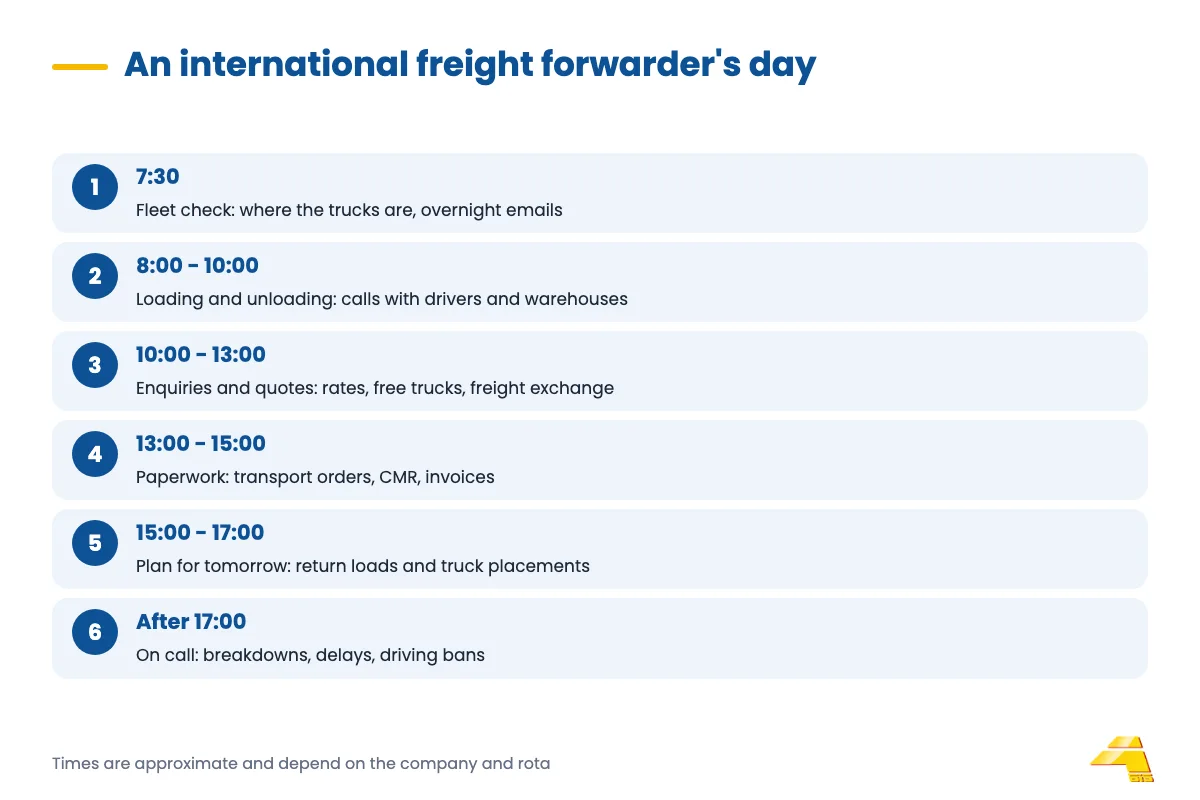
The last point is there because transport doesn’t stop at 17:00. In companies that run transport around the clock, forwarders work in shifts or take turns being on call. At Antrans, forwarders are available to carriers 24/7 and speak to them in Polish, English, German and Italian. We publish current job openings for freight forwarders on our careers page.
Domestic vs international freight forwarder
A domestic forwarder handles transport within Poland. Routes are shorter, so there are more orders per day, and a foreign language is usually not required. With part loads and pallets, what counts is quickly consolidating loads onto one truck.
An international forwarder handles transport between countries, for example from Poland to Italy, Germany or Spain. They need to know the CMR Convention, the rules on drivers’ driving and rest times, driving bans in individual countries and the Incoterms rules, which determine who pays for which leg of the journey. Without at least one foreign language, it is hard to do this job.
There are also sea, air and rail freight forwarders. Their work has more to do with customs documents and booking space with the carrier than with phone calls to drivers.
What skills and languages a freight forwarder needs
A degree in a related field (logistics, transport) helps, but it is not a requirement. What more often counts is:
- staying calm under time pressure and making quick decisions when a truck breaks down or a warehouse refuses to unload,
- negotiation, because the company’s margin depends on the rate agreed with the carrier,
- good organisation, because one forwarder handles anything from a few to a dozen or more trucks at once,
- geography and the basics of regulations: CMR, drivers’ working time, vehicle dimensions and weights,
- computer skills: email, spreadsheets, TMS, freight exchanges,
- a foreign language in international forwarding, most often English, and German or Italian on routes to Germany and Italy.
It also helps to know the documents that accompany a shipment. You will find an overview in our article on transport documents.
Freight forwarder certificates: PISiL, FIATA and professional competence
No certificate is legally required to work as an employed forwarder in Poland. Training does, however, help with career development and when you talk about promotion:
- The Polish Chamber of Forwarding and Logistics (PISiL) runs a forwarding course and a course based on a programme approved by FIATA, the international federation of freight forwarders.
- The FIATA Diploma in Freight Forwarding covers 15 modules, including multimodal transport, air freight, customs procedures and digital tools for forwarders. Courses are run by FIATA’s national member associations.
- The certificate of professional competence in road transport is obtained by passing a written exam. In Poland it is required of the person managing a company that wants a licence to act as an intermediary in the carriage of goods, for example a forwarder setting up their own business.
How much does a freight forwarder earn in Poland in 2026
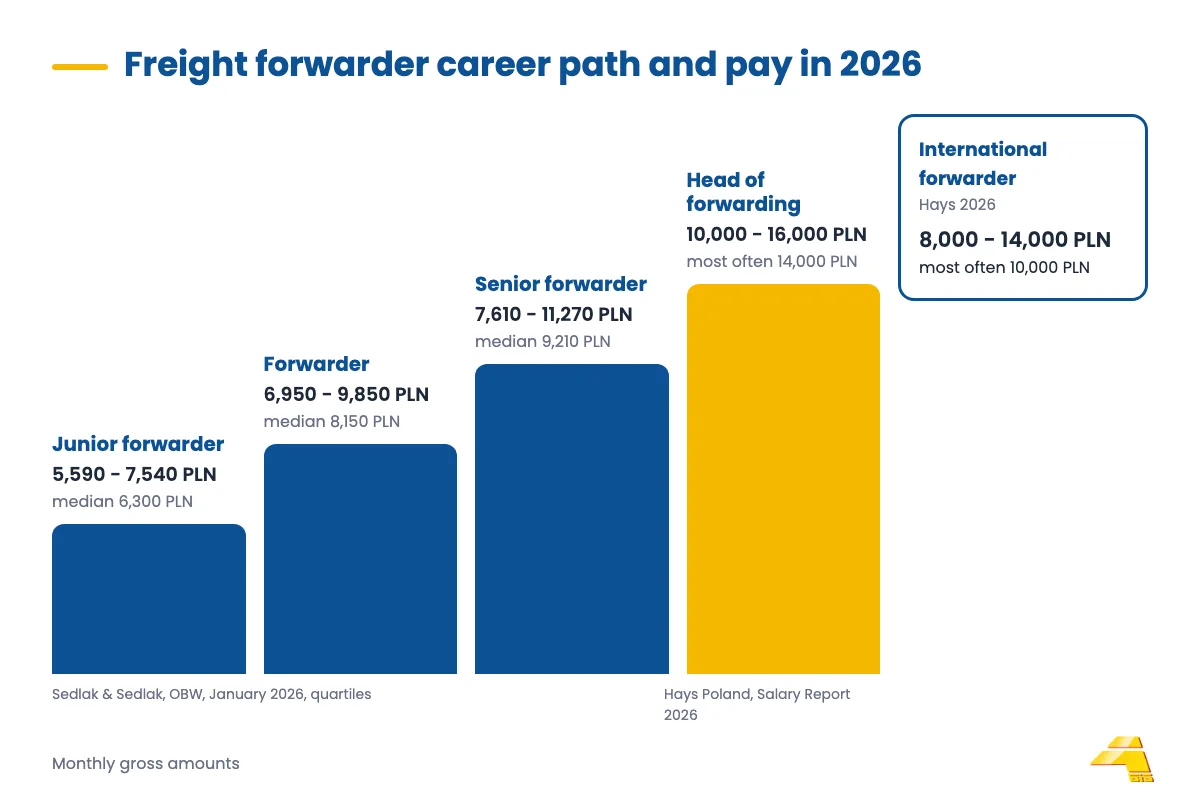
A forwarder’s pay depends on experience, languages, company size, city and the bonus scheme. In many companies the bonus is calculated on the margin from orders, so the difference between a good month and an average one can be large. Below are figures from three Polish sources, all given as gross monthly amounts.
| Level | Lower quartile | Median | Upper quartile |
|---|---|---|---|
| Junior freight forwarder | 5,590 PLN | 6,300 PLN | 7,540 PLN |
| Freight forwarder | 6,950 PLN | 8,150 PLN | 9,850 PLN |
| Senior freight forwarder | 7,610 PLN | 9,210 PLN | 11,270 PLN |
Table source: Sedlak & Sedlak, Polish National Salary Survey, January 2026 update, sample of 718 forwarders. The median for a forwarder at specialist level is about 5,886 PLN net on a standard employment contract.
Hays Poland’s 2026 salary report gives an international freight forwarder a range of 8,000 - 14,000 PLN gross, with 10,000 PLN the most frequently offered figure. A head of forwarding is at 10,000 - 16,000 PLN gross, most often 14,000 PLN.
Pracuj.pl, a Polish job portal, shows a median of 10,000 PLN gross based on the salary ranges in job ads (checked on 9 October 2026). There is also a clear gap between cities: in cities with more than 250,000 inhabitants the median is 12,333 PLN, while in towns of up to 25,000 inhabitants it is 8,000 PLN.
For comparison, GUS (Statistics Poland), in its survey of the structure of wages for October 2024 (published in February 2026), reported an average of 7,679.15 PLN gross for the business services agents group, which includes freight forwarders.
How pay looks at the other end of the phone line is covered in our article on how much an HGV driver earns.
Freight forwarder career path
A typical path in a transport and forwarding company leads through four levels:
- Junior freight forwarder. Supports experienced colleagues, deals with drivers and warehouses, learns the paperwork and the freight exchanges.
- Freight forwarder. Handles orders independently and manages their own clients or carriers.
- Senior freight forwarder. Looks after the largest clients or the most demanding routes, onboards new team members.
- Head of forwarding or team leader. Responsible for the department’s results, rates and people.
After a few years, some forwarders set up their own forwarding company. In Poland this requires a licence to act as an intermediary in the carriage of goods, a certificate of professional competence and proof of financial standing.
Pros and cons of working as a freight forwarder
Pros:
- a quick start, because many companies take people on without experience,
- pay that grows with experience and performance-related bonuses,
- working with people from all over Europe and using languages every day,
- tangible results: the truck has left, the goods have arrived.
Cons:
- stress and unpredictability, because a breakdown or a queue at the border can wreck the day’s plan,
- calls outside working hours and on-call duty at companies that run around the clock,
- pressure on margins and negotiating with both sides,
- responsibility for other people’s goods and deadlines.
Frequently asked questions
What does a freight forwarder do?
A freight forwarder organises the transport of goods from accepting the order to unloading. They find a carrier or a truck from the company’s own fleet, negotiate the rate, give the driver instructions, keep the documents in order and update the client on how the transport is going. Finally, they settle the order.
How do you get a job as a freight forwarder with no experience?
The easiest way is to start as a junior forwarder or an assistant in a forwarding department, where the company provides onboarding. A foreign language, a basic knowledge of European geography and computer skills all help. A forwarding course is not required, but it shows an employer that the candidate knows the basics.
Can you become a freight forwarder without a degree?
Yes. Employers rarely require a degree; more often they expect secondary education, a foreign language and resilience to stress. A degree in logistics or transport makes the start easier, but practical knowledge is gained on the job anyway.
Is freight forwarding a hard job?
It is a demanding job, because a forwarder handles anything from a few to a dozen or more trucks at once and has to react quickly to breakdowns, delays and changes of plan. For people who cope well with time pressure and enjoy working with others, it can be rewarding and well paid.
What is the difference between a logistics specialist and a freight forwarder?
A freight forwarder organises the transport of specific loads and deals with carriers, routes and documents. A logistics specialist has a broader remit and plans the whole flow of goods in a company, including purchasing, stock, warehousing and distribution. Freight forwarding is one area of logistics.
Sources
- Sedlak & Sedlak, wynagrodzenia.pl: How much does a freight forwarder earn (Polish National Salary Survey, January 2026 update)
- Trans.info, 16 June 2026: data from the Hays Poland Salary Report 2026
- Pracuj.pl for employers: freight forwarder salaries (data from job ads, checked on 9 October 2026)
- GUS (Statistics Poland): Structure of wages and salaries by occupation in October 2024 (published 10 February 2026)
- PISiL: training, including the forwarding course and the FIATA-based course
- FIATA: Diplomas
- Polish Civil Code, consolidated text, Journal of Laws (Dz.U.) 2026, item 795 (Art. 794), ISAP
- Polish Road Transport Act, consolidated text, Journal of Laws (Dz.U.) 2025, item 1490 (Art. 5b, 5c), ISAP
Antrans is recruiting freight forwarders, dispatchers and drivers. If you would like to work on transport to Italy, Germany, Austria and Scandinavia in a team that runs around the clock, check the current openings on our careers page.

Managing Director | Antrans BiS, Olkusz
Sebastian Szklarczyk has led the development of Antrans BiS, a transport company operating throughout Europe, for more than 15 years. He started as Head of the Freight Forwarding Department, gaining practical experience in organising international transport and managing a vehicle fleet on European routes.
As Managing Director, he is responsible for the strategic management of a company handling more than 21,000 transport operations a year on its main routes: Poland-Italy, Poland-Germany, Poland-Austria, Spain, the Benelux countries and Scandinavia. Under his leadership, Antrans BiS has expanded its fleet to 220 vehicles, including its own and partners’ vehicles, and achieved an on-time delivery rate of 98%.
Specialisms: international FTL transport throughout Europe, automotive and FMCG logistics, optimisation of European routes, road traffic regulations and driving bans in the EU, and transport documentation (CMR, VAT-UE, INTRASTAT).
On the Antrans BiS blog, he shares practical knowledge about international freight forwarding, transport regulations and the business aspects of running a transport, freight forwarding and logistics company in different European countries.