A freight exchange is an online platform where freight forwarders, shippers and carriers post available loads and free trucks and then agree transport orders. Polish carriers most often choose Trans.eu or TIMOCOM, while Teleroute and Wtransnet fill in the western and southern routes. The best freight exchange is the one with loads on your lanes, but what really decides the outcome is something else: whether you can check the client before you send your truck to load.
This article compares freight exchanges and explains how to take transport orders from them safely. If you are looking for general ways to win new loads, such as tenders, direct sales or industry contacts, we cover them in our article on finding transport orders.
How a freight exchange works
The client posts an offer: loading place and date, unloading point, trailer type, weight and often the rate. The carrier filters offers by route and vehicle, replies via the built-in messenger or by phone and, once the terms are agreed, receives the order in writing. It also works the other way round: the carrier posts a free vehicle, e.g. “curtainsider, 13.6 m, free tomorrow morning in Verona”, and forwarders get in touch themselves.
Access is paid for by subscription. Each of the big exchanges checks a company’s details before letting it in, but verification at registration is no substitute for your own checks on every order. The exchange brings the parties together; the contract of carriage is concluded by you, with a specific company.
For many carriers, a freight exchange is a supplementary channel. The backbone of the month is often regular work with a forwarding company, and the exchange fills return legs and idle days. That is how some of the carriers in our carrier zone work: on regular lanes they have loads all year round.
Freight exchanges in Poland in 2026 compared
All the exchanges in the table are operating and accepting new users (as of 9 October 2026). We only give prices where the exchange publishes them on its website.
| Exchange | Coverage (as stated by the exchange) | Pricing model, checked 9 October 2026 | Counterparty verification | Vans up to 3.5 t |
|---|---|---|---|---|
| Trans.eu (Trans.eu Group S.A., since 2004) | users from 24 European countries, over 40,000 verified companies | Trans for Carriers subscription 530 PLN net/month, 10% off when you pay for a year upfront | verification before access, user ratings, TransRisk payment score | yes, a van filter and an offer for carriers up to 3.5 t |
| TIMOCOM | offers from 46 countries, over 58,000 companies | from 71.62 EUR/month (international transport), from 5.88 EUR/month (domestic), free trial of up to 4 weeks | multi-step verification, profile with documents, average rating, closed exchange for trusted partners | yes, a separate exchange for vehicles up to 3.5 t |
| Teleroute (Alpega Group) | 29 countries, over 85,000 companies | price on request, monthly packages | licence and valid insurance certificate required; optional payment guarantee with Coface | no information on the website |
| Wtransnet | Spain, Portugal, France | price on request | mandatory QAP quality label, payment protection with Coface | no information on the website |
| CargoON (Trans.eu Group) | platform for shippers | carriers do not buy access, the shipper pays | carriers verified on Trans.eu | not applicable |
How should you read this table? Trans.eu is a Polish platform and a good choice if you run domestic routes in Poland and work in Central Europe. TIMOCOM states it has offers from 46 countries, so carriers with routes to Germany, Benelux or Italy use it more often. Teleroute is worth considering for France and Benelux, and Wtransnet for Spain and Portugal. Some carriers pay for two exchanges at once, because a monthly subscription can cost less than a single empty return run from Spain.
CargoON is not a classic freight exchange for carriers. It is a system for manufacturers and distributors, who use it to allocate their loads. From a carrier’s point of view, what matters is that some of these offers end up on the Trans.eu exchange, so you see loads posted directly by shippers.
Best freight exchange for vans up to 3.5 t
In the van segment turnover is fast, and offers are gone within fifteen minutes or so. TIMOCOM runs a separate exchange for vehicles up to 3.5 t and a cheap domestic package, while Trans.eu has a van filter and an offer for carriers up to 3.5 t. For domestic work one exchange is usually enough; for express runs abroad, wider coverage comes in handy.
Keep an eye on the rules, too. Since 1 July 2026, vans from 2.5 to 3.5 t used in international transport must have a smart tachograph, as we explain in our article on tachographs in vans from 2026.
How to take loads from a freight exchange safely
The exchange checks the company at registration. It does not check for you whether the person writing on behalf of that company really works there, or whether they will pay for a specific run. That check is up to you, every time the client is new.
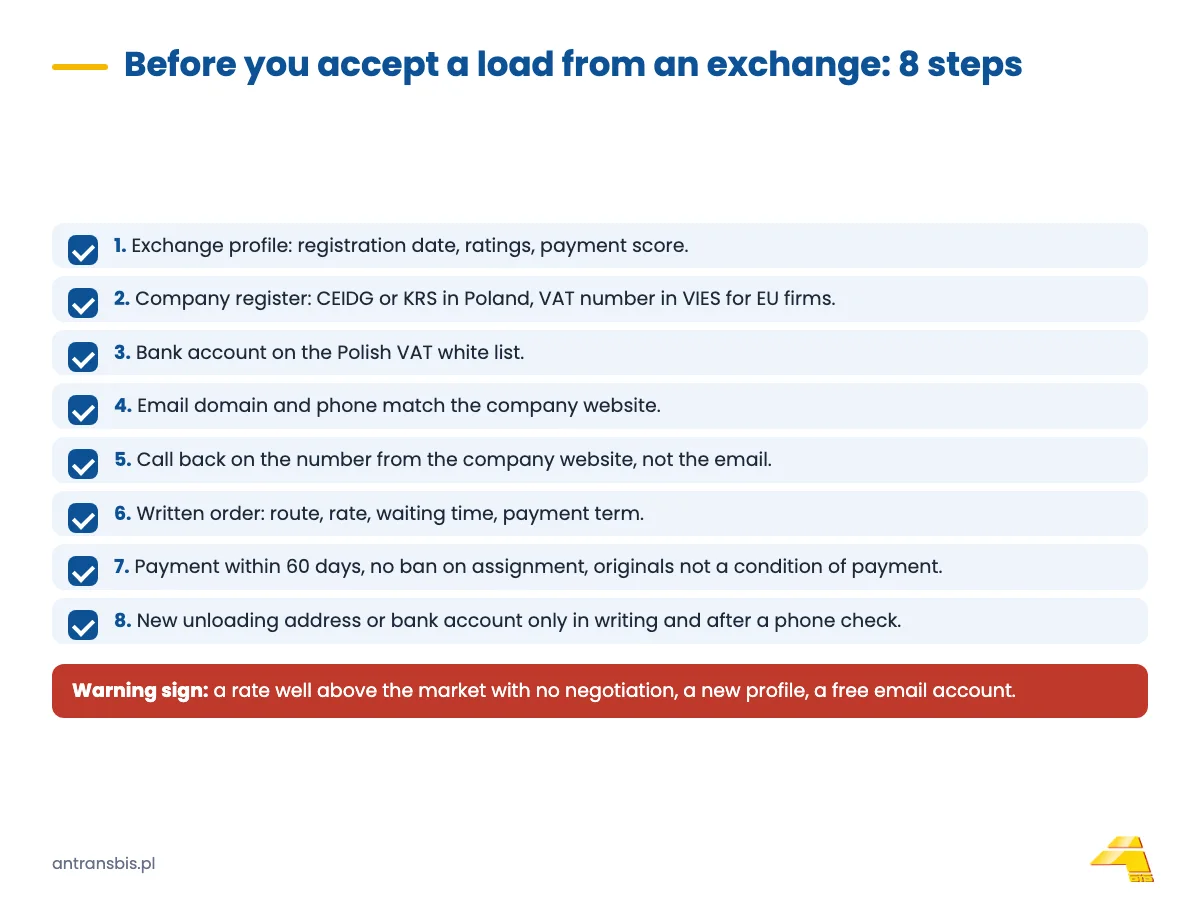
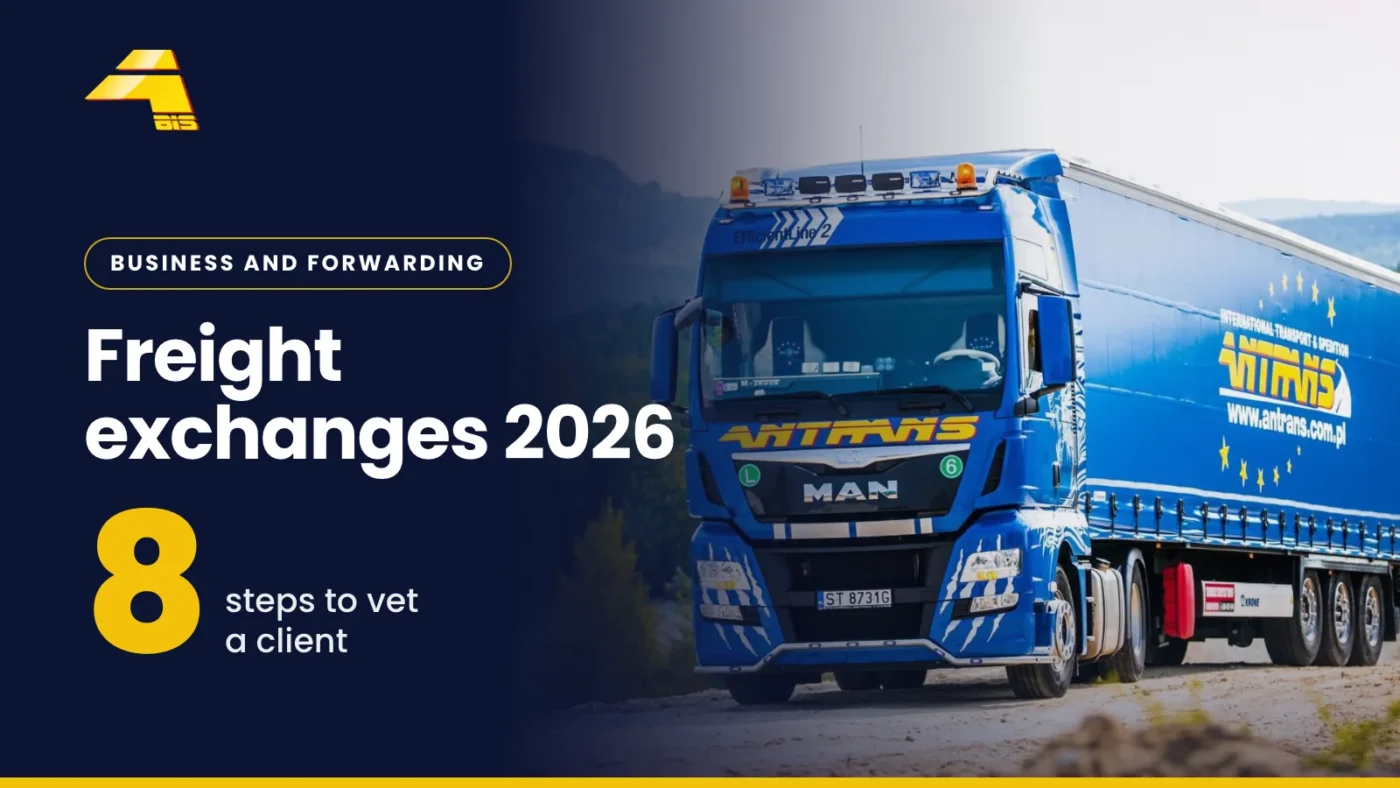
Vetting a client in 8 steps
- Check the profile on the exchange: how long the company has been registered, what ratings it has and, on Trans.eu, its TransRisk score as well.
- Look the company up in CEIDG (the Polish register of sole traders) or KRS (the Polish National Court Register), and check a client from another EU country in the VIES system.
- Check that the bank account for payment is on the white list of VAT taxpayers kept by the Polish tax authorities.
- Compare the email domain and phone number with the details on the company’s website. A free mailbox or a domain with one letter changed is a warning sign.
- Call back on the number from the company’s official website, not the one given in the email.
- Only accept an order in writing: route, dates, rate, rules for charging waiting time and the payment term.
- Read the payment terms. A payment term of more than 60 days, a ban on assigning receivables and making original documents a condition of payment are clauses that Trans.eu itself warns against.
- Only accept a change of unloading address or bank account number in writing and after confirming it by phone with the company.
Scams targeting carriers
The most common scheme is a client posing as a well-known forwarding company. They write from an address that looks deceptively like the real one and send a genuine-looking order, and after unloading it turns out that the real company never booked that run. The carrier is left without payment and without a counterparty who can be asked to pay.
The second scheme is a hijacked exchange account. The fraudster phishes the login details, for example through a fake login page, and posts loads from the profile of a company with good ratings. That is why you should turn on two-factor authentication if the exchange offers it (TIMOCOM mentions it in its security information), and never log in from links in emails.
Also be wary of a rate well above the market that is accepted without any negotiation, and of requests to transship the load or change the unloading place mid-route.
Cargo theft and phantom carriers
The same mechanism works against shippers. A fake carrier takes an order for a valuable load from the exchange and disappears after loading. According to data from the Hesse criminal police and German insurers, reported by Trans.info on 13 May 2026, losses from this in Germany reached 17.5 million euros in the first half of 2025, and 266 such cases were recorded in 2024.
For an honest carrier, there are two takeaways. First, fraudsters also impersonate real carriers, so expect the forwarder to call you and ask for documents. Second, a load handed over to an unauthorised person as a result of fraud is a classic dispute with the insurer, so it pays to know the scope of your own policy; we cover this in our article on carrier’s liability insurance (OCP).
Payment terms
In Poland, the payment term in transactions between businesses should not exceed 60 days from delivery of the invoice. A longer term is only allowed if the parties expressly agree on it and it is not grossly unfair to the creditor, and when the debtor is a large company and you are a small or medium-sized business, the 60-day limit is fixed. Once the term has passed, you are entitled to statutory interest for late payment in commercial transactions without having to send a separate demand.
On freight exchanges, payment ratings and debt collection or payment guarantee schemes help. Teleroute offers a payment guarantee under which the carrier receives at least 90% of the amount due if the client does not pay. It is an add-on service, so check its terms before you activate it.
Freight exchange or regular work with a forwarder?
A freight exchange gives you flexibility: you choose the run, direction and rate from one day to the next. You pay for it with the subscription, the time spent looking for loads and the risk of a new client on every order. Regular work with a freight forwarding company reverses these proportions: you have less choice, but you know how many kilometres you will drive in a month and when you will get paid.
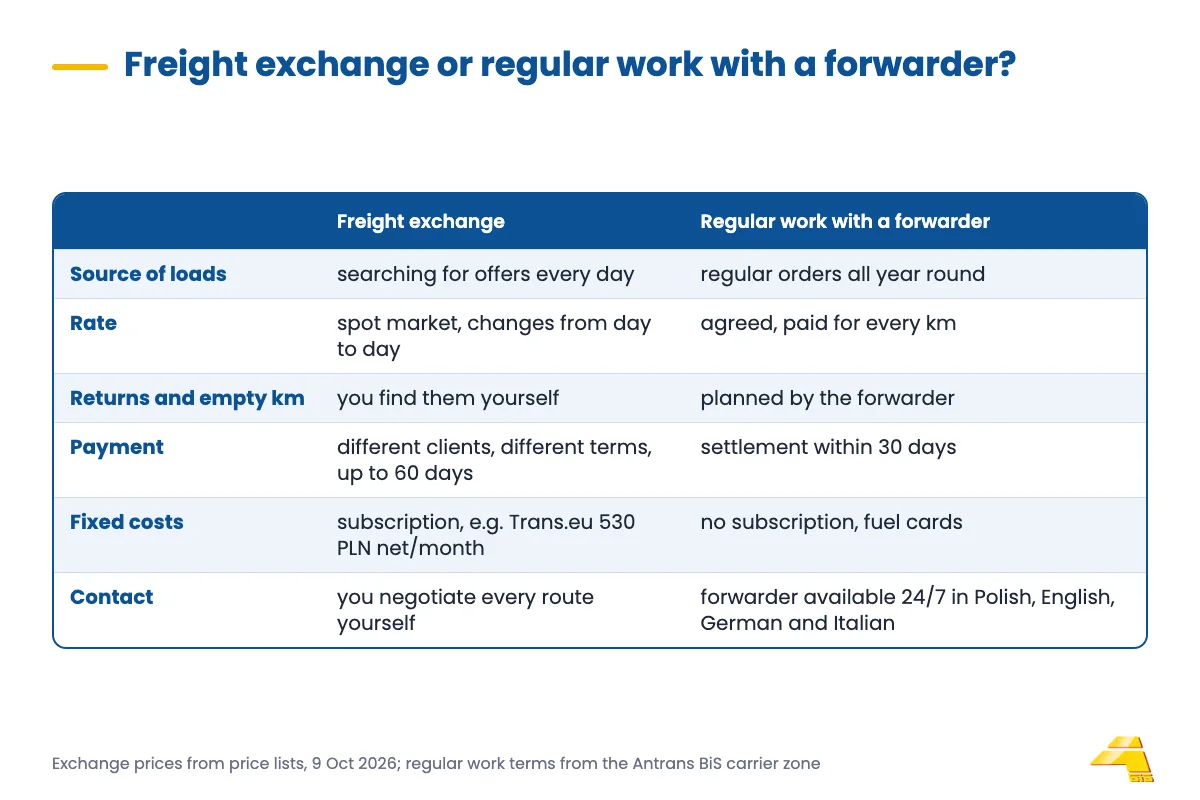
This is how it works at Antrans BiS, a company with 32 years on the market that mainly serves routes between Poland and Italy, Germany, Austria, Spain, Benelux, Scandinavia, France and the UK:
- regular orders all year round, not just in the peak season,
- payment for every kilometre driven,
- settlement within 30 days and over 12,000 km a month,
- fuel cards and advances for fuel and road tolls,
- forwarders available 24/7 in Polish, English, German and Italian.
The requirements are simple: a Community licence, carrier’s liability insurance (OCP) with a sum insured of at least 100,000 EUR, a tractor unit with a curtainsider, tarpaulin, mega or refrigerated semi-trailer, payload up to 24 t, preferably Euro 5 or Euro 6 because of low emission zones (LEZ), and drivers with a C+E licence and a driver card.
The two models can be combined. Some carriers run regular lanes with a forwarder and treat the exchange as a reserve for weeks when a truck is free.
Frequently asked questions
Which freight exchange is the best?
There is no single best freight exchange for everyone. Trans.eu works well for domestic transport in Poland and for Central Europe, TIMOCOM has offers from more countries and a strong position in Western Europe, and Teleroute and Wtransnet cover France, Benelux and the Iberian Peninsula. Choose the exchange that has loads on your routes and test it before signing a longer contract.
Do you have to pay for a freight exchange?
Yes, carriers pay a monthly subscription for access. Some exchanges publish price lists, others only quote a price after you contact their sales team. Some offer a free trial period.
Can you use a freight exchange without a company?
No, freight exchanges are intended for transport, forwarding, manufacturing and trading companies. You have to provide your business details when you register, and the exchanges verify them before granting access. For transport for hire or reward you also need the appropriate licence.
How do you check a client from a freight exchange?
Check their profile and ratings on the exchange, their details in the Polish CEIDG or KRS registers or in VIES, and whether their bank account is on the Polish VAT white list. Compare the email address and phone number with the company’s official website and call back on the number from the website. Only accept the order in writing, with a clear payment term.
Is a freight exchange enough to keep a haulage business going?
It is possible to work only from a freight exchange, but it means looking for loads every day and accepting the risk of new clients. Many carriers combine the exchange with regular work for a forwarding company or directly for shippers. Regular orders stabilise the month, and the exchange helps fill the return legs.
Sources
- Trans.eu: freight exchange (description, number of companies and countries)
- Trans.eu: Trans for Carriers price list valid from 1 June 2026 (PDF)
- Trans.eu: security, TransRisk and clauses in orders
- TIMOCOM: freight exchange, prices and verification
- TIMOCOM: freight exchange for vans up to 3.5 t
- Teleroute: verification process
- Teleroute: payment guarantee
- Wtransnet: about the exchange
- CargoON: platform for shippers
- Polish Act on Counteracting Excessive Delays in Commercial Transactions (ISAP)
- Polish register of VAT taxpayers (white list)
- VIES: EU VAT number validation
- Trans.info: phantom carriers in Germany, 13 May 2026
Do you have your own tractor unit and semi-trailer and are you tired of hunting for loads on freight exchanges? In our carrier zone we describe regular cooperation: orders all year round, payment for every kilometre, settlement within 30 days and fuel cards. You can also call us on +48 666 666 863.

Managing Director | Antrans BiS, Olkusz
Sebastian Szklarczyk has led the development of Antrans BiS, a transport company operating throughout Europe, for more than 15 years. He started as Head of the Freight Forwarding Department, gaining practical experience in organising international transport and managing a vehicle fleet on European routes.
As Managing Director, he is responsible for the strategic management of a company handling more than 21,000 transport operations a year on its main routes: Poland-Italy, Poland-Germany, Poland-Austria, Spain, the Benelux countries and Scandinavia. Under his leadership, Antrans BiS has expanded its fleet to 220 vehicles, including its own and partners’ vehicles, and achieved an on-time delivery rate of 98%.
Specialisms: international FTL transport throughout Europe, automotive and FMCG logistics, optimisation of European routes, road traffic regulations and driving bans in the EU, and transport documentation (CMR, VAT-UE, INTRASTAT).
On the Antrans BiS blog, he shares practical knowledge about international freight forwarding, transport regulations and the business aspects of running a transport, freight forwarding and logistics company in different European countries.