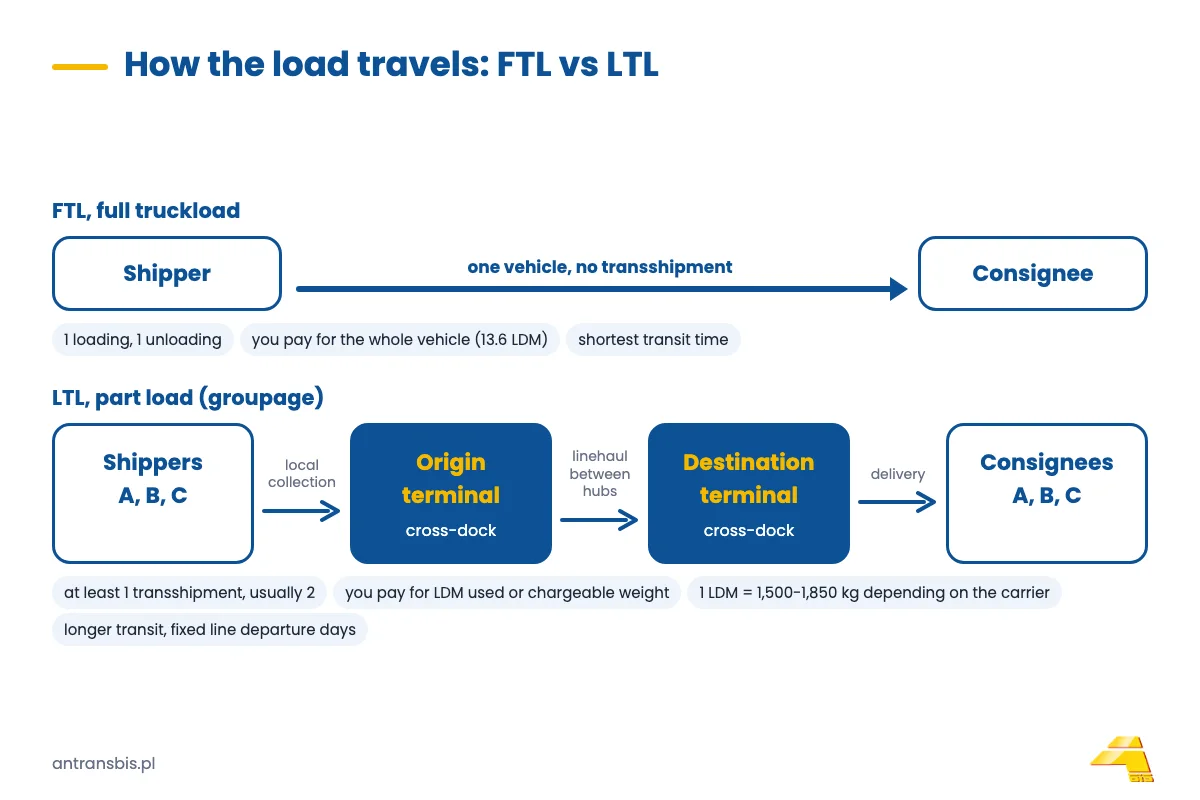
FTL is full truckload transport: one company books the entire semi-trailer, and the goods travel from the shipper’s loading dock straight to the consignee, with no transshipment and no other customers’ freight on board. LTL is part load (groupage) transport: you pay only for the loading metres (LDM) or pallet spaces you actually use, and your shipment travels through terminals together with goods from other shippers. Three numbers decide which one to choose: how many LDM the load takes up, how much it weighs and when it has to arrive.
Below I show how to calculate LDM, how carriers convert loading metres into kilograms and at what shipment size it usually pays to book a whole truck. We cover the number of pallets per trailer separately in our article on how many pallets fit on an HGV, and rates per kilometre in our HGV transport price guide for 2026.
What is FTL (full truckload) transport
FTL (Full Truck Load) means that a tractor unit and semi-trailer run exclusively for one client. It makes no difference whether the goods fill the entire 13.6 m of floor or only half of it: you pay for the vehicle, usually as a rate per trip or per kilometre. In return, you get one loading, one unloading and a route with no detours to terminals.
In international road haulage, FTL is the core service on lanes such as Poland-Italy transport or Poland-Germany. The typical vehicle is a curtainsider or mega trailer with an internal length of about 13.6 m and a payload of up to 24 t. A whole truck is also booked for smaller loads that need direct delivery or a constant temperature, or that cannot tolerate transshipment. You can get a quote for an FTL order in the Antrans BiS client zone by choosing the “FTL - full truckload” option.
What is LTL (part load, groupage) transport
LTL (Less than Truck Load) is the carriage of shipments that take up only part of a trailer. In Poland this is known as drobnica (general cargo), and in international traffic also as groupage. The operator collects pallets from many shippers, brings them to a terminal and consolidates them into full trucks for a given destination; at the other end, the goods are sorted again and delivered to the consignees.
The price of LTL transport depends on the floor space used (LDM or pallet spaces), the actual or chargeable weight and the distance. In exchange for paying less than for a whole vehicle, you accept a longer transit time, fixed departure days on the line and at least one transshipment.
Partial load (PTL)
Between groupage and a whole truck sits the partial load, also called PTL (Partial Truck Load). This is usually anything from a few to a dozen or so loading metres that travel directly from shipper to consignee, but in a trailer shared with another load. Some companies do not treat PTL as a separate service and price such a load individually, either as a large groupage shipment or as FTL with a co-load.
LDM (loading metre): how to calculate it
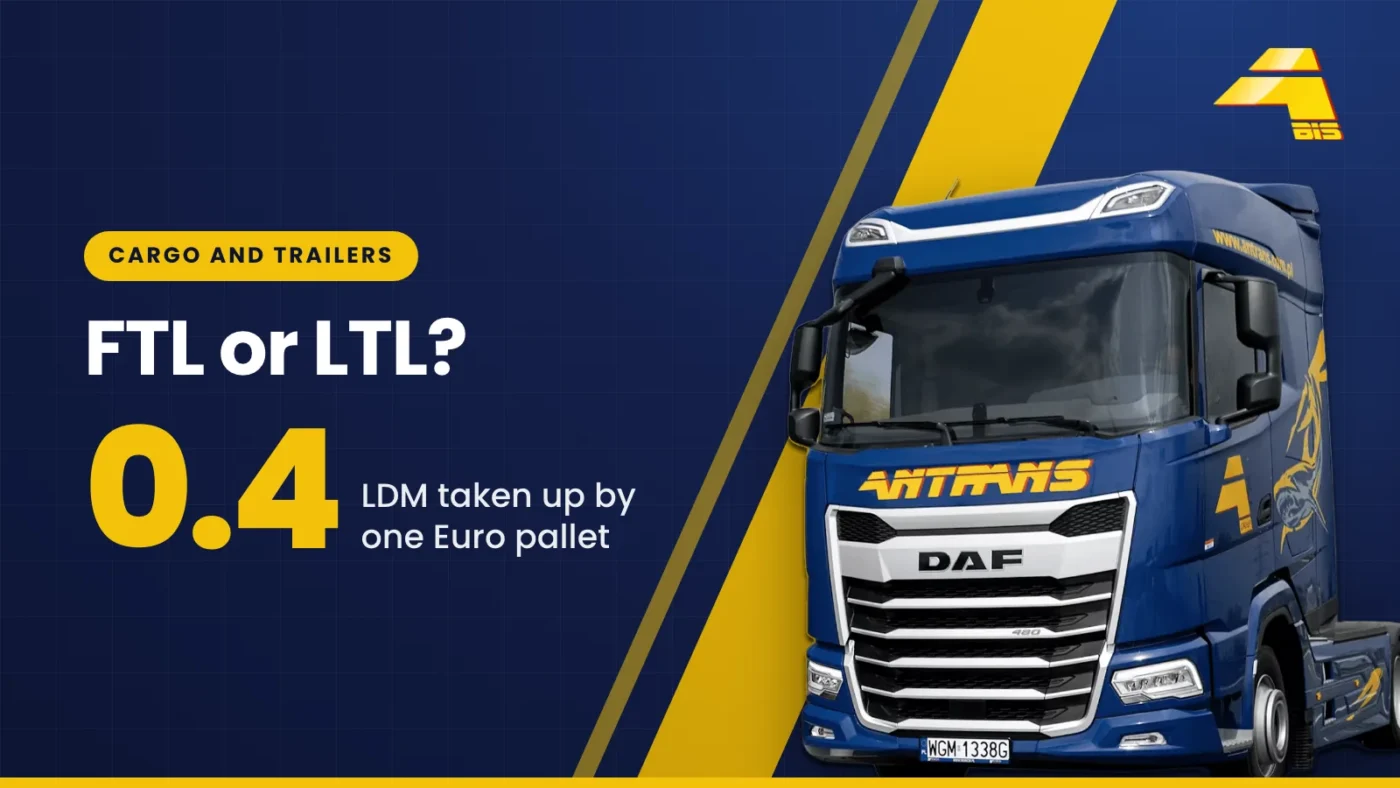
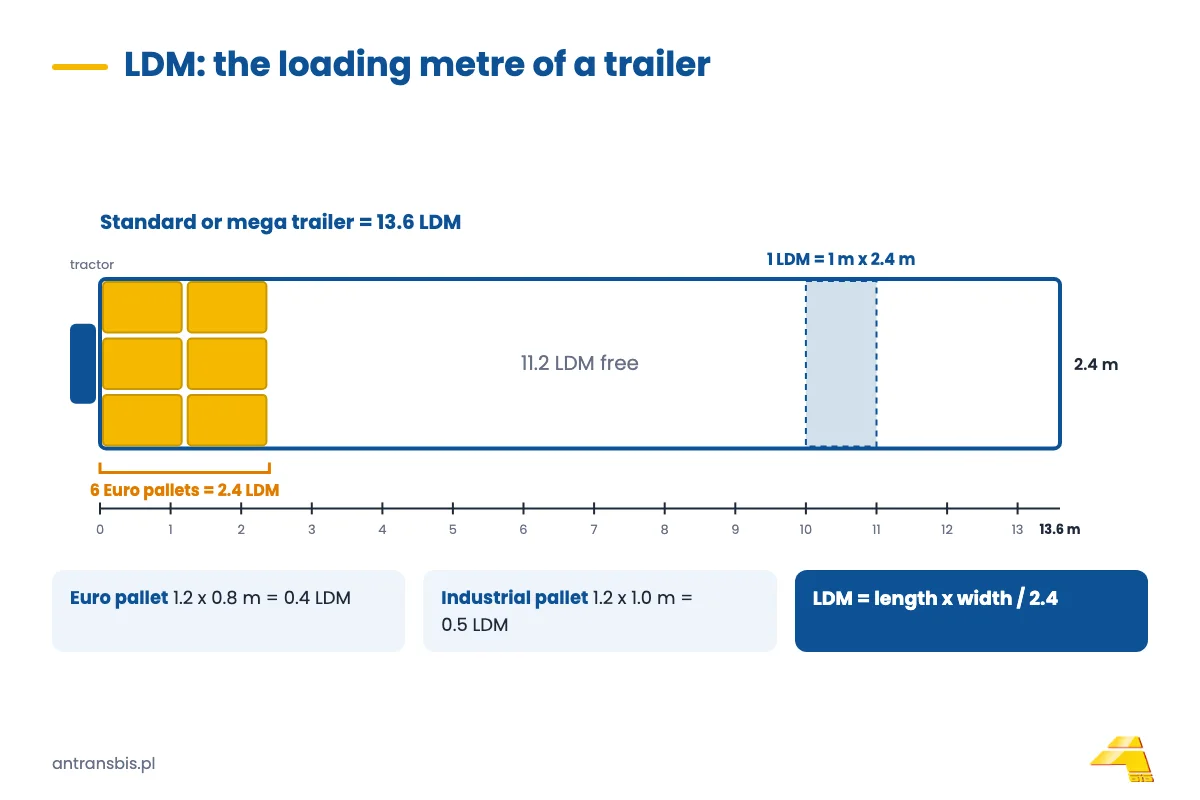
An LDM (loading metre) is one metre of trailer length across the trailer’s full width, which is taken as 2.4 m in calculations. A standard 13.6 m trailer therefore has 13.6 LDM. The formula for a single load unit is:
LDM = load length (m) x load width (m) / 2.4
| Load unit | Base dimensions | LDM |
|---|---|---|
| Euro pallet EUR/EPAL | 1.2 x 0.8 m | 0.4 |
| Industrial pallet | 1.2 x 1.0 m | 0.5 |
| Half pallet | 0.8 x 0.6 m | 0.2 |
| Crate | 2.4 x 1.2 m | 1.2 |
| Entire standard or mega trailer | 13.6 x 2.4 m | 13.6 |
The formula measures floor area, not volume. A pallet 1 m high and a pallet 2.4 m high take up the same number of LDM if nothing can be placed on top of them.
Stacked pallets
If the goods are stackable, two Euro pallets placed one on top of the other take up 0.4 LDM together, not 0.8. However, the shipper must declare this in the order, and the packaging must withstand the weight of the upper layer. In a standard trailer with an internal height of about 2.7 m, two layers will fit if the units are up to about 1.3 m high including the pallet. A mega trailer, with an internal height of about 3 m, gives you more headroom.
A non-stackable load blocks the space above it, which is why many carriers have separate rules for such pallets in their groupage price lists. Always state in your enquiry whether the pallets can be stacked.
Chargeable weight: how many kilograms is 1 LDM
In groupage you pay for the higher of two values: the actual weight or the chargeable weight. The carrier converts LDM into kilograms because a light but bulky load takes up space that it cannot sell to another customer.
The conversion rate is not set by law; each carrier states it in its terms and conditions or price list. A few examples:
- Raben Logistics Polska, in the remuneration annex to its general terms of carriage, uses 1 loading metre = 1,500 kg and 1 m³ = 330 kg. For a Euro pallet, this gives 0.4 x 1,500 = 600 kg.
- JAS-FBG, in its freight rate table valid from 22 April 2025, applies 1 LDM = 1,500 kg (for packages exceeding both 1.7 m in length and 1.2 m in width) and 1 m³ = 300 kg.
- In international groupage, many carriers use 1,850 kg per 1 LDM as the minimum chargeable weight.
In practice, assume a range of 1,500-1,850 kg per 1 LDM and always check the figure in the quote. Why this order of magnitude? A trailer has 13.6 LDM and a payload of about 24 t, so one loading metre accounts for about 1,765 kg on average (24,000 / 13.6). The conversion rate balances light and heavy loads so that a full truck in the price list weighs roughly as much as it can actually carry.
FTL vs LTL: a side-by-side comparison
| Criterion | FTL (full truckload) | LTL (part load, groupage) |
|---|---|---|
| What you pay for | the whole vehicle, rate per trip or per kilometre | LDM or pallet spaces used, actual or chargeable weight |
| Cost per load unit | low with a full truck, high with just a few pallets | low for small shipments, rises for large ones |
| Transit time | shortest, no stops at terminals | longer, depends on line departure days and sorting |
| Transshipment | none, one loading and one unloading | at least one, usually at the origin and destination terminals |
| Risk of damage | lower | higher, each transshipment means another forklift operation |
| Loading date | set to suit the shipper, including the time | according to the operator’s collection schedule |
| Requirements for the goods | flexible, side or top loading possible | pallets or shipping cartons, labels, standard dimensions |
| When it pays off | large, urgent, valuable or sensitive loads | a few pallets, flexible timing, regular small shipments |
Example: 6 Euro pallets vs 18 Euro pallets
Two loads on the same route, for example from the Małopolska region in southern Poland to northern Italy. I am not quoting prices, because rates change from week to week. For indicative rate ranges on routes within Poland, see our article on domestic transport prices per km in 2026.
6 Euro pallets at 400 kg each
- Floor space: 6 x 0.4 = 2.4 LDM, or about 18% of the trailer floor.
- Actual weight: 2,400 kg.
- Chargeable weight: 2.4 x 1,500 = 3,600 kg or 2.4 x 1,850 = 4,440 kg.
A groupage carrier will charge for 3,600 or 4,440 kg, not 2,400 kg, because the pallets are light relative to the space they occupy. Even so, LTL clearly wins here: with FTL you would pay for 13.6 LDM, of which 11.2 LDM would travel empty.
If the goods can be stacked two high, the pallets will take up 3 floor spaces, i.e. 1.2 LDM. The chargeable weight then drops to 1,800 kg (at 1,500 kg/LDM), below the actual weight, so the charge will be based on 2,400 kg. A single piece of information in the order cuts the pricing basis by a third.
18 Euro pallets at 600 kg each
- Floor space: 18 x 0.4 = 7.2 LDM, more than half the trailer (half is 6.8 LDM).
- Actual weight: 10,800 kg, about 45% of a 24 t payload.
- Chargeable weight: 7.2 x 1,500 = 10,800 kg or 7.2 x 1,850 = 13,320 kg.
Here the answer is not obvious. For a groupage network this is a large shipment, often priced individually. In an FTL trailer, 6.4 LDM remain free, which is room for about 15 Euro pallets that you pay for anyway. Get two quotes: one for groupage or a partial load and one for a full truckload. For valuable or fragile goods, or a fixed unloading window, the difference in transit time and transshipment risk often outweighs the difference in price.
When to choose FTL and when to choose LTL
The thresholds below come from forwarding practice, not from regulations or any single price list:
- up to about 5-6 LDM (12-15 Euro pallets) and a few tonnes, groupage usually wins,
- between about 6 and 10-12 LDM, compare a partial load with a whole truck,
- above about 10-12 LDM (25-30 Euro pallets) or with a weight close to 24 t, FTL is the standard choice, because the shipment blocks almost the whole vehicle anyway.
The threshold moves in both directions. You opt for FTL sooner when the goods are fragile, expensive, temperature-controlled or oddly sized, or when the consignee has set a strict unloading window. Groupage makes sense even for larger volumes when the timing is flexible and weekly shipments go to many consignees.
Weight matters too. Thirteen pallets of beverages at 1,000 kg each take up only 5.2 LDM but weigh 13 t, so in groupage the charge will be based on the actual weight, while in FTL the same truck could still take about 11 t more. With heavy loads, count metres and tonnes at the same time.
What to include in an FTL or LTL enquiry
You will get comparable quotes if your enquiry states the number and dimensions of the load units, the gross weight, whether the goods can be stacked, the addresses with postcodes, the loading and unloading windows and the type of ramp or forklift available at both ends. For high-value goods, ask about insurance: at Antrans BiS, orders are covered by cargo insurance of up to 300,000 EUR per incident. At every stage of the transport, you deal with one freight forwarder who is responsible for your order.
Frequently asked questions
What does FTL mean in transport?
FTL stands for Full Truck Load, i.e. full truckload transport. The entire trailer is reserved for one client, and the goods travel directly from the shipper to the consignee without transshipment. You pay for the whole vehicle, regardless of how much space the load takes up.
What is the difference between FTL and LTL?
With FTL you book a whole vehicle exclusively, whereas with LTL you pay only for the loading metres or pallets you use and share the trailer with other shippers. LTL transport is cheaper for small shipments, but it takes longer and involves transshipment at terminals. FTL is faster and safer for the goods, and it pays off for large or urgent loads.
What is part load transport?
Part load transport is the carriage of shipments that do not fill a whole vehicle, most often a few pallets. The operator consolidates shipments from many shippers in one truck and distributes them through a network of terminals. In the industry it is also called LTL or groupage.
How much is 1 LDM?
1 LDM is one metre of trailer length across its full width, taken as 2.4 m, which gives 2.4 m² of floor. One Euro pallet takes up 0.4 LDM, so 1 LDM equals 2.5 Euro pallets. A standard trailer has 13.6 LDM.
How do you calculate LDM?
Multiply the length and width of the load’s base in metres and divide the result by 2.4. A 1.2 x 0.8 m Euro pallet gives 0.4 LDM, and a 1.2 x 1.0 m industrial pallet gives 0.5 LDM. If the pallets can be stacked, you count only the floor area they occupy.
How many kilograms is 1 LDM in groupage pricing?
It depends on the carrier, because each company states the conversion rate in its price list or terms and conditions. Polish price lists commonly use 1,500 kg per 1 LDM, and international groupage also uses 1,850 kg. The charge is based on the higher of the two values: the actual weight or the chargeable weight.
Sources
- Raben Logistics Polska, Annex No. 4: Carrier’s remuneration (chargeable weight, 1 loading metre = 1,500 kg)
- JAS-FBG, SKP freight rate table valid from 22 April 2025 (1 LDM = 1,500 kg)
- Exfreight, What is a loading meter (LDM formula, 1,850 kg per 1 LDM)
- DSV, Standard curtainsider trailer: dimensions and payload
- EPAL, EPAL Euro pallet (dimensions 1200 x 800 mm)
- TimoCom, Transport glossary: FTL (Full Truck Load)
Have a few pallets or a whole truckload to ship and not sure which option works out cheaper? Describe the load in the quote form in the client zone, tick FTL, LTL or pallet transport, and a freight forwarder will price the option that best suits your route. During working hours we usually reply within 60 minutes, and you can also request a quote by phone on +48 666 666 863.

Managing Director | Antrans BiS, Olkusz
Sebastian Szklarczyk has led the development of Antrans BiS, a transport company operating throughout Europe, for more than 15 years. He started as Head of the Freight Forwarding Department, gaining practical experience in organising international transport and managing a vehicle fleet on European routes.
As Managing Director, he is responsible for the strategic management of a company handling more than 21,000 transport operations a year on its main routes: Poland-Italy, Poland-Germany, Poland-Austria, Spain, the Benelux countries and Scandinavia. Under his leadership, Antrans BiS has expanded its fleet to 220 vehicles, including its own and partners’ vehicles, and achieved an on-time delivery rate of 98%.
Specialisms: international FTL transport throughout Europe, automotive and FMCG logistics, optimisation of European routes, road traffic regulations and driving bans in the EU, and transport documentation (CMR, VAT-UE, INTRASTAT).
On the Antrans BiS blog, he shares practical knowledge about international freight forwarding, transport regulations and the business aspects of running a transport, freight forwarding and logistics company in different European countries.