Domestic haulage in Poland: price per km in 2026
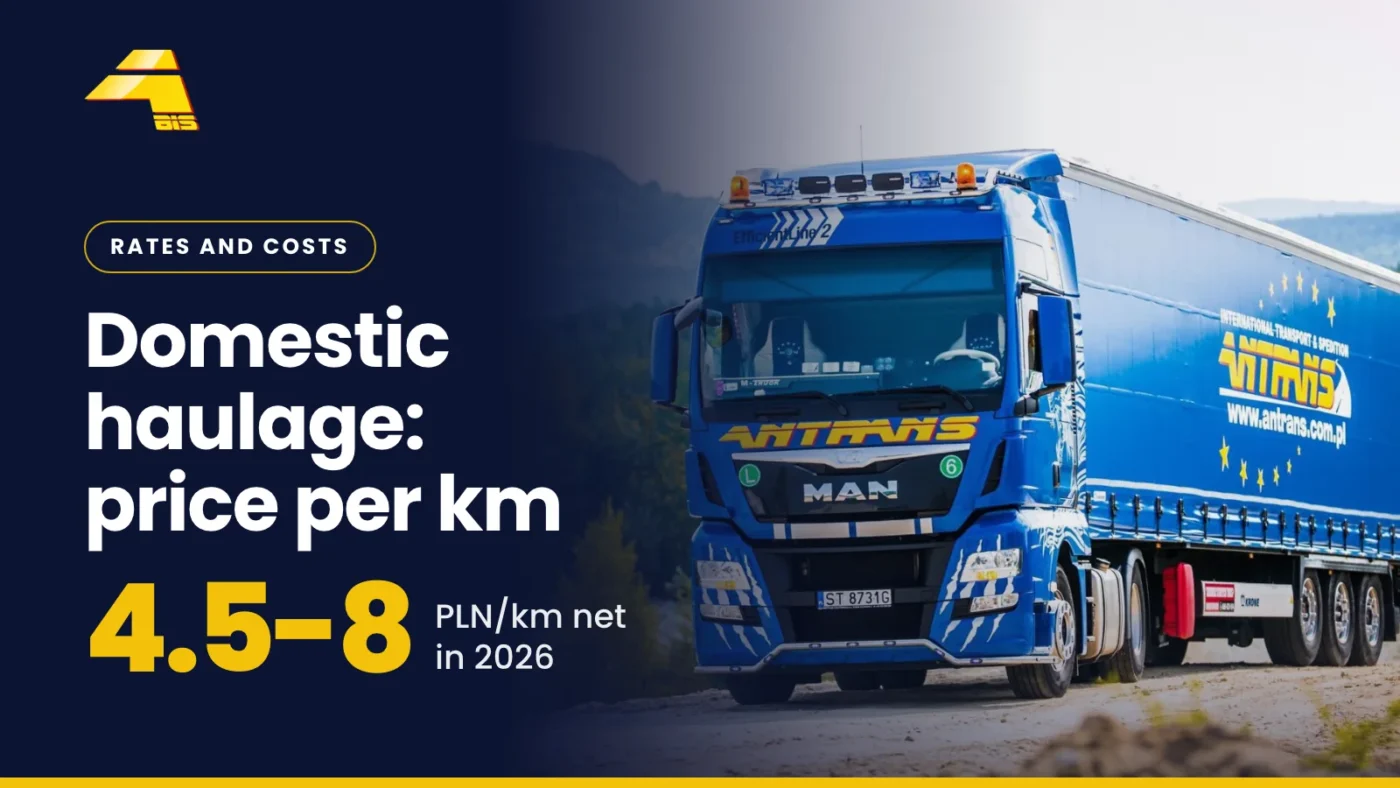
In 2026, domestic transport within Poland costs an average of 4.5-8 PLN/km net, although the actual rate depends on several variables at once. A delivery van will be cheaper than a full-size HGV, and ADR transport dearer than standard pallets. In this article you will find tables of rates by vehicle and type of load, a cost formula with three worked examples, an overview of the factors that drive prices and answers to the questions shippers ask most often.
How much does domestic transport in Poland cost per km? Current rates for 2026
There is no official price list on the Polish road haulage market, because every carrier prices orders individually, based on its own operating costs. Even so, offers on freight exchanges and long-term contracts point to recurring market ranges.
Table 1: Domestic transport rates in Poland by vehicle type (2026)
| Vehicle type | Net rate per km |
|---|---|
| Van up to 3.5 t (tarpaulin or insulated body) | 3.5-5.5 PLN/km |
| Rigid truck 6-12 t | 4.5-6.5 PLN/km |
| Truck 12-18 t | 5.0-7.0 PLN/km |
| Articulated HGV 24 t (tarpaulin / curtainsider) | 4.5-7.0 PLN/km |
| Refrigerated transport (all weight classes) | 6.0-8.0 PLN/km |
| ADR transport (dangerous goods) | 6.5-8.0 PLN/km |
| Low-loader / oversize transport | 8.0-15.0+ PLN/km |
* Indicative net rates excluding VAT (23%). There is no fixed price list for domestic transport in Poland: every order is priced individually. On top of the base rate you need to add e-TOLL charges (the Polish electronic road toll), cargo insurance and any loading and unloading costs.
Domestic transport rates in Poland by type of load
After the vehicle type, the type of load is the most important price driver. The table below shows how special requirements translate into the final rate per km.
Table 2: Domestic transport rates in Poland by type of load (2026)
| Type of load | Rate per km | Why it costs more / less |
|---|---|---|
| Standard load (pallets, building materials) | 4.5-6.0 PLN/km | no special requirements |
| Refrigerated load (food, medicines, flowers) | 6.0-8.0 PLN/km | refrigeration unit, higher fuel consumption, ATP certificates |
| ADR load, classes 1-9 (chemicals, fuels, gases) | 6.5-8.0 PLN/km | ADR training, placarding, emergency equipment |
| Heavy / bulk load (metal, aggregates, waste) | 5.5-7.5 PLN/km | higher fuel consumption, axle loads |
| Oversize load | 8.0-15.0+ PLN/km | permits, police escort, flatbed or low-loader trailer |
| Express load (time-critical, JIT) | 20-50% surcharge on the base rate | dedicated vehicle, guaranteed delivery time, no consolidation |
| Part load, LTL (a few pallets) | rate per pallet space / LDM instead of per km | consolidated with other loads, you pay only for the space you use |
* Net rates excluding VAT (23%), indicative for routes over 200 km. Shorter distances can cost more per km because of the fixed costs of loading and unloading.
Why is domestic transport cheaper than international transport?
Having checked the rates, many shippers wonder why the same kilometres cost less within Poland than abroad. There are several reasons, and knowing them helps you plan your logistics with your eyes open.
No foreign road tolls. On domestic routes the carrier pays only the Polish e-TOLL and, where applicable, motorway charges. Abroad, every country adds its own toll: Toll Collect in Germany, the e-vignette in Austria, electronic tolls in Czechia, France, Belgium and other countries. Together, these charges can add several hundred euros to an order.
No customs formalities. Transport within Poland requires no customs documents, TIR carnet or border clearance. Outside the EU, every customs clearance costs time and money: a driver may wait at the border for many hours, and that is working time someone has to pay for.
Invoicing in Polish zloty. Domestic transport carries no exchange rate risk, as both the carrier and the client calculate in PLN. In international transport, swings in the euro can change the profitability of an order overnight.
Lower insurance costs. The scope of a domestic carrier’s liability insurance (domestic OCP) is narrower and cheaper than the CMR policy required for international transport.
Faster turnaround. Domestic transport usually takes 1-2 days, and the driver is back home the same day or the next. A driver on international routes may be away from home for weeks, so the company has to cover per diems, overnight allowances and the cost of layovers abroad.
Good to know: A domestic carrier’s margin averages only 5-10% of the rate per km. Most of the price goes on fuel (30-40%), the driver’s pay (20-30%) and vehicle leasing (15-20%). An offer well below the market rate is rarely a bargain; more often it signals missing cargo insurance or financial trouble at the company.
What affects the price of domestic transport per km?
The rate per km is the product of many factors. Below are the eight most important ones, which decide whether a quote lands closer to the bottom or the top of the range.
1. Vehicle and trailer type. A van up to 3.5 t has lower fixed costs: lower fuel consumption, cheaper leasing and lower insurance. An articulated HGV (24 t) costs more to run, but those costs are spread over a much larger load, so the rate per tonne is often better for large volumes.
2. Route length and economies of scale. On routes up to 100 km, the driver’s fixed costs (loading, unloading, waiting, getting to the pickup point) dominate the calculation, hence a higher rate per km and often a minimum charge of 300-500 PLN net per trip. On routes over 300 km, the fixed costs are spread over more kilometres and the unit rate falls.
3. Type of load and special requirements. Standard pallets mean the base rate. A refrigerated or ADR load means a surcharge of 20-50%: a specialised vehicle, additional certificates and driver qualifications are real costs that have to be reflected in the price.
4. Fuel price. Diesel accounts for 30-40% of a carrier’s operating costs. A rise of 0.50 PLN per litre at an average consumption of 32 l/100 km adds 0.16 PLN to the cost of every km. That is why many carriers use a fuel surcharge clause, which automatically adjusts the rate when the diesel price index changes.
5. e-TOLL charges and motorways. The Polish e-TOLL system covers national roads and expressways for vehicles over 3.5 t GVW. After the increases of 1 February 2026, rates are approx. 0.15-0.60 PLN/km, depending on the road class and the vehicle’s Euro emission standard. The tolled network now runs to almost 5,900 km, so this is an item you cannot leave out of the calculation. Current rates and the list of tolled sections are available at etoll.gov.pl.
6. Fleet availability and seasonality. In the fourth quarter (October-December), demand for domestic transport rises by double-digit percentages and rates go up by 10-30%. The same happens over long weekends and during the summer holidays, when some drivers are on leave. Last-minute orders can cost 20-40% more than those planned in advance.
7. Route direction and empty running. On routes with well-balanced freight flows, e.g. along the main transport corridors, the carrier can easily find a return load and offer a lower rate. On one-way lanes, where the truck comes back empty, the cost of empty running is built into the price of the order.
8. Type of order: spot vs contract. The spot market (one-off orders) means higher rates and variable vehicle availability. A long-term contract brings rates 10-20% lower and guaranteed delivery dates, which benefits both sides: the carrier gets steady fleet utilisation, and the client a predictable logistics budget.
How to calculate the cost of domestic transport: formula and examples
Before you ask for a quote, you can make a rough estimate using a simple formula:
Total cost = (number of km × rate per km) + additional costs
Additional costs include e-TOLL charges and motorway tolls, loading and unloading (if included in the service), cargo insurance, the fuel surcharge and waiting time beyond the agreed limit (demurrage).
Example 1: van, part load, Warszawa-Wrocław route (360 km)
360 km × 4.5 PLN/km = 1,620 PLN, motorway tolls included in the carrier’s price. Total cost: approx. 1,620-1,800 PLN net.
Example 2: tarpaulin HGV, full load, Gdańsk-Kraków route (600 km)
600 km × 6.0 PLN/km = 3,600 PLN + e-TOLL approx. 80 PLN + cargo insurance approx. 50 PLN. Total cost: approx. 3,730 PLN net.
Example 3: reefer, food, Poznań-Lublin route (500 km)
500 km × 7.0 PLN/km = 3,500 PLN + fuel surcharge for the refrigeration unit approx. 150 PLN. Total cost: approx. 3,650 PLN net.
The rate per km is only ever a starting point, as the total cost of an order is made up of several components. Before you sign an order, ask for an all-in quote to avoid surprises on the invoice.
What does a domestic carrier’s cost structure look like?
Many companies that order domestic transport wonder what the rate per km is actually made of. The cost breakdown below for a typical articulated truck shows that the carrier’s margin is only a small part of the price.
Fuel: 30-40% of total costs. With diesel at approx. 6.5 PLN/l and consumption of 30-35 l/100 km, fuel alone costs 1.95-2.28 PLN per km.
Driver’s pay + ZUS (Polish social security): 20-30%. Since January 2026, the minimum wage in Poland has been 4,666 PLN gross per month, plus per diems and allowances. The total cost of a driver’s work to the employer is often 35-50 PLN per hour.
Leasing and depreciation of the tractor unit and semi-trailer: 15-20%. A modern articulated truck is an investment of around 500,000-700,000 PLN, and financing it is a fixed monthly cost regardless of the number of trips.
Insurance (third-party liability, own damage, OCP): 5-8%. Servicing and tyres: 5-8%. Road charges (e-TOLL, motorways): 3-7%. Overheads (management, office, telematics, IT): 3-5%.
Carrier’s margin: 5-10%. This is the real answer to the question of how much a company earns on an order. The rate per km is not ‘profit’; it is the sum of many components. That is why offers well below the market should put you on your guard: they may point to financial problems at the carrier, missing cargo insurance or other savings that will hit the client if damage occurs.
You can read more about the financial health of the Polish transport industry in the report by Transport and Logistics Poland, the employers’ association (tlp.org.pl), which publishes an analysis of the sector every year.
Domestic FTL vs LTL transport: how pricing differs
The two basic pricing models for domestic transport are FTL and LTL. The difference between them often decides whether you pay 400 PLN or 2,000 PLN for a shipment.
FTL (full truckload, the whole trailer) means hiring an entire vehicle for your exclusive use. The client pays for the whole load space regardless of how full it actually is, and the price is based on the rate per km multiplied by the distance. FTL pays off for loads over 14-16 LDM or 15 tonnes, urgent orders and point-to-point deliveries.
LTL (less than truckload: groupage or part load) is transport in which the client pays only for their own pallets, according to the number of pallet spaces or loading metres (LDM). The operator consolidates loads from several clients in one vehicle. LTL makes sense below 10 pallets or 3 tonnes and when the delivery date is flexible. The downside is a longer transit time: consolidation at a cross-dock warehouse adds 1-2 days to delivery.
A worked comparison: transporting 5 pallets from Warszawa to Gdańsk (350 km).
FTL, hiring a whole HGV: 350 km × 6 PLN/km = 2,100 PLN.
LTL, groupage: 5 pallet spaces × approx. 80 PLN each = 400 PLN.
Here LTL is more than 5 times cheaper, but delivery takes 2-3 days, compared with 1 day for FTL.
Choosing between FTL and LTL is always a trade-off between price on the one hand and speed and convenience on the other. It is worth costing both options before every order. You will find a sample calculation of LDM and chargeable weight in our FTL vs LTL guide.
How to reduce the cost of domestic transport: practical tips
A few proven ways to genuinely cut your domestic transport spend without compromising on service quality.
1. Plan ahead. Last-minute bookings cost 20-40% more. Book transport at least 2-3 days in advance, so the carrier has time to plan the route and combine it with other orders.
2. Offer a return load. If you deliver goods to, say, the Tricity area (Gdańsk, Gdynia, Sopot), ask the carrier whether they could come back with a load from that region. A lower cost of empty kilometres is a tangible saving that the carrier can share with you through a lower rate.
3. Negotiate on the strength of regular business. Regular orders, a dozen or more trips a month, give you real bargaining power. A fixed contract lets you secure rates 10-20% below spot prices and guarantees vehicle availability.
4. Choose LTL for small loads. Below approx. 10 pallets or 3 tonnes, LTL groupage is many times cheaper than hiring a whole truck. It pays to have two or three groupage operators to hand and to compare their offers.
5. Avoid seasonal peaks. The fourth quarter and long weekends mean higher rates and fewer available trucks. If you can, schedule deliveries for January-March or September, when the market is calmer.
6. Consolidate orders. Instead of three small shipments a week, send one large one: it is cheaper per tonne, easier to plan and less of an administrative burden for both parties.
7. Negotiate a fuel clause. A fixed rate without fuel indexation can work in your favour when diesel prices are rising, or against you when they fall. A well-drafted fuel clause protects both parties from unforeseen cost changes.
8. Compare offers on freight exchanges. Platforms such as TimoCom or Trans.eu let you quickly check what rates the market is offering on a specific lane. This gives you a good benchmark when negotiating with your regular carrier.
Get a free quote for domestic transport in Poland
The price of domestic transport depends on a dozen or more factors, so the most accurate quote always comes from contacting a carrier directly. Get in touch with us, give us the route, the type and weight of the load and your preferred date, and we will send you a quote within 15-30 minutes.
We provide domestic transport with our own fleet: tarpaulin trailers, refrigerated trailers, delivery vans and specialist vehicles. We work 7 days a week, and our prices are transparent and quoted all-in, with no hidden surcharges on the invoice.
Useful articles: How to start a transport company in Poland in 8 steps | Finding transport orders: 5 effective ways to win new loads | Funding for road transport: grants for transport businesses | Transport documents in road haulage in 2026
FAQ: common questions about domestic transport in Poland in 2026
We have gathered the questions that come up most often when planning shipments within Poland. Here you will find answers on rates per km and per pallet, the difference between FTL and LTL, how a fuel clause affects the final price and when in the year domestic transport is cheapest.
How much does domestic transport in Poland cost per km in 2026?
The average price of domestic transport in 2026 is 4.5-8 PLN/km net for a standard tarpaulin semi-trailer. A delivery van up to 3.5 t costs 3.5-5.5 PLN/km, refrigerated and ADR transport 6-8 PLN/km, and oversize vehicles over 8 PLN/km. There is no official price list: every order is priced individually, and the ranges given are indicative market rates.
How much does it cost to ship 1 pallet in Poland?
In LTL groupage, one Euro pallet costs approx. 50-150 PLN net, depending on the route and the operator. On routes over 300 km, the LTL price per pallet comes closer to 80-120 PLN. If you book a whole vehicle (FTL), the cost does not depend on the number of pallets: what counts is the rate per km multiplied by the distance.
Is a short route (up to 100 km) more expensive per km?
Yes. On short routes, the driver’s fixed costs (loading, unloading, getting there and waiting) are spread over a small number of kilometres, so the unit rate goes up. Most carriers apply a minimum charge of 300-500 PLN net per trip, regardless of distance. It is worth bearing this in mind when planning local deliveries. It often pays to combine several short trips into a single order.
What is the difference between FTL and LTL, and which should I choose?
FTL (full truckload) means hiring a whole vehicle for your exclusive use, so you pay for the entire trailer regardless of how full it is. LTL (less than truckload) is groupage: you pay only for your own pallets, and the operator consolidates several loads in one vehicle. FTL pays off for large loads (over approx. 14-16 pallets) and tight deadlines. LTL is several times cheaper for small shipments, but consolidation adds 1-2 days to delivery.
When are domestic transport rates at their highest?
Prices peak in the fourth quarter: October, November and December bring the highest demand, driven by the Christmas season and e-commerce sales. Rates then rise by 10-30% compared with the annual average. Prices are also higher over long weekends and in July-August, when some drivers are on holiday. The best time to negotiate and sign contracts is January-March.
What is a fuel clause and should I negotiate one?
A fuel clause (fuel surcharge) is a contract provision that automatically adjusts the domestic transport rate up or down when the price of diesel moves beyond an agreed threshold. For the client, it means that when fuel prices fall, the rate falls too. For the carrier, it means that a sudden price rise does not cause losses on the contract. In long-term contracts, it is worth negotiating a clause based on an objective index, e.g. the prices of PKN Orlen (Poland’s largest fuel company).

Managing Director | Antrans BiS, Olkusz
Sebastian Szklarczyk has led the development of Antrans BiS, a transport company operating throughout Europe, for more than 15 years. He started as Head of the Freight Forwarding Department, gaining practical experience in organising international transport and managing a vehicle fleet on European routes.
As Managing Director, he is responsible for the strategic management of a company handling more than 21,000 transport operations a year on its main routes: Poland-Italy, Poland-Germany, Poland-Austria, Spain, the Benelux countries and Scandinavia. Under his leadership, Antrans BiS has expanded its fleet to 220 vehicles, including its own and partners’ vehicles, and achieved an on-time delivery rate of 98%.
Specialisms: international FTL transport throughout Europe, automotive and FMCG logistics, optimisation of European routes, road traffic regulations and driving bans in the EU, and transport documentation (CMR, VAT-UE, INTRASTAT).
On the Antrans BiS blog, he shares practical knowledge about international freight forwarding, transport regulations and the business aspects of running a transport, freight forwarding and logistics company in different European countries.