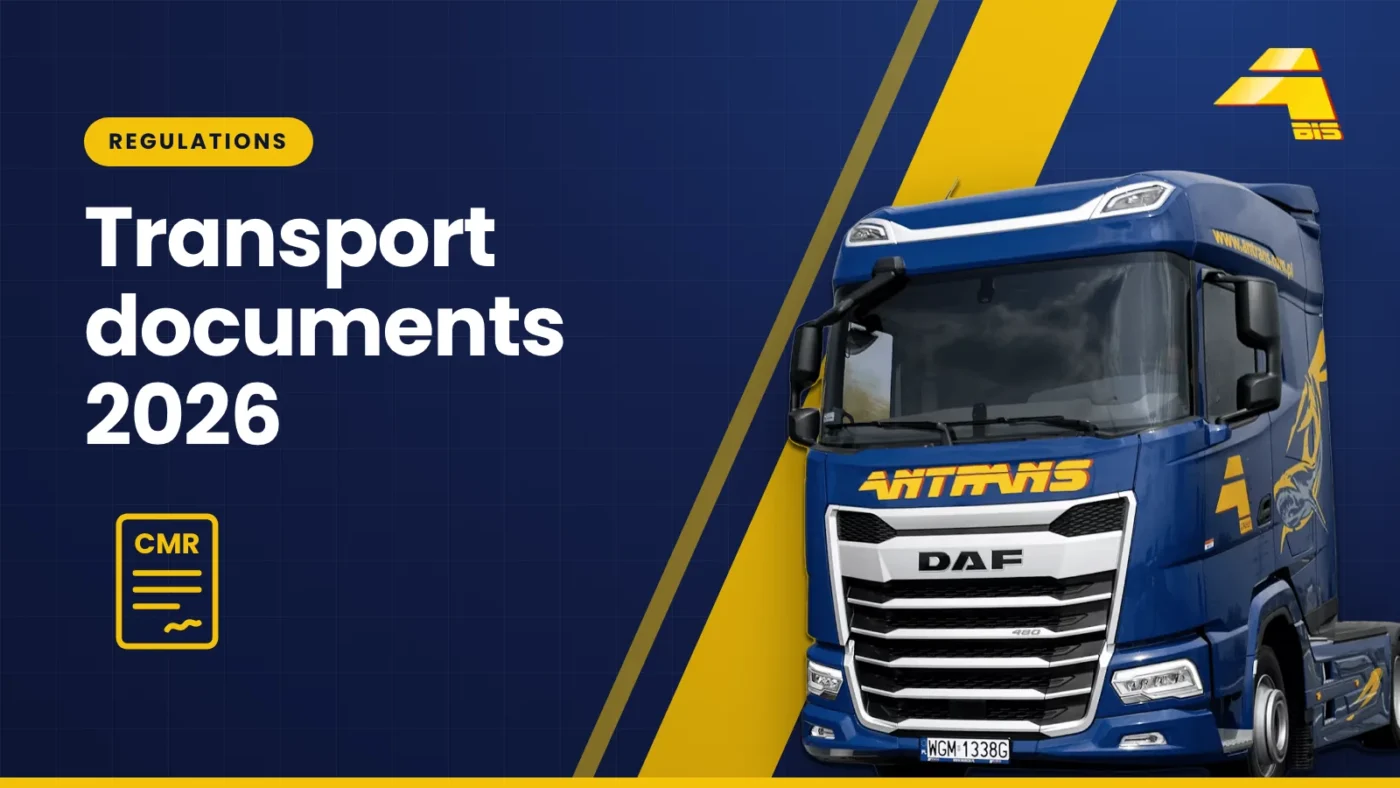
Transport documents in road haulage in 2026
Transport documents prove that goods are being carried legally. Roadside inspectors check them, and after delivery they are the basis for invoicing the order. The set consists of the carriage document, documents describing the goods and additional paperwork that depends on the route and the load: the CMR, customs documents, ADR papers or proof of delivery. Below we explain what you need for domestic and international journeys, and the mistakes that most often bring a transport to a halt or start a dispute over payment.
What role do transport documents play in road haulage?
Transport documents confirm the carriage, get you through roadside checks and let you close the settlement with the client. They show that the goods were collected, what condition they were in, how much there was and that they reached the consignee. In disputes and delays they are the main evidence. At a roadside inspection, officers ask for them first, because they show who is responsible for the carriage, what is on board and whether the transport complies with the rules.
What documents are required for road transport?
The minimum is a carriage document and documents describing the goods. International transport adds the CMR consignment note, and sometimes customs or specialist documents. The full set depends on whether you are driving within Poland, across the EU or outside the EU, and on the load itself. Dangerous goods (ADR), refrigerated loads, waste and animals each have their own requirements.
Domestic transport
For domestic transport in Poland, the standard is a domestic consignment note (or whichever carriage document the company uses) plus warehouse documents showing what was released for transport. To close the delivery and invoice it, you also need proof of delivery. That is what proves the goods arrived.
International transport
In international haulage, the basis is the CMR consignment note. On top of that come commercial documents and the cargo specification, which the consignee uses to check the delivery. For carriage outside the EU you need customs documents; without them, clearance or transit can grind to a halt.
What customs documents are required in road transport?
Customs documents are needed when goods leave the EU or enter the EU from outside. This means the export or import declaration and the goods documents on the basis of which the load is classified and given a status in the customs systems. They are usually prepared by a customs agency, but the carrier must have the full set on board and check that the numbers and details match across all documents. Who declares the goods for export and import clearance is decided by the Incoterms 2020 rule in the contract, for example EXW, FCA, DAP or DDP.
What are the main groups of transport documents in road haulage?
Transport documents fall into three groups: carriage documents, goods documents and additional documents. The carriage document confirms the carriage itself. Goods documents describe the load and the transaction. Additional documents are only needed in specific cases, for example for ADR, refrigerated transport, waste or animals.
Documents most often required in domestic road transport
For domestic transport you need a carriage document and documents showing exactly what was released and to whom it has to be delivered. This set decides whether a roadside check goes smoothly and whether you can close the settlement after delivery. When a signature is missing or the details do not match, a dispute over payment or shortages usually follows.
1. Domestic consignment note
The domestic consignment note confirms that the carriage was ordered and describes the terms on which it is performed. In claims and inspections it is the core document. The key items are the shipper and consignee details, the loading and unloading places, the date, the description of the goods, the number of units, the weight and remarks on load securing or the unloading method. If details are missing or differ from the goods issue note and the specification, the warehouse or the inspectors will very often challenge them.
2. Goods issue note (WZ) or cargo specification
The WZ (the Polish goods issue note) or the cargo specification shows what was actually released from the warehouse and in what quantity. At loading and unloading, the delivery is checked against exactly this document. It usually lists the number of pallets, type of packaging, product codes, batches, weights and piece counts. When the consignee claims that “2 pallets are missing”, they compare the WZ or the specification with what they received and with what was entered in the carriage document.
3. Proof of delivery
Proof of delivery shows that the delivery was made. Without it you may have trouble with the invoice and the payment term. It must contain the signature of the person receiving the goods and the date, ideally the time as well. Larger companies add a stamp or a legible identifier of that person. If the goods are damaged or short, the reservations must be written exactly here. A claim made later, without a note on the document, is much weaker evidence.
4. Transport order
The transport order sets out the commercial and operational terms. It protects the carrier when questions come up about waiting time, slot bookings, time windows or extra costs. It should clearly state the dates, route, rate, rules for charging waiting time, vehicle and document requirements and how completion of the service is confirmed. When the client later disputes a waiting-time charge or a change of address, both sides go back to what the order says.
5. Quality and conformity documents, if the goods or the consignee require them
Some consignees will not accept goods without documents confirming quality or conformity. This applies to selected industries such as manufacturing, automotive, chemicals, food or pharmaceuticals, where batches, certificates and compliance with standards matter. A missing document of this kind often does not end with a roadside fine, but with the goods being refused at the loading dock and waiting-time costs.
6. Documents for regulated loads, e.g. waste, ADR, animals
Loads covered by separate regulations require special documents. Without them the carriage is unlawful. They include waste, ADR dangerous goods and animals, and each of these groups has its own formal requirements. Here a single missing paper can stop the transport rather than end with a warning. We describe the documents and markings needed for waste in our article on hazardous waste transport.
7. Temperature records and transport conditions, if you run a reefer
In temperature-controlled transport, the documents must match how the carriage actually went. Consignees often want temperature records, the temperature range stated in the order and confirmation that the goods travelled in the required conditions. If the documents say one thing and the reefer unit’s logs say another, a claim becomes much more likely.
8. Insurance and carrier details, if the contract requires them
Clients often ask for the carrier’s liability (OCP) policy and the haulage company’s details, even though these are not “papers” required at every inspection. The scope of the carrier’s insurance affects the client’s risk, especially with high-value loads. In many companies, missing proof of insurance blocks the order or holds up payment until the documents arrive. We explain what such a policy covers and how to check it in our post on carrier’s liability insurance (OCP).
Documents most often required in international road transport
In international transport, the CMR is the foundation. It confirms the contract of carriage between countries and is the first document checked on the road and at the warehouse. On top of it come commercial and special documents that depend on the route, the borders and the load, so the list can look different every time. In cabotage, the CMR or e-CMR also proves that the whole cycle of operations is legal.
1. CMR consignment note
The CMR is the core document of international carriage. It must be filled in so that the details of the parties and the goods leave no room for doubt. The most common problems are wrong addresses, a missing weight, illegible reference numbers and no note of damage or shortages at loading. If the consignee accepts the goods with reservations, they must go on the CMR. We explain how to fill in the CMR consignment note box by box in a separate guide.
2. Commercial invoice
The commercial invoice states the value and origin of the goods. It is needed for settlement, and for carriage outside the EU it is one of the core clearance documents. In many warehouses, goods receipt cannot be closed without an invoice or another commercial document, because the system requires a matching value, order numbers and identification of the goods.
3. Packing list or detailed cargo specification
A packing list describes the contents of the shipment down to pallets, cartons and line items, which means fewer disputes at unloading. It shows how many units there are, how they were packed, what they weigh and sometimes their batch numbers. When the consignee spots discrepancies, they start by comparing the packing list with what physically arrived.
4. Transit and customs documents for carriage outside the EU
Without customs documents, neither export nor import clearance outside the EU will get started. The biggest operational problem is not a missing paper as such, but numbers, references and goods details that differ from one document to another. The driver must know where clearance takes place, under which procedure the goods are travelling and which numbers to show at the border.
5. Transport permits, if the route or country requires them
Some destinations and some types of carriage require permits, especially outside the EU or where quotas and market access rules apply. They do not come up on every job, but if they are required and missing, the carriage may be considered illegal. It is best to clear this up when you accept the order.
6. ATP certificate and temperature documents for reefers, if required
ATP matters when the goods need confirmed refrigerated conditions or when the consignee and the contract require it. Temperature records are just as important, because in international haulage temperature claims are more frequent and more expensive. Without consistent documentation, the costs can easily end up with the carrier.
7. ADR documents for dangerous goods
For dangerous goods, ADR documentation is mandatory and must match the classification of the goods. Approximate data is not enough. Errors in the UN number, hazard class or quantities are taken seriously and can lead to the transport being stopped. The document must exactly match what is on board.
8. Driver and vehicle documents on international routes
Driver and vehicle documents must be valid. In an international inspection they are often checked before anyone looks at the CMR. This means the driving licence, vehicle documents, driver card and other required credentials, and outside the EU also identity documents and visas where needed. If something does not add up here, the journey can end in an inspection car park.
What are the most common mistakes in road transport documents?
The most common mistakes are a missing signature on delivery, differences in quantity and weight, an imprecise description of the goods and a missing document required for the route or load. Without a signature and date it is harder to prove delivery, and payment may be blocked. Inconsistent weights and quantities increase the risk of claims and of suspected overloading. A badly completed CMR or missing customs documents can hold up a transport at the border or in the warehouse.
How to prepare transport documents for road haulage
Documents are well prepared when the details in them match what is physically on the vehicle. First, collect complete details of the goods, route and requirements from the client. Then issue the carriage document and compare it with the warehouse specification. At loading, check the number of units, the condition of the packaging and the seals, and write any discrepancy into the documents straight away. At unloading, make sure you get a signature and date. Finally, archive the documents so they can be found quickly if a dispute arises.
FAQ: road transport documents in 2026
Do transport documents have to be on paper?
Not always. They must, however, be available for inspection and match the actual situation. Many companies use scans or documents in a TMS, but some procedures, consignees and borders may still require paper.
Is a CMR mandatory for every international transport?
The CMR is the standard document in international road haulage, and in practice it is required on most cross-border routes. Without it, a transport often fails verification at the warehouse or during an inspection, and in a dispute it is harder to prove the terms on which the carriage took place.
Who should issue the CMR and who signs it?
The CMR is usually prepared by the carrier or the freight forwarder and signed by the shipper, the carrier and the consignee. The consignee’s signature and the date of receipt matter most, because they confirm delivery.
What should you do if there are shortages or damage at unloading?
Shortages and damage must be recorded as reservations on the documents at the moment of receipt, before the driver leaves the loading dock. Without a note and a signature under the reservation, a claim is harder and more often ends in a dispute over liability.
Is proof of delivery necessary for domestic transport?
In practice, yes, if you want proof that the service was performed and to invoice the transport without trouble. Without a signature, a date and clear identification of the recipient, the client may delay payment or dispute that the delivery took place.
What documents are needed for customs clearance outside the EU?
You need customs documents and goods documents on the basis of which the load is classified and given a status in the customs systems. Typically these are the customs declaration, the transit document, the commercial invoice and the cargo specification. The full set is most often prepared by a customs agency.
Can one missing document stop a transport?
Yes, if it concerns a route or load covered by separate regulations, for example carriage outside the EU, ADR, waste or animals. In ordinary domestic transport, inconsistent data, a missing signature or a wrong quantity cause problems more often than a missing paper as such.
Which details in the documents must always match?
The details of the parties, the places of loading and unloading, the description of the goods, the quantity and the packaging method. If the number of pallets, the weight, the seal numbers or the addresses do not match, the risk of being held at an inspection, having the goods refused or receiving a claim goes up.
Can the documents be on the driver’s phone?
They can, if the company and the client accept it and the driver can show them quickly at an inspection. It is safer to also have a copy in the system or a printout, because problems start when there is no signal, the battery dies or the consignee wants paper.
How long do transport documents have to be kept?
Long enough to be able to produce them in a dispute, a claim or an audit of settlements. Companies usually keep them for the period required for accounting records and contracts with business partners, because that period most often determines how long the documents are needed.
Transport orders for carriers from Antrans BiS
Correctly prepared documents reduce the risk of fines, downtime and problems with settlement.
Antrans BiS, based in Olkusz, Poland, provides carriers with orders and supports them at every stage of the job, including the paperwork. The company offers:
- payment for every kilometre driven,
- 30-day payment terms,
- trips on rotations of 2 weeks or more,
- the option to rent a semi-trailer,
- round-the-clock support from experienced freight forwarders.
Contact: Miłosz, +48 666 666 863, wspolpraca@antransbis.pl

Managing Director | Antrans BiS, Olkusz
Sebastian Szklarczyk has led the development of Antrans BiS, a transport company operating throughout Europe, for more than 15 years. He started as Head of the Freight Forwarding Department, gaining practical experience in organising international transport and managing a vehicle fleet on European routes.
As Managing Director, he is responsible for the strategic management of a company handling more than 21,000 transport operations a year on its main routes: Poland-Italy, Poland-Germany, Poland-Austria, Spain, the Benelux countries and Scandinavia. Under his leadership, Antrans BiS has expanded its fleet to 220 vehicles, including its own and partners’ vehicles, and achieved an on-time delivery rate of 98%.
Specialisms: international FTL transport throughout Europe, automotive and FMCG logistics, optimisation of European routes, road traffic regulations and driving bans in the EU, and transport documentation (CMR, VAT-UE, INTRASTAT).
On the Antrans BiS blog, he shares practical knowledge about international freight forwarding, transport regulations and the business aspects of running a transport, freight forwarding and logistics company in different European countries.