CMR is short for the Convention on the Contract for the International Carriage of Goods by Road, signed in Geneva in 1956, and it is also the everyday name for the consignment note that evidences such a contract. A CMR note is issued in at least 3 originals: one for the shipper, one for the consignee (it travels with the goods) and one for the carrier. Below we go through the boxes on the form one by one, then cover reservations, the liability limit of 8.33 SDR per kilogram and the state of e-CMR in Poland in 2026.
This article covers the CMR note only. The full set of papers that travel with a load in Poland and abroad is described in our guide to transport documents in road haulage.
The CMR Convention: when it applies
The Convention covers every contract for the carriage of goods by road in vehicles for reward where the place of taking over the goods and the place designated for delivery are in two different countries, at least one of which is a party to the Convention (Art. 1). The place of residence and nationality of the parties are irrelevant. Poland has applied the CMR since 1962 (Polish Journal of Laws, Dz.U. 1962 No. 49, item 238).
The Convention does not apply to postal consignments, funeral consignments or furniture removals. Domestic carriage, including cabotage, is governed by the law of the country concerned; in Poland, that is the Transport Law Act (Prawo przewozowe).
An important rule in Art. 4: if the consignment note is missing, irregular or lost, the contract of carriage remains valid. It is still subject to the Convention; it is simply harder to prove what was handed over to the carrier and in what condition.
Who fills in the CMR consignment note
Under the Convention, the consignment note is made out by the shipper and signed by both the shipper and the carrier (Art. 5). The shipper is responsible for the accuracy of the particulars of the parties, the goods, the weight and the customs instructions (Art. 7). In practice, the blank form is often brought by the driver or prepared by the freight forwarder, but the data comes from the shipper, who should check it before signing. When you book transport through the Antrans client zone, the forwarder handling your order collects the data for the note and you confirm it before loading.
Under the Convention, the shipper (sender) is whoever concluded the contract with the carrier. In a sale on Incoterms EXW or FCA terms, this may be the buyer or the buyer’s forwarder, even though the goods leave the seller’s warehouse.
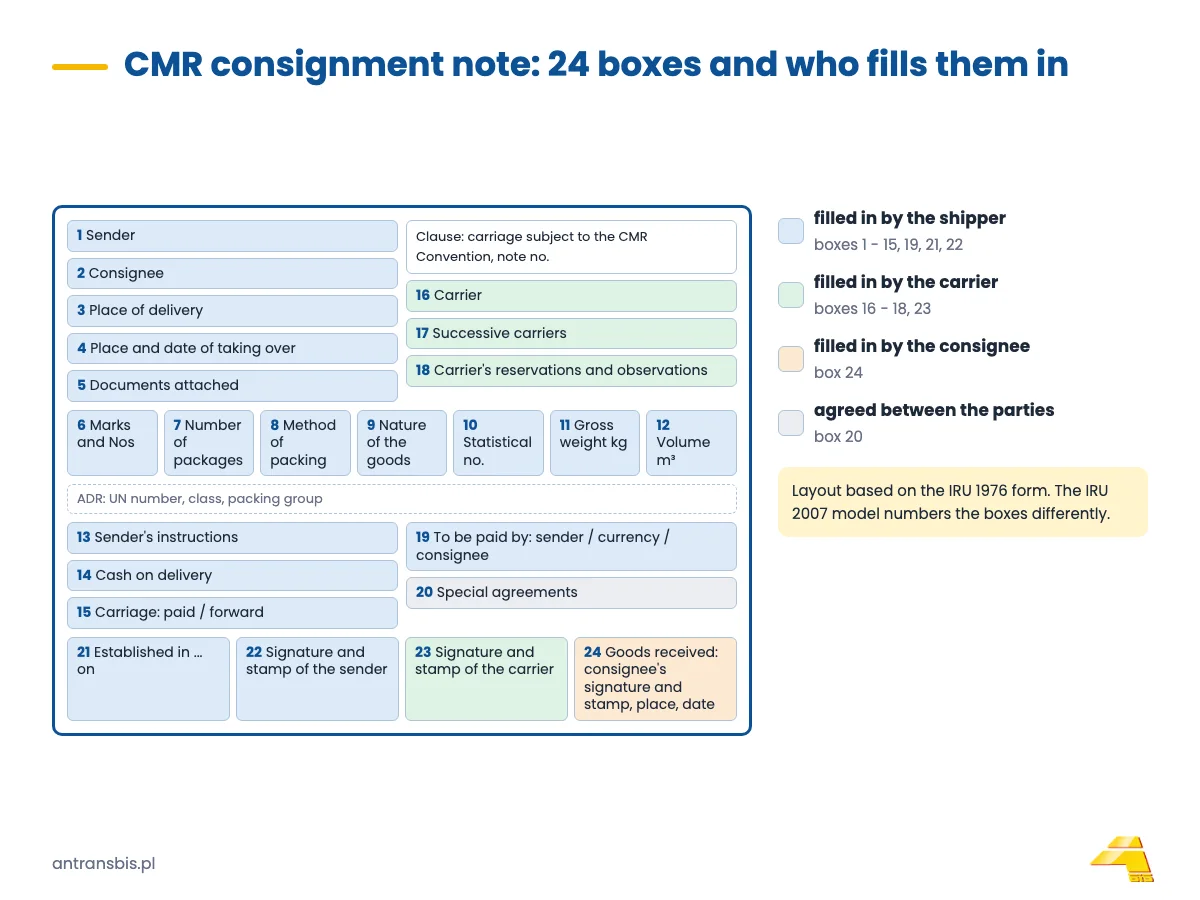
How to fill in a CMR: boxes 1 - 24 in order
In Poland, the most widely used form follows the IRU model of 1976, so that is the layout we describe here. In 2007 the IRU issued a newer model with different numbering (there, for example, box 3 is the place of taking over the goods and box 6 is the carrier), so always go by the box heading, not just the number.
| Box | Heading on the form | What to enter | Who fills it in |
|---|---|---|---|
| 1 | Sender | name, full address, country | shipper |
| 2 | Consignee | company to which the carrier delivers the goods, address, country | shipper |
| 3 | Place of delivery of the goods | town and country, ideally the full warehouse address | shipper |
| 4 | Place and date of taking over the goods | town, country, date; the driver may add arrival and departure times | shipper, driver |
| 5 | Documents attached | e.g. invoice, packing list, customs document, certificate | shipper |
| 6 | Marks and Nos | markings on pallets and packaging | shipper |
| 7 | Number of packages | number of pallets, crates, cartons | shipper |
| 8 | Method of packing | e.g. Euro pallet, crate, big bag | shipper |
| 9 | Nature of the goods | a clear description of the goods; for ADR loads, the UN number, class and packing group on the last line | shipper |
| 10 | Statistical number | commodity code, if customs procedures require it | shipper |
| 11 | Gross weight in kg | weight including packaging and pallets | shipper |
| 12 | Volume in m³ | when the load is light and volume is what counts | shipper |
| 13 | Sender’s instructions | customs clearance, no transhipment, temperature, insurance | shipper |
| 14 | Cash on delivery | amount to be collected from the consignee, if agreed | shipper |
| 15 | Directions as to payment for carriage | carriage paid or carriage forward | shipper |
| 16 | Carrier | name, address, registration numbers of the tractor unit and semi-trailer | carrier |
| 17 | Successive carriers | where several carriers perform the carriage one after another | successive carrier |
| 18 | Carrier’s reservations and observations | condition of the goods and packaging, no means of checking the count, seal number | carrier (driver) |
| 19 | To be paid by | carriage charges and supplements, who pays, currency | shipper |
| 20 | Special agreements | e.g. declared value, delivery deadline | shipper and carrier |
| 21 | Established in … on | place and date the note is made out | shipper |
| 22 | Signature and stamp of the sender | signature of the person handing over the goods | shipper |
| 23 | Signature and stamp of the carrier | driver’s signature on behalf of the carrier | carrier |
| 24 | Goods received | town, date, time, signature and stamp, any reservations | consignee |
The 1976 form carries a note that boxes 1 - 15 are completed under the shipper’s responsibility. A clause stating that the carriage is subject to the CMR Convention is printed in the header. This matters, because if the clause is missing, the carrier is liable for any expenses, loss and damage that result (Art. 7(3)). For dangerous goods, the data in box 9 must match the ADR paperwork, including the ADR instructions in writing carried in the cab.
CMR copies: who gets which one
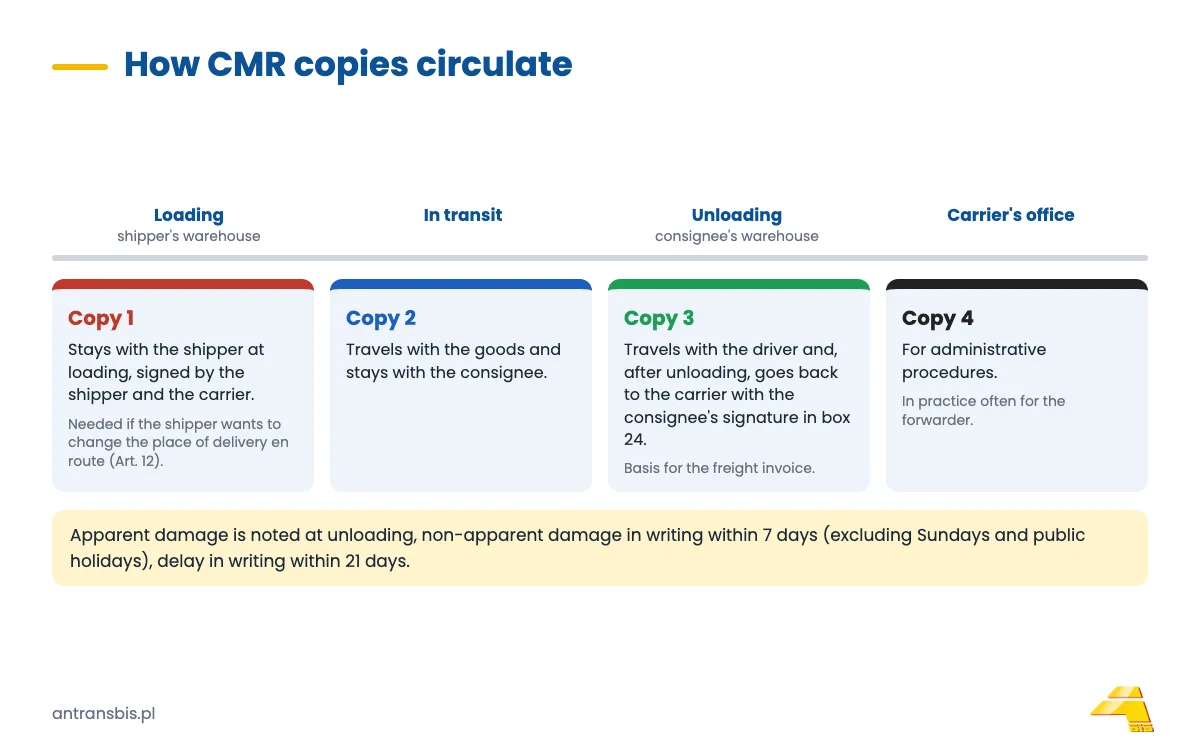
The Convention requires 3 originals signed by the shipper and the carrier (Art. 5). The first stays with the shipper, the second travels with the goods to the consignee and the third is kept by the carrier. The IRU model has 4 colour-coded copies:
- red for the shipper,
- blue for the consignee, travelling with the goods for the whole journey,
- green for the carrier, coming back with the consignee’s signature and serving as the basis for the freight invoice,
- black for administrative procedures, in practice often kept by the forwarder.
Sets of 5 copies are also in use. All copies must have identical content. The first copy also matters during transit: a shipper who wants to change the place of delivery or the consignee must produce it to the carrier (Art. 12).
Carrier’s and consignee’s reservations
On loading, the driver must check the number of packages, their marks and numbers, and the apparent condition of the goods and their packaging (Art. 8). If this cannot be done, for example because the goods are shrink-wrapped on pallets or the shipper seals the trailer, the driver records this in box 18 with the reasons. Reservations are binding on the shipper only if the shipper has expressly accepted them in the consignment note.
An empty box 18 has legal consequences. Without reservations, the goods and packaging are presumed to have been in good condition and the number of packages to have matched the note (Art. 9). A good reservation is specific: “2 pallets with torn wrap, goods not counted, load shrink-wrapped by the shipper, seal no. …”.
On the consignee’s side, the time limits of Art. 30 apply:
- apparent damage is noted on delivery, ideally in box 24,
- non-apparent damage must be notified in writing within 7 days of delivery, excluding Sundays and public holidays,
- a claim for delay requires written notice within 21 days of the goods being placed at the consignee’s disposal.
Carrier liability and the 8.33 SDR/kg limit
The carrier is liable for loss of or damage to the goods from the moment it takes them over until delivery, and for delay (Art. 17). It is relieved of liability by, among other things, the wrongful act or instructions of the claimant, inherent vice of the goods, circumstances it could not avoid, and special risks such as defective packing or loading carried out by the shipper.
Compensation is capped at 8.33 units of account (SDR, the IMF’s Special Drawing Rights) per kilogram of gross weight short. This limit was introduced by the 1978 Protocol, which has been in force for Poland since 21 February 2011. For a total loss of a 20 t load, the upper limit is therefore 166,600 SDR, whatever the invoice value of the goods. Carriage charges and customs duties are refunded on top. Compensation for delay cannot exceed the carriage charges.
You can get higher protection by entering a declared value of the goods (Art. 24) or a special interest in delivery (Art. 26) in box 20, against an agreed surcharge. The limit does not apply in the case of wilful misconduct by the carrier or default that the law of the court seised considers equivalent (Art. 29). Claims are generally time-barred after one year (Art. 32). The carrier’s liability is covered by carrier’s liability insurance (OCP), while cargo insurance protects the value of the load above the limit.
e-CMR: the electronic consignment note in 2026
The electronic CMR note is based on the Additional Protocol of 20 February 2008. The President of Poland ratified it on 23 April 2019, and it has been in force for Poland since 11 September 2019 (Dz.U. 2019, items 1487 and 1488). According to the UN treaty register (accessed 9 October 2026), the protocol has 42 parties, including Germany (since 2022), Italy and Austria (since 2024), France, Spain, the Netherlands, the Scandinavian countries and the United Kingdom.
An e-CMR has the same evidential value as a paper note, provided the system ensures authentication of the parties and integrity of the data. On transports from Poland you can therefore use it when the country of unloading has also adopted the protocol and the shipper, carrier and consignee all agree to the electronic form.
Polish domestic law is still catching up. The draft act amending the Road Transport Act and certain other acts (UD18), in its latest version of 27 February 2026, adds a provision to the Transport Law Act (Prawo przewozowe) stating that a consignment note is issued in writing, in paper or electronic form (Art. 2(1) of the draft, new Art. 38(3)). This concerns the domestic consignment note, because international carriage is governed by the CMR Convention and its protocol. The same draft allows a driver to present a transport document in electronic form at a roadside check and to share it with the inspecting officer by electronic means (new Art. 87(9) of the Road Transport Act). This version was published by the Government Legislation Centre (RCL) on 6 March 2026. The government planned to adopt the draft in Q3 2026, but as of 11 October 2026 the Council of Ministers had not adopted it and it had not been sent to the Sejm (the Polish parliament).
The second deadline comes from the EU eFTI Regulation (2020/1056). From 9 July 2027, enforcement authorities in all EU Member States must accept freight information made available electronically through certified platforms. The obligation applies to authorities, not businesses, so the paper CMR note remains acceptable.
CMR form template: where to get one
There is no official state-issued CMR form. The Convention only sets out the particulars the note must contain (Art. 6). The market standard is the model of the IRU (International Road Transport Union), in its 1976 or 2007 version. Forms are sold in pads by printers and office supply shops, and TMS systems and e-CMR platforms generate them in the same layout. The IRU publishes official instructions for completing the 2007 model as a PDF (link in the sources).
The most common mistakes on a CMR note
- The driver signs the note without checking the load, leaves box 18 empty and is later held liable for shortages they did not cause.
- The consignee signs box 24 without a date and time, so waiting time at unloading cannot be proven.
- The description of the goods in box 9 is vague, e.g. “goods”, and does not match the invoice or the customs document.
- The copies differ in content because corrections were made on only one of them.
- The delivery address is changed en route by phone, without an annotation and without producing the first copy.
- The gross weight in box 11 is an estimate that does not match the weighbridge reading, which ends in a fine at a roadside check if the vehicle is overloaded.
Frequently asked questions
What does CMR stand for?
CMR is the abbreviation of the French name of the Convention on the Contract for the International Carriage of Goods by Road (Convention relative au contrat de transport international de marchandises par route). The same name is used for the consignment note issued under the Convention. The document evidences the contract of carriage, the carrier’s taking over of the goods and their condition at loading.
Who fills in a CMR document?
Under the Convention, the note is made out by the shipper and signed by the shipper and the carrier. The shipper is responsible for the particulars of the goods, the parties and the instructions. The carrier enters its own details and any reservations, and the consignee confirms receipt in the last box.
When do you need a CMR?
The CMR applies to the carriage of goods by road for reward when loading and unloading take place in two different countries, at least one of which is a party to the Convention. This includes transport within the EU, for example from Poland to Germany. Domestic transport uses a national consignment note.
What is the difference between a CMR and a consignment note?
A CMR note is a type of consignment note designed for international road haulage. A domestic consignment note is governed by the law of the country concerned; in Poland, by the Transport Law Act (Prawo przewozowe). The CMR has a uniform box layout and the same liability rules in all Convention countries.
How many copies does a CMR note have?
The Convention requires 3 originals: for the shipper, the consignee and the carrier. A typical form based on the IRU model has 4 copies in red, blue, green and black, with the fourth used for administrative procedures. Sets of 5 copies are also in use.
Is e-CMR valid in Poland?
Yes. Poland has been a party to the Additional Protocol on the electronic consignment note since 11 September 2019. In international transport, an e-CMR has the same evidential value as a paper note, provided the system meets the requirements of the protocol. An electronic domestic consignment note is provided for in the draft act UD18 (version of 27 February 2026), which had not reached the Sejm by 11 October 2026.
Sources
- CMR Convention, Dz.U. 1962 No. 49, item 238
- 1978 Protocol to the CMR Convention (SDR), Dz.U. 2011 No. 72, item 382
- Government statement on the binding force of the 1978 Protocol for Poland, Dz.U. 2011 No. 72, item 383
- Additional Protocol to the CMR Convention concerning the electronic consignment note, Dz.U. 2019, item 1487
- Government statement on the binding force of the e-CMR Protocol for Poland, Dz.U. 2019, item 1488
- UN Treaty Collection: 1978 Protocol to the CMR Convention, list of parties
- IRU: How to fill in the CMR consignment note (IRU model 2007), PDF
- Gov.pl: draft act amending the Road Transport Act (UD18)
- Government Legislation Centre: draft UD18, version of 27 February 2026 (Art. 2 amends the Transport Law Act)
- Regulation (EU) 2020/1056 on electronic freight transport information (eFTI)
- European Commission: eFTI Regulation, timeline
Shipping goods abroad and want the CMR, reservations and proof of delivery handled without your involvement? Describe your load in the client zone or call +48 666 666 863. A dedicated forwarder manages the transport from loading to the consignee’s signature, and we provide shippers with cargo insurance of 300,000 EUR per event.

Managing Director | Antrans BiS, Olkusz
Sebastian Szklarczyk has led the development of Antrans BiS, a transport company operating throughout Europe, for more than 15 years. He started as Head of the Freight Forwarding Department, gaining practical experience in organising international transport and managing a vehicle fleet on European routes.
As Managing Director, he is responsible for the strategic management of a company handling more than 21,000 transport operations a year on its main routes: Poland-Italy, Poland-Germany, Poland-Austria, Spain, the Benelux countries and Scandinavia. Under his leadership, Antrans BiS has expanded its fleet to 220 vehicles, including its own and partners’ vehicles, and achieved an on-time delivery rate of 98%.
Specialisms: international FTL transport throughout Europe, automotive and FMCG logistics, optimisation of European routes, road traffic regulations and driving bans in the EU, and transport documentation (CMR, VAT-UE, INTRASTAT).
On the Antrans BiS blog, he shares practical knowledge about international freight forwarding, transport regulations and the business aspects of running a transport, freight forwarding and logistics company in different European countries.