Freight forwarding means organising the carriage of goods on behalf of a shipper: the freight forwarder chooses the carrier and the vehicle, plans the route and dates, prepares the documents and keeps track of the consignment until it is unloaded. A forwarder does not need to own any trucks, but it is responsible for whoever it hands the load to. For the shipper, a freight forwarding company means one point of contact instead of several carriers, phone calls and invoices.
Below I explain how freight forwarding differs from transport, what a forwarding order looks like step by step, what the forwarder and the carrier are each liable for, and how to check a company before you trust it with your goods. I write from the perspective of a company that has been both a carrier and a freight forwarder for 32 years.
What is freight forwarding? The legal definition in Poland
In Poland, freight forwarding is defined in Article 794 of the Civil Code. Under a forwarding contract, the forwarder undertakes, for a fee and within the scope of its business, to dispatch or receive a consignment or to perform other services related to its carriage. It may act in its own name or in the name of the client.
The provisions that follow (Art. 795-804 of the Civil Code) set out several points that matter to a shipper:
- The forwarder is liable for the carriers and subsequent forwarders it used to perform the order, unless it is not at fault in choosing them (Art. 799).
- The forwarder may carry the goods itself. It then has the rights and obligations of a carrier at the same time (Art. 800).
- The forwarder must safeguard the client’s rights against the carrier, for example by reporting damage on time (Art. 798).
- Claims under a forwarding contract become time-barred after one year (Art. 803).
Matters not covered by these provisions are governed, as appropriate, by the rules on the contract of mandate (Art. 796).
Freight forwarding vs transport: how a forwarder differs from a carrier
A carrier enters into a contract of carriage (Art. 774 of the Civil Code) and physically moves the goods in its own vehicle. A forwarder enters into a forwarding contract and organises the whole process: it finds a truck, negotiates the rate, passes on instructions and collects the documents. In practice, many companies combine both roles, so the same business acts as the forwarder on one job and as the carrier on another. You can read more about the haulage side in our article on what a transport company does.
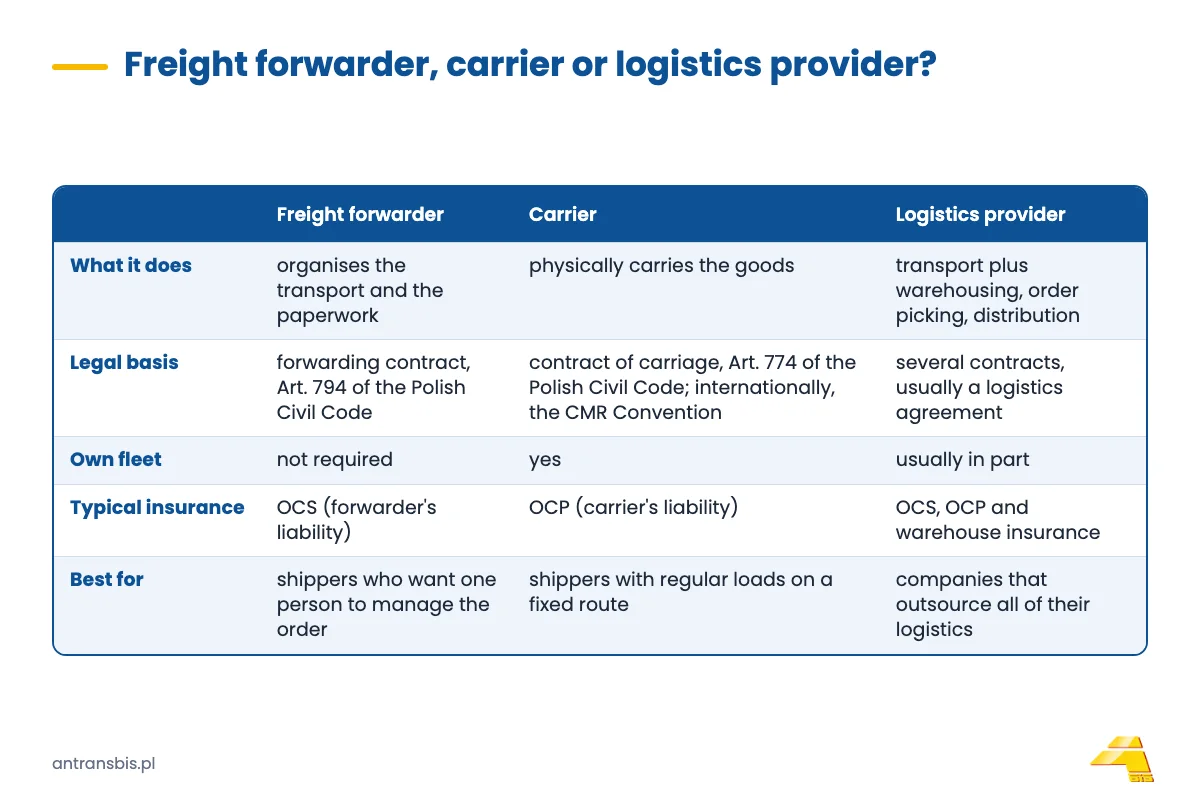
The third role that freight forwarding is often confused with is the logistics provider. Besides transport, a logistics provider also takes over warehousing, order picking and distribution.
| Criterion | Freight forwarder | Carrier | Logistics provider |
|---|---|---|---|
| What it does | organises the transport and the paperwork | physically carries the goods | transport plus warehousing, order picking, distribution |
| Legal basis | forwarding contract, Art. 794 of the Civil Code | contract of carriage, Art. 774 of the Civil Code; in international traffic, the CMR Convention | several contracts, usually a logistics agreement |
| Own fleet | not required | yes | usually in part |
| Typical insurance | OCS (forwarder’s liability) | OCP (carrier’s liability) | OCS, OCP and warehouse insurance |
| Best for | shippers who want one person to manage the order | shippers with regular loads on a fixed route | companies that outsource all of their logistics |
What does a freight forwarding company do?
The scope of services depends on the contract, but a typical freight forwarder and carrier in one handles the following tasks for the shipper:
- receives the enquiry and prepares a quote with the date the truck can arrive for loading,
- chooses the type of transport (full truckload FTL, part load LTL, pallet, oversize) and the type of semi-trailer,
- selects a carrier and checks its licence and OCP insurance,
- gives the driver the addresses, time windows and loading requirements,
- prepares or collects the documents: the transport order, the CMR consignment note and the cargo specification,
- monitors the transport and responds to delays, breakdowns and driving bans,
- collects the signed documents after unloading and settles the freight charges,
- handles the claim if the goods arrive damaged.
Day to day, these tasks are carried out by a specific person. I have described what that work looks like in a separate article about the job: who a freight forwarder is.
How a freight forwarding order works step by step
Taking a full truckload from the Małopolska region in southern Poland to northern Italy as an example:
- Enquiry. The shipper gives the loading and unloading addresses, the type of goods, the weight or number of pallets and the preferred date. At Antrans, you do this with the transport quote form in the client area.
- Quote. The forwarder checks available trucks, road tolls and driving bans on the route, then gives the rate and the date the truck can be at the loading point.
- Order. Once the quote is accepted, both parties confirm the terms in writing: route, dates, rate, payment term, and requirements for the semi-trailer and load securing.
- Truck assigned. The forwarder sends the shipper the registration number and driver details, and gives the carrier full instructions.
- Loading. The driver collects the goods and documents, and the shipper issues the CMR consignment note.
- Transport and tracking. The forwarder follows the truck’s position, checks that the plan fits within the driver’s working time and keeps the client informed of any changes.
- Unloading and settlement. The consignee signs the CMR note, the signed document goes back to the forwarder, and the forwarder issues the invoice.
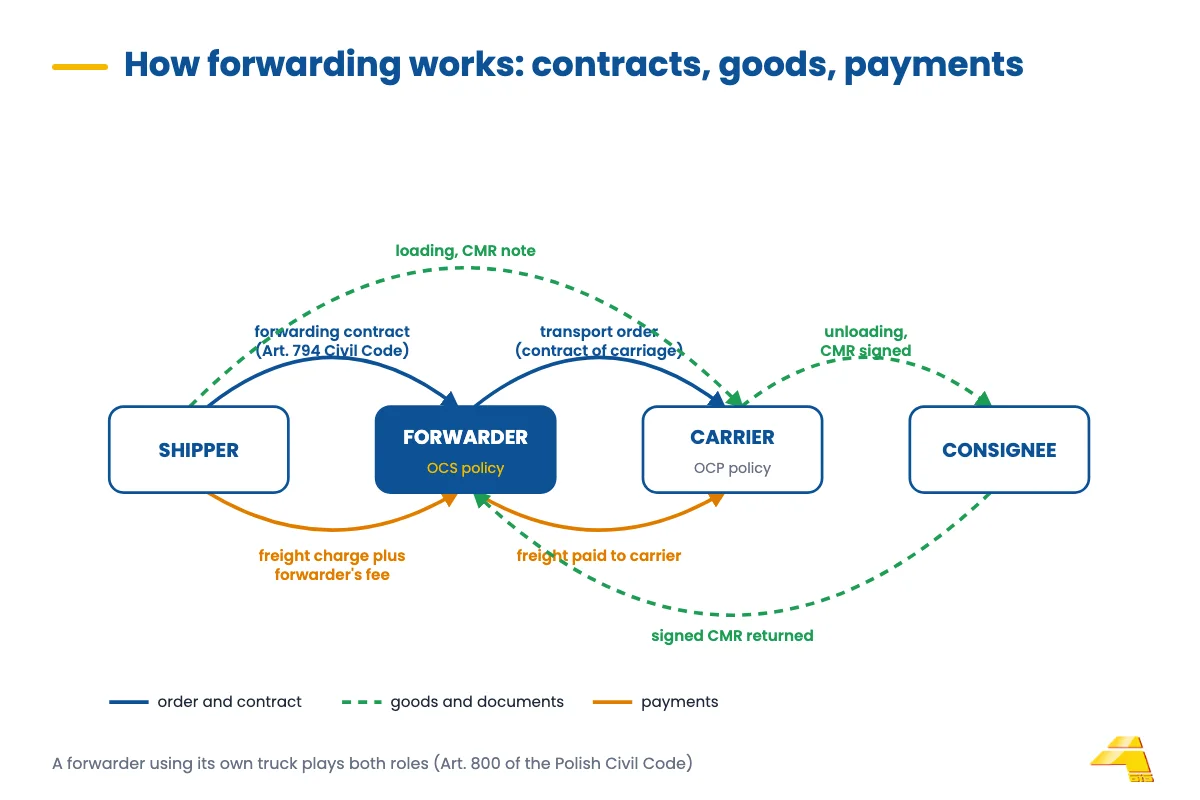
In international transport, the list also includes agreeing who pays for which leg of the journey and who bears the risk. These questions are settled by the Incoterms rules, and the course of the transport is confirmed by the CMR consignment note. We cover both topics in separate blog articles.
International freight forwarding: what changes when goods go abroad
International freight forwarding means organising transport where the loading and unloading points are in different countries. For the shipper, the difference lies mainly in the number of things to keep an eye on:
- an international road haulage contract is governed by the CMR Convention, not by the Polish Civil Code,
- the carrier must hold a Community licence,
- different weekend and public holiday driving bans for trucks apply along the route, and some cities have low-emission zones,
- shipments outside the European Union also require customs clearance.
Antrans covers routes from Poland to Italy, Germany, Austria, Spain, the Benelux countries, Scandinavia, France, England and the other EU countries, for export, import and cabotage.
Forwarder and carrier liability: OCS vs OCP insurance
This question comes up with every claim: who pays when the goods arrive damaged?
The forwarder is liable for choosing the carrier with due care and for its own actions. Its liability is covered by forwarder’s liability insurance, known in Poland as OCS. The carrier is liable for the goods from the moment it takes them over until delivery to the consignee and is insured under carrier’s liability insurance (OCP). We describe these policies in detail in our article on carrier’s OCP liability insurance.
The limits matter. In domestic transport, compensation for loss of or damage to a consignment may not exceed its ordinary value, unless the damage resulted from wilful misconduct or gross negligence (Art. 788 of the Civil Code for the carrier, Art. 801 for the forwarder). In international transport, the CMR Convention limits the carrier’s liability to 8.33 SDR units per kilogram of gross weight of the missing goods. For light, high-value cargo, that amount can be far below what the goods are worth.
That is why, with valuable goods, the shipper should ask about cargo insurance, not just OCP. Shippers working with Antrans are covered by cargo insurance of EUR 300,000 per incident, with clauses for robbery, theft, gross negligence and release of the goods to an unauthorised person.
If the forwarder carries the goods in its own truck, it is liable as a carrier under Art. 800 of the Civil Code. For the shipper, this is a simpler situation, because there is no further link in the chain to shift the blame to.
When does freight forwarding pay off?
A forwarder charges a fee for organising the transport, so not every shipment needs to go through one. In my experience, freight forwarding pays off most when:
- the company has no logistics department and nobody knows the rates or carriers on a given route,
- shipments are irregular: several trucks one week, then a break,
- the goods go to several countries and each route needs a different carrier,
- the deadline is tight and finding a truck quickly is what counts,
- the load is unusual, for example oversize, and the right equipment and permits have to be arranged.
If a shipper has one fixed route and a large, predictable volume, it may consider a contract directly with a carrier. In that case, however, it has to arrange cover itself when a truck breaks down or a driver drops out of the schedule. A middle way is a company with its own fleet and a forwarding department: it runs the fixed routes with its own trucks and covers peaks and unusual destinations through partners.
How to choose a freight forwarding company: a checklist
Before your first order, check these eight things:
- A licence to act as an intermediary in the carriage of goods. In Poland it is issued by the starosta (district authority). Under the Road Transport Act, it requires, among other things, financial standing of EUR 50,000 and a certificate of professional competence held by the transport manager.
- OCS insurance and its sum insured. Ask for confirmation that the policy is valid.
- Own fleet or brokerage only. A company with its own trucks has more control over deadlines and vehicle condition.
- One person handling the order. A dedicated forwarder saves you time, because you do not have to explain the case to several people.
- Truck tracking. GPS access for the client cuts down on calls asking where the goods are.
- Response time to enquiries. This is a good test of how the company will react when something goes wrong on the road.
- Terms in writing. The order should state the rate, dates, payment, liability and any general terms it refers to (e.g. the Polish General Forwarding Conditions, OPWS).
- Cargo insurance. Ask whether it covers theft and robbery en route.
We describe the wider process of finding and vetting a partner, including checks in public registers, in our guide on how to find a transport company.
Antrans: carrier and freight forwarder in one company
Antrans BiS has a fleet of 220 vehicles, its own and partners’, and carries out over 21,000 transports a year with 98% on-time delivery. One forwarder handles each order from quote to unloading, the client can track the tractor unit by GPS, and our forwarders are available around the clock. During office hours, we usually reply to quote requests within 60 minutes. We take FTL, LTL, pallet and oversize orders.
Frequently asked questions
What does freight forwarding involve?
Freight forwarding is about organising the carriage of goods on behalf of a shipper. The forwarder chooses the carrier and the vehicle, plans the route and dates, prepares the documents, monitors the transport and settles the order. It does not need to own any trucks to do this.
What is the difference between freight forwarding and logistics?
Freight forwarding is about organising the carriage of a specific consignment from point A to point B. Logistics is a broader concept that covers the whole flow of goods, including purchasing, warehousing, order picking and distribution. Freight forwarding is therefore one part of logistics.
What services does a freight forwarder provide?
Freight forwarding services include dispatching and receiving consignments, choosing a carrier, preparing transport documents, monitoring the transport and settling the freight charges. A forwarder can also arrange transhipment, cargo insurance or customs clearance. The exact scope depends on the contract with the client.
What is international freight forwarding?
International freight forwarding means organising transport where loading and unloading take place in different countries. For road transport, the contract of carriage is then governed by the CMR Convention. The forwarder must also take into account driving bans, road tolls and any customs clearance in each country on the route.
Does a freight forwarding company need a licence?
Yes. In Poland, acting as an intermediary in the carriage of goods by road requires a licence issued by the starosta (district authority). One condition is a certificate of professional competence held by the transport manager, another is proof of adequate financial standing.
Sources
- Polish Civil Code, consolidated text, Journal of Laws (Dz.U.) 2026, item 795 (Art. 774, 788, 794-804), ISAP
- Polish Road Transport Act, consolidated text, Journal of Laws (Dz.U.) 2025, item 1490 (Art. 5b, 5c, 7a), ISAP
- Convention on the Contract for the International Carriage of Goods by Road (CMR), Journal of Laws (Dz.U.) 1962 No. 49, item 238, ISAP
- Protocol to the CMR Convention of 5 July 1978, Journal of Laws (Dz.U.) 2011 No. 72, item 382, ISAP
Do you have goods to ship within Poland or abroad? Describe the route and the load in the client area, and a forwarder will get back to you with a rate and the date the truck can arrive for loading. You can also call us on +48 666 666 863.

Managing Director | Antrans BiS, Olkusz
Sebastian Szklarczyk has led the development of Antrans BiS, a transport company operating throughout Europe, for more than 15 years. He started as Head of the Freight Forwarding Department, gaining practical experience in organising international transport and managing a vehicle fleet on European routes.
As Managing Director, he is responsible for the strategic management of a company handling more than 21,000 transport operations a year on its main routes: Poland-Italy, Poland-Germany, Poland-Austria, Spain, the Benelux countries and Scandinavia. Under his leadership, Antrans BiS has expanded its fleet to 220 vehicles, including its own and partners’ vehicles, and achieved an on-time delivery rate of 98%.
Specialisms: international FTL transport throughout Europe, automotive and FMCG logistics, optimisation of European routes, road traffic regulations and driving bans in the EU, and transport documentation (CMR, VAT-UE, INTRASTAT).
On the Antrans BiS blog, he shares practical knowledge about international freight forwarding, transport regulations and the business aspects of running a transport, freight forwarding and logistics company in different European countries.