OCP is the Polish name for road carrier’s liability insurance. It covers the compensation a carrier has to pay for loss of, shortage of or damage to the goods, or for delay in delivery, within the limits of the Polish Carriage Act (Prawo przewozowe) for domestic haulage or the CMR Convention for international carriage. No Polish statute requires a carrier to buy it, but without an OCP policy a carrier will hardly get a single order from a freight forwarder or a shipper.
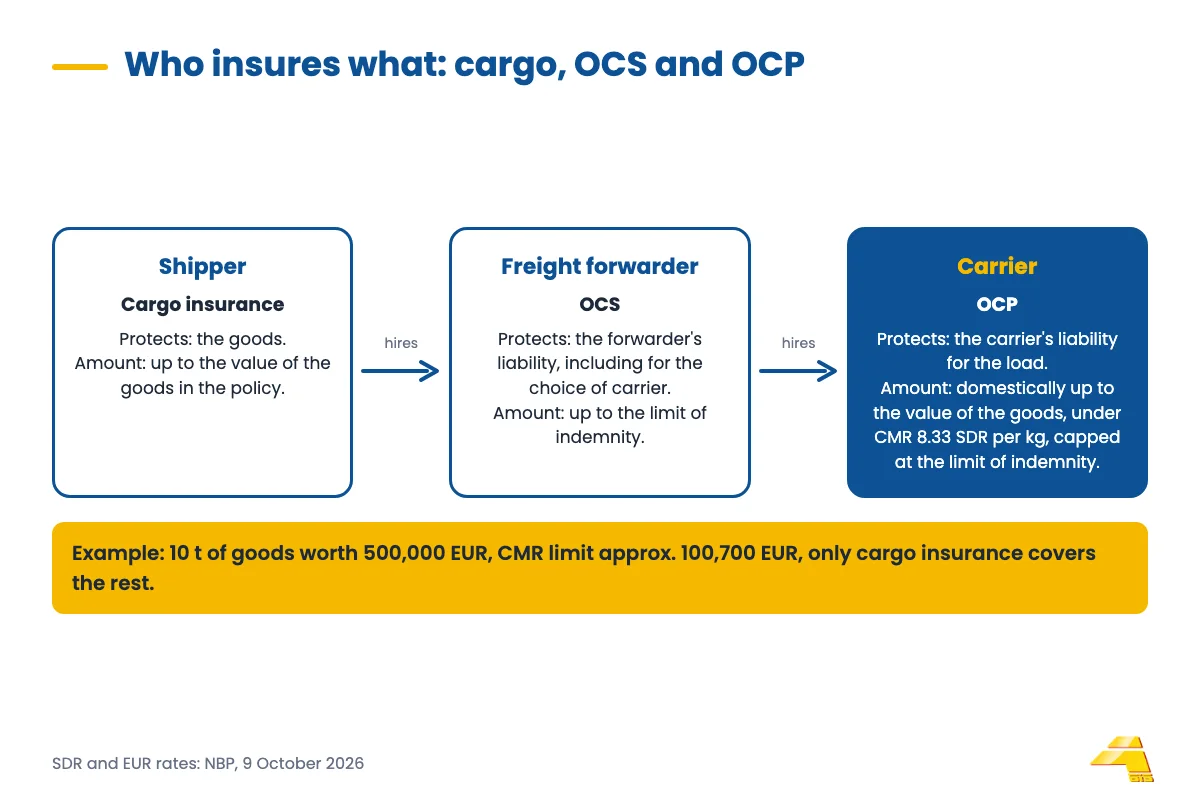
One point gets confused more than any other. OCP protects the carrier, not the goods. If the carrier is not liable for the loss, or is liable only up to a limit, the shipper receives less than the value of the load. That is what cargo insurance is for, and the freight forwarder also has its own liability cover, known in Poland as OCS.
What carrier’s liability insurance (OCP) covers
The carrier is liable for the consignment from the moment it takes it over for carriage until delivery to the consignee. This is set out in Article 65 of the Polish Carriage Act, and Article 17 of the CMR Convention says much the same. An OCP policy takes over this liability up to the limit of indemnity.
Insurers usually split OCP into two sections: domestic (carriage within Poland under the Carriage Act) and international (carriage under CMR, often together with cabotage in the EU). Standard cover typically includes, among other things, losses caused by subcontractors, robbery, damage during loading and unloading carried out by the carrier, and gross negligence, although the last of these is often subject to conditions in the general terms of insurance.
The motor third-party liability insurance on the tractor unit does not cover damage to the load. These are two separate policies.
Is carrier’s liability insurance compulsory?
Not in Poland. The law requires a carrier to prove financial standing to obtain a licence (we cover this in our article on the transport licence), but that is a different product from OCP. Protection of the load is a matter for the contract with the client.
In practice, OCP is required in every transport order, because a freight forwarder is liable for the carriers it uses unless it is not at fault in selecting them (Article 799 of the Polish Civil Code). Checking the policy is the forwarder’s evidence that it chose with due care. We, too, require our partner carriers to hold an OCP policy with a limit of indemnity of at least 100,000 EUR, as described in our carrier zone.
Germany is different. A carrier performing a transport with loading and unloading in Germany must hold liability insurance of at least 600,000 EUR per event (§ 7a of the German Road Haulage Act, GüKG). This applies to cabotage too, so before such a run check whether your policy covers it.
OCP limit of indemnity and limits of liability
The limit of indemnity is the most the policy will pay out. How much the carrier actually has to pay, however, depends on the law, which works differently for domestic carriage and for CMR.
| Legal basis | For loss or damage | For delay | When the limit does not apply |
|---|---|---|---|
| Polish Carriage Act (domestic carriage) | up to the value of the goods from the invoice, the price list or the market value (Art. 80) | up to twice the carriage charges (Art. 83) | wilful misconduct or gross negligence (Art. 86) |
| CMR Convention (international carriage) | up to 8.33 SDR per kg of gross weight short (Art. 23(3)) | up to the amount of the carriage charges (Art. 23(5)) | wilful misconduct or such default as, under the law of the court seised, is considered equivalent to wilful misconduct (Art. 29) |
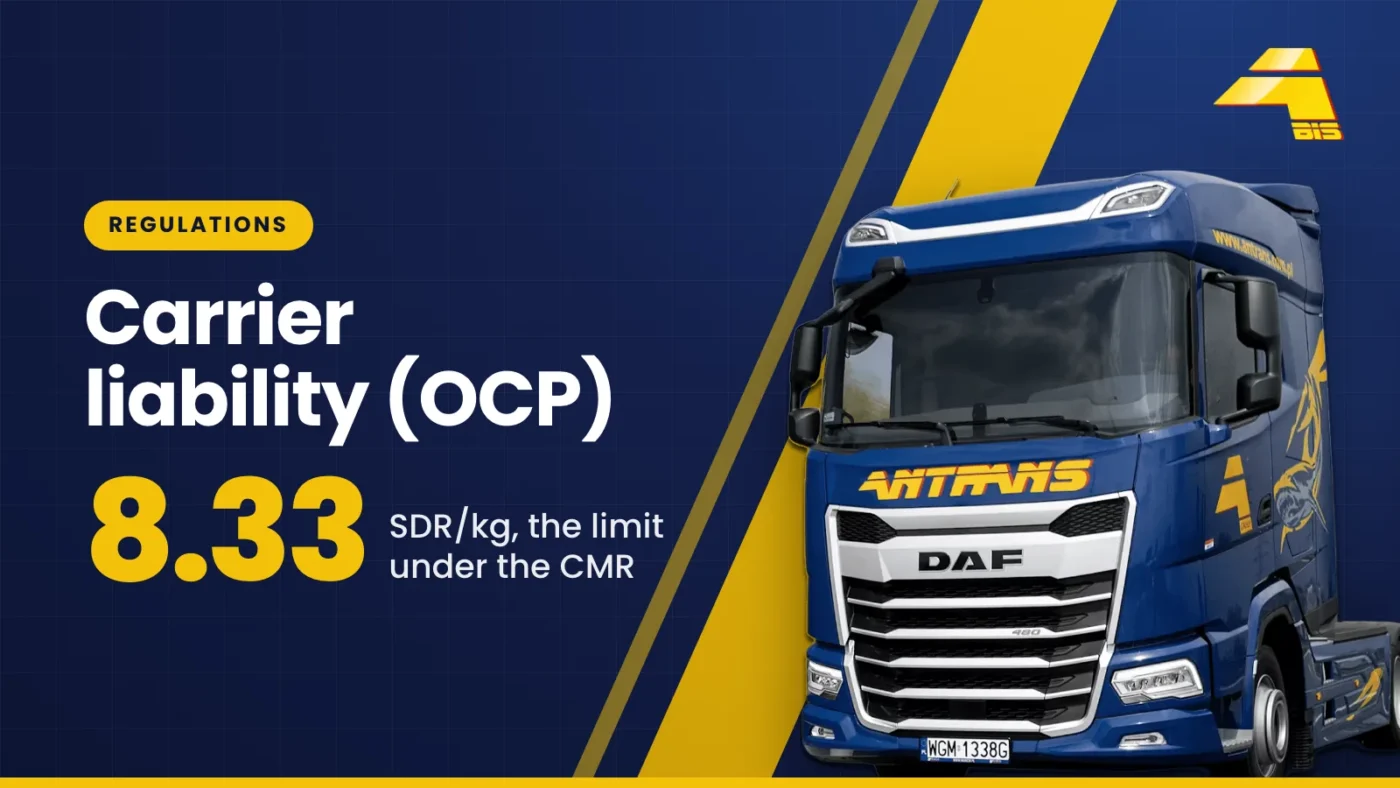
SDR (Special Drawing Rights) is the unit of account of the International Monetary Fund. At National Bank of Poland (NBP) rates of 9 October 2026, 8.33 SDR is about 44.07 PLN, or about 10.07 EUR per kilogram. A full 24 t load therefore gives a limit of 199,920 SDR, about 1.06 million PLN or about 241,600 EUR. That is why 300,000 EUR is the standard in international transport: it covers a full load within the CMR limit with room to spare.
The limit also works the other way. With 10 t of electronics worth 500,000 EUR, the carrier is liable under CMR for up to about 100,700 EUR. The shipper loses the rest unless it has cargo insurance or has declared the value of the goods in the consignment note (Articles 24 and 26 CMR). On the other hand, in the event of gross negligence the limit no longer applies and the carrier is liable for the full value of an expensive load, at which point a low limit of indemnity is quickly used up.
Exclusions and clauses in an OCP policy
Cover differs from insurer to insurer, so the list below is an example, not a rule. Under the general terms of ERGO Hestia, a Polish insurer, exclusions include the carriage of weapons and ammunition, ADR class 1 and 7 goods, cash and valuables, works of art, samples and prototypes, and live animals. Contractual penalties, carriage charges and confiscation are also outside the cover.
Three situations cause the most disputes:
- theft of the load from an unsecured parking area or while the vehicle is left unattended, which many policies exclude or make conditional on parking requirements,
- gross negligence by the driver, covered only if the policy provides for it, and often with reservations,
- high-risk loads such as electronics, alcohol, tobacco products or pharmaceuticals, for which insurers apply separate clauses, sub-limits or requirements.
Extension clauses are bought for specific types of transport: temperature-controlled goods, pharmaceuticals, abnormal loads, new and used vehicles or machinery. If you run a reefer and your policy has no temperature clause, damage caused by a failure of the refrigeration unit may go uncovered.
OCP, cargo and OCS insurance: who buys it, what it covers and up to what amount
| Policy | Who buys it | What it protects | Up to what amount |
|---|---|---|---|
| OCP | carrier | its liability for the load under the Polish Carriage Act or CMR | up to the amount the carrier is liable for (domestically up to the value of the goods, under CMR 8.33 SDR/kg), but no more than the limit of indemnity |
| Cargo insurance | shipper, consignee or the freight forwarder on the client’s behalf | the goods themselves, even when the carrier is not liable for the loss, for the risks selected | up to the sum insured, usually the value of the goods |
| OCS | freight forwarder | its liability under the forwarding contract, including for the choice of carrier and errors in organising the transport | up to the policy’s limit of indemnity |
For the shipper, cargo insurance is the simplest route to compensation, because there is no need to prove that the carrier was at fault. The forwarder’s OCS, in turn, protects it against claims for a badly organised transport, and when the forwarder carries the goods itself, it has the rights and obligations of a carrier (Article 800 of the Polish Civil Code).
At Antrans BiS, our clients’ shipments are covered by cargo insurance of 300,000 EUR per event, with clauses for robbery, theft, gross negligence and release of the goods to an unauthorised person. Details for shippers are in our client zone.
How to check a carrier’s OCP policy
Ask for a copy of the policy or an insurer’s certificate, not just a statement in an email. Then check:
- That the company name and tax ID (NIP in Poland) on the policy match the company accepting the order.
- The period of cover: whether the policy is valid on the day of the transport.
- Territorial scope: Poland, Europe, cabotage, the United Kingdom.
- The limit of indemnity per event and the aggregate limit for all events in a year.
- Exclusions and parking conditions, especially for high-risk goods.
- The clauses your load needs: temperature, ADR, gross negligence.
- If in doubt: confirmation of validity directly with the insurer.
Carriers from freight exchanges send these documents as a matter of routine, and we explain how to vet the other party to an order in our comparison of freight exchanges.
What to do if the load is damaged
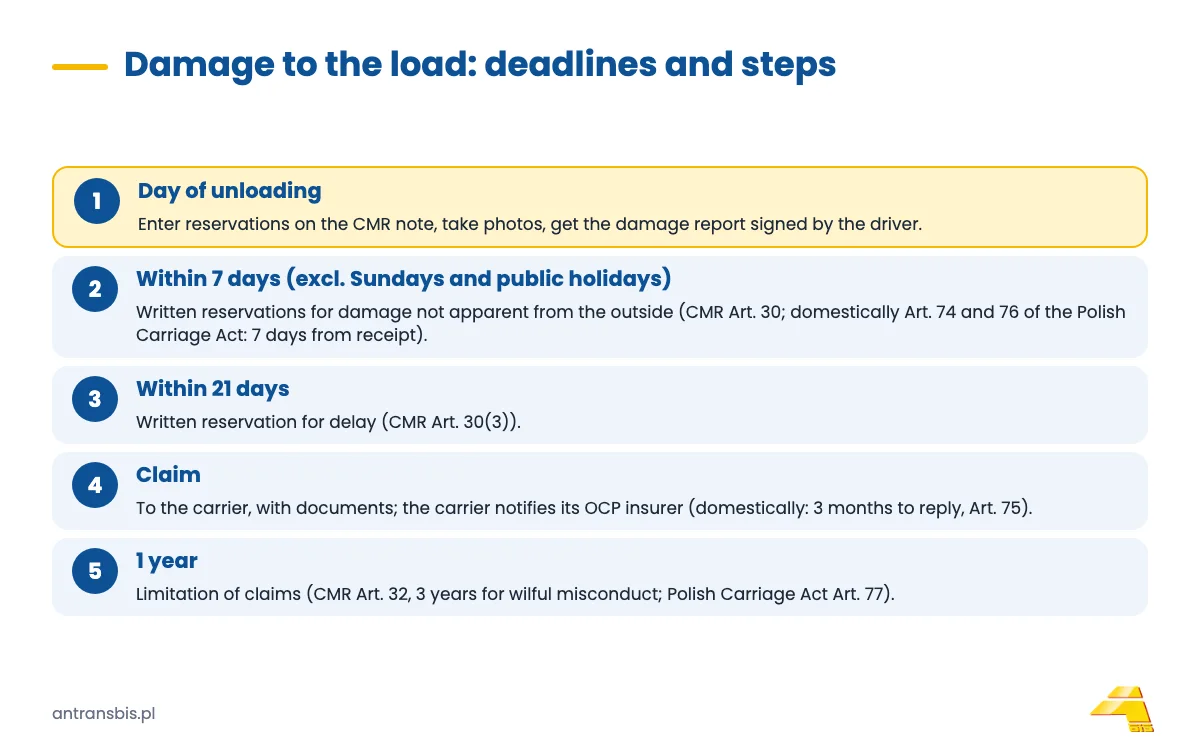
The deadlines are short, and missing them can close the door to compensation.
- On unloading, describe the damage in the consignment note and in a damage report, take photos and have the driver sign the report. We explain how to fill in the boxes correctly in our article on the CMR consignment note.
- Report damage that is not apparent from the outside in writing within 7 days of delivery, excluding Sundays and public holidays (Art. 30 CMR). In Polish domestic carriage, request an inspection of the consignment’s condition without delay and no later than 7 days after receipt (Articles 74 and 76 of the Carriage Act). In domestic carriage, accepting the consignment without reservations as a rule extinguishes any claims, whereas under CMR it is prima facie evidence that the goods arrived in the condition described in the consignment note.
- For delay in CMR carriage, compensation is payable only if a written reservation is made within 21 days of the goods being placed at the consignee’s disposal (Art. 30(3)).
- File a claim with the carrier, enclosing the CMR note, the invoice for the goods and the damage documentation. The carrier notifies its OCP insurer of the loss within the deadline set in the policy terms. In domestic carriage, a claim must be filed before going to court, and the carrier has 3 months to pay (Art. 75).
- Watch the limitation period: one year under CMR (3 years for wilful misconduct, Art. 32) and one year under the Polish Carriage Act (Art. 77). Under CMR, a written claim suspends the limitation period until the carrier replies.
The full set of papers worth having on every run is described in our article on transport documents.
Frequently asked questions
What is OCP insurance?
OCP is road carrier’s liability insurance. It covers the compensation the carrier has to pay for loss of, shortage of or damage to the load, or for delay in delivery. It does not protect the goods themselves, but the carrier against claims.
Is OCP insurance compulsory?
There is no statutory obligation to buy OCP in Poland. In practice, almost every client requires it, because without a policy a carrier will not get most orders. The exception is Germany, where carrier’s liability insurance is required by law for transports with loading and unloading in that country.
How does OCP differ from cargo insurance?
OCP is bought by the carrier and protects its liability, so whether and how much is paid out depends on whether the carrier is liable and up to what limit. Cargo insurance is usually bought by the shipper or the consignee and protects the goods themselves, even when the carrier is not liable for the loss. For high-value loads in international transport, only cargo insurance covers the full value of the goods.
What is a freight forwarder’s OCS insurance?
OCS is freight forwarder’s liability insurance. It protects the forwarder against claims under the forwarding contract, for example for errors in organising the transport or careless selection of a carrier. It does not replace the carrier’s OCP or the shipper’s cargo insurance.
What OCP limit of indemnity do you need in international transport?
Freight forwarders and shippers most often require a limit of 300,000 EUR or more per event. That amount covers the CMR Convention liability limit for a full 24 t load. For high-value goods or transports to Germany, the client may require more.
Does motor third-party liability insurance cover the load?
No. Motor third-party liability insurance protects against damage caused to third parties in road traffic, while a load carried for hire needs a separate OCP policy. A carrier without OCP pays for damage to the goods out of its own pocket.
Sources
- Polish Carriage Act (Prawo przewozowe) of 15 November 1984, consolidated text Dz.U. 2024 item 1262 (ISAP)
- CMR Convention, Dz.U. 1962 No. 49 item 238 (ISAP)
- 1978 Protocol to the CMR Convention (SDR unit of account), Dz.U. 2011 item 382 (ISAP)
- Polish Civil Code, Articles 794-804 on the forwarding contract (ISAP)
- § 7a GüKG, compulsory carrier’s liability insurance in Germany
- NBP: Table A of average exchange rates (SDR, EUR)
- ERGO Hestia: key facts about carrier’s and forwarder’s liability insurance (PDF, in Polish)
- CUK: OCP insurance, what it is and what it covers (in Polish)
Shipping goods abroad and want the transport covered by cargo insurance of 300,000 EUR per event? Describe your load in our client zone, and during business hours we usually reply within 60 minutes. Are you a carrier with a Community licence and an OCP policy? In our carrier zone you will find the terms of regular cooperation, with payment for every kilometre.

Managing Director | Antrans BiS, Olkusz
Sebastian Szklarczyk has led the development of Antrans BiS, a transport company operating throughout Europe, for more than 15 years. He started as Head of the Freight Forwarding Department, gaining practical experience in organising international transport and managing a vehicle fleet on European routes.
As Managing Director, he is responsible for the strategic management of a company handling more than 21,000 transport operations a year on its main routes: Poland-Italy, Poland-Germany, Poland-Austria, Spain, the Benelux countries and Scandinavia. Under his leadership, Antrans BiS has expanded its fleet to 220 vehicles, including its own and partners’ vehicles, and achieved an on-time delivery rate of 98%.
Specialisms: international FTL transport throughout Europe, automotive and FMCG logistics, optimisation of European routes, road traffic regulations and driving bans in the EU, and transport documentation (CMR, VAT-UE, INTRASTAT).
On the Antrans BiS blog, he shares practical knowledge about international freight forwarding, transport regulations and the business aspects of running a transport, freight forwarding and logistics company in different European countries.