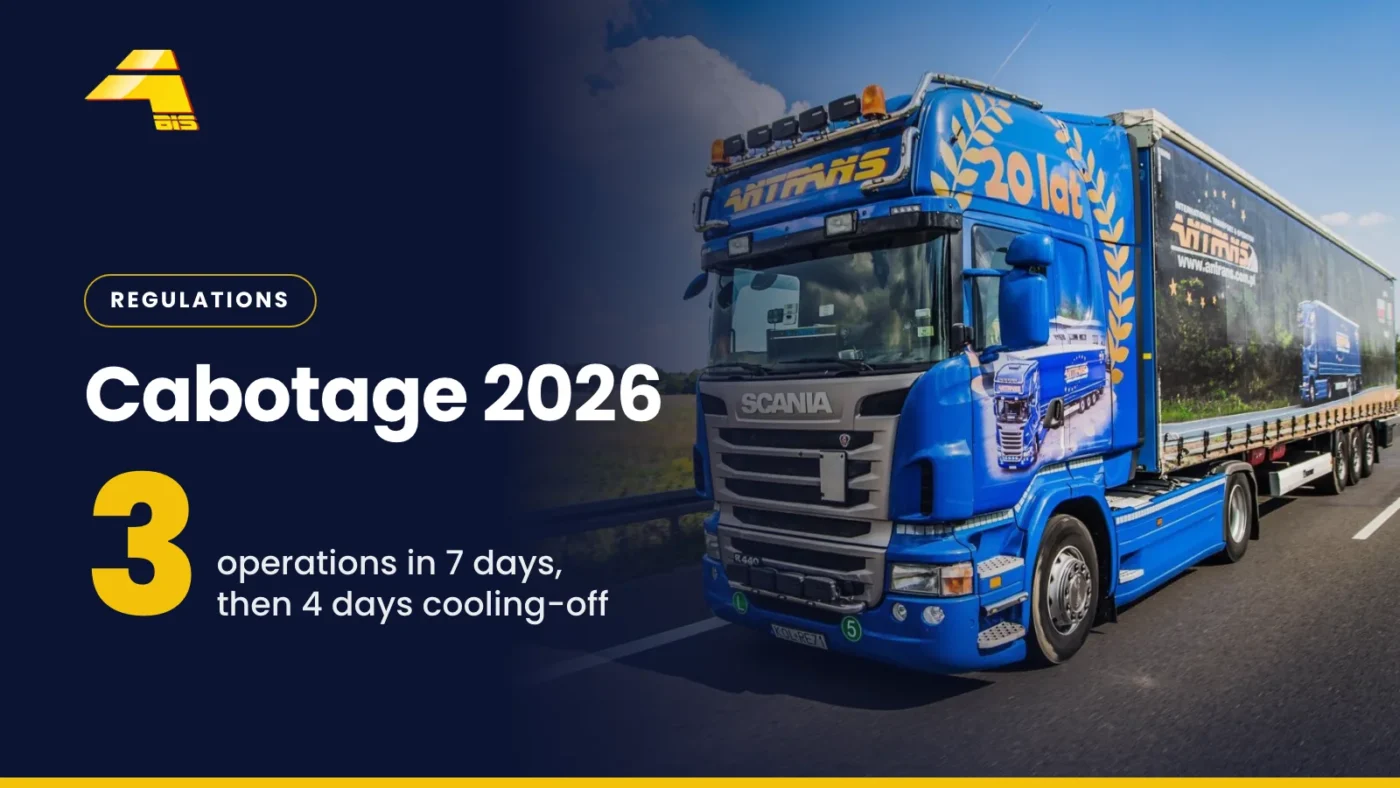
Cabotage is the domestic carriage of goods for hire or reward by a haulier from another country, for example a Polish truck running from Hanover to Hamburg. Under the Mobility Package you may carry out no more than 3 such operations within 7 days of unloading goods brought in from abroad, after which the same vehicle has to wait 4 days before it can do cabotage in that country again. A driver on cabotage is a posted worker, so the company must declare them in the IMI system and pay them according to the rules of the country where they are driving.
Below we explain the rules step by step, with a table, a sample route and a list of documents. The law is stated as of October 2026.
What is cabotage? Domestic haulage in a foreign country
Regulation (EC) No 1072/2009 defines cabotage operations as national carriage for hire or reward carried out on a temporary basis in a host Member State. The key word here is “temporary”. Cabotage is meant to supplement international transport so that the truck does not have to return empty, not to serve another country’s domestic market on a permanent basis.
The right to perform cabotage belongs to hauliers holding a Community licence. If the driver is a national of a non-EU country, they also need a driver attestation. A certified true copy of the licence must be carried in the motor vehicle. How to obtain a licence and how long it takes is covered in our article on the transport licence in 2026.
Carriage from Germany to Poland or from Germany to Austria is not cabotage. These are international operations, bilateral and cross-trade respectively, and cabotage limits do not apply to them. Regular international loads for haulage companies are described in the Antrans BiS carrier zone.
The Mobility Package in brief
The Mobility Package is a set of three EU legal acts adopted in July 2020 that changed the rules of road transport. It was phased in, and the last element took effect on 1 July 2026.
| Area | What changed | Since |
|---|---|---|
| Driving times and rest periods (Reg. 2020/1054) | ban on taking the regular weekly rest in the cab, driver’s return every 4 weeks, two reduced weekly rests in a row in international transport | 20 August 2020 |
| Posting of drivers (Dir. 2020/1057) | cabotage and cross-trade covered by posting rules, declarations in IMI, bilateral operations exempt from posting | 2 February 2022 |
| Cabotage and market access (Reg. 2020/1055) | 4-day cooling-off period, evidence of operations, new establishment requirements for companies | 21 February 2022 |
| Licence for light vehicles | Community licence for vehicles over 2.5 t in international transport | 21 May 2022 |
| Tachographs | G2V2 in new vehicles from 21 August 2023, retrofitting in international vehicles by 31 December 2024 and 18 August 2025, vans over 2.5 t from 1 July 2026 | in stages |
One element no longer applies. On 4 October 2024 the Court of Justice of the EU annulled the requirement for trucks to return to the operational centre in the country of establishment every 8 weeks. The Court upheld the other contested provisions, including the 4-day cooling-off period, posting rules for cabotage and the driver’s return every 4 weeks. We cover driving and rest time limits separately in our article on driver working time.
The 3-in-7 cabotage rule
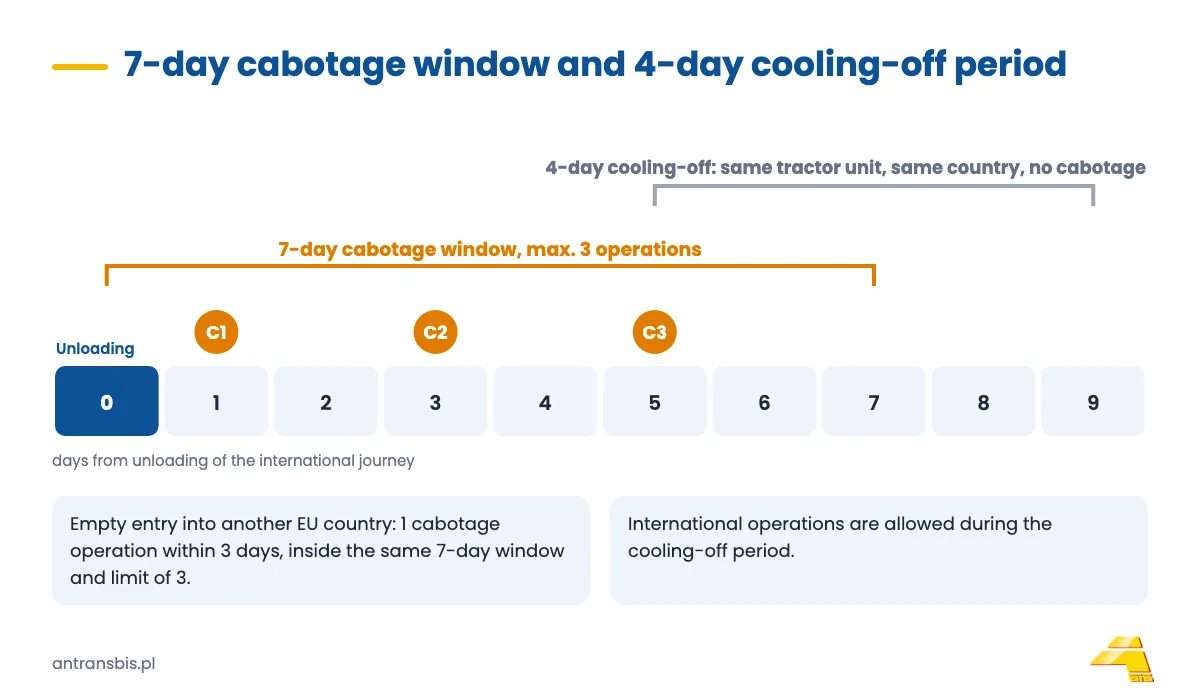
Cabotage starts with a laden international journey into the country concerned. After unloading, the haulier may carry out up to three cabotage operations with the same vehicle. In a vehicle combination it is the tractor unit that counts, so the semi-trailer may be changed. The last unloading in the course of cabotage must take place within 7 days of the last unloading of the international journey.
The limit is 3 operations or 7 days, whichever comes first. Three cabotage runs in two days close the cycle just as the end of the 7-day period does after a single run.
Cooling-off period: 4 days without cabotage
Since 21 February 2022, once cabotage in a given country has been completed, the same vehicle may not perform cabotage there for the next 4 days. The restriction applies to the vehicle, not to the driver or the company. Another tractor unit of the same haulier may carry out cabotage during that time under its own cycle. International operations are allowed during the cooling-off period, including those to and from that country.
After the cooling-off period, a new cycle requires a new laden international journey. If the vehicle was in the host country during the 4 days before the international journey, the haulier must hold evidence of all operations carried out in that period.
Cabotage in transit countries
Cabotage does not have to take place in the country where the goods were delivered. Some or all of the three operations may be carried out in other EU countries the truck passes through on its way back. The condition: the vehicle enters such a country empty and performs no more than one cabotage operation there within 3 days of entry. Everything must fit into the same 7-day window and the overall limit of 3 operations.
Cabotage rules: what is allowed and what is not
| Allowed | Not allowed |
|---|---|
| 3 cabotage operations within 7 days of unloading the international journey | a fourth cabotage operation in the same cycle |
| changing the semi-trailer, as long as the same tractor unit performs the cabotage | starting cabotage without a prior laden international journey |
| cabotage in a transit country, 1 operation within 3 days of entering empty | a second cabotage operation in the transit country within those 3 days |
| carrying international loads during the cooling-off period | cabotage with the same tractor unit in the same country before the 4 days are up |
| showing evidence in electronic form, e.g. e-CMR | driving without the driver being declared in IMI |
Example route: Poland - Germany with three cabotage operations
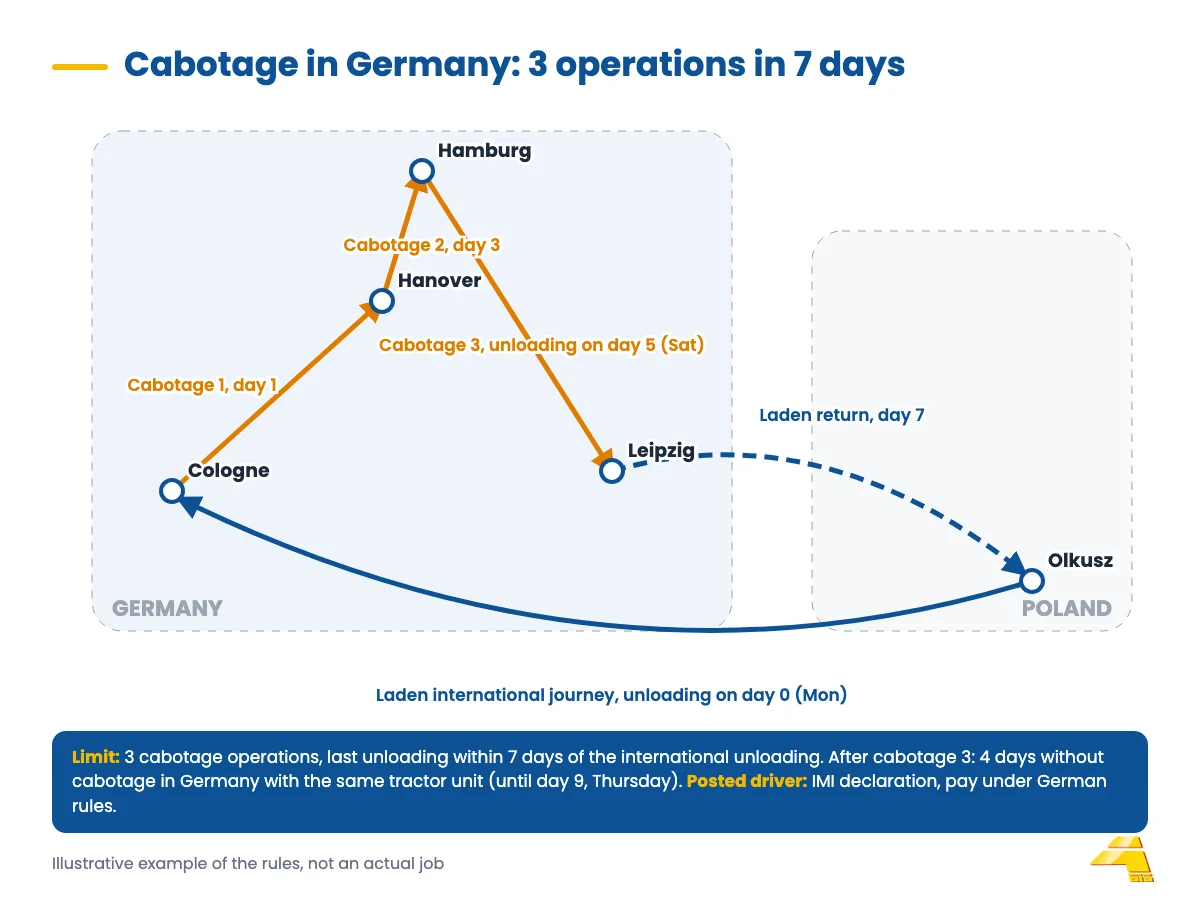
A tractor unit with a curtainsider carries a load from Poland to Cologne and unloads on Monday (day 0). The 7-day clock starts at that moment.
- Tuesday, day 1: cabotage 1 from Cologne to Hanover.
- Thursday, day 3: cabotage 2 from Hanover to Hamburg.
- Saturday, day 5: cabotage 3 from Hamburg to Leipzig, with unloading. The limit of 3 operations has been used up.
- Monday, day 7: loading in Saxony and a laden return to Poland. This is an international journey, so the cabotage limit does not apply to it.
Until Thursday (day 9) this tractor unit cannot perform any more cabotage in Germany. Throughout the cabotage the driver is posted to Germany, and the company must pay them in line with German rules. Rest periods need planning too: the regular weekly rest may not be taken in the cab. For more on this lane, see our Poland - Germany transport page.
Posting of drivers on cabotage
Directive 2020/1057 settles that a driver performing cabotage is a posted worker. The posting ends when the driver leaves the host country in the course of an international journey. For a Polish haulier, bilateral operations to and from Poland and mere transit do not count as posting. Cross-trade, on the other hand, for example from Germany to France, does.
The haulier’s obligations:
- Submitting a posting declaration via the public interface of the IMI system no later than at the start of the posting, with the licence number, driver details, registration numbers and an indication that the operation is cabotage.
- Paying the driver in line with the rules of the host country, meaning at least the local minimum wage plus the mandatory components of universally applicable collective agreements. In Germany the statutory minimum wage from 1 January 2026 is 13.90 EUR gross per hour.
- At the request of the host country’s authorities, after the posting has ended: sending them via IMI, within 8 weeks, the pay records, employment contract, working time records and proof of payment.
Each country decides which pay components are mandatory and must publish them. Before your first cabotage run in France, Belgium or Italy, check the current rates for that country on its official posting website.
Documents and evidence in the cab
The haulier must have clear evidence of the preceding international journey and of each subsequent cabotage operation. For each operation, the evidence includes:
- the name, address and signature of the shipper and of the haulier,
- the name and address of the consignee and, after delivery, their signature and the delivery date,
- the place and date of taking over the goods and the place of delivery,
- a description of the goods and the method of packing and, for ADR loads, their markings,
- the gross mass or quantity of the goods,
- the registration numbers of the tractor unit and the trailer.
In practice this information is on the CMR consignment note or e-CMR. No additional documents are required. The driver also carries a copy of the IMI posting declaration and tachograph records with the symbols of the countries visited. During a roadside check the driver may contact the office, which sends any missing evidence before the check ends. We write more about paperwork on the road in our article on transport documents.
Combined transport
In combined transport the semi-trailer travels part of the way by rail or by sea, and the truck only handles the initial and final road legs. Directive 92/106/EEC exempts these legs from cabotage restrictions. Since 2022, however, countries may apply cabotage rules to them, with a window longer than 7 days and a cooling-off period shorter than 4 days. In that case they must notify the Commission and publish the rules. Before serving a terminal abroad, check whether the country in question has used this option.
A driver on the road leg of a combined transport operation is not posted if that leg on its own is a bilateral operation.
Cabotage fines and roadside checks
Each country imposes penalties under its own law, and cabotage checks are mandatory. At least twice a year, EU countries run concerted roadside checks on cabotage together with their neighbours. In Poland, a foreign haulier performing cabotage in breach of the conditions pays a fine of 12,000 PLN (Annex 3 to the Polish Road Transport Act).
Frequently asked questions
What is cabotage?
Cabotage is the domestic carriage of goods for hire or reward by a haulier from another EU country, for example by a Polish truck between two cities in Germany. It is allowed only temporarily, after an international journey and within strictly defined limits.
How many cabotage operations can you do in Germany?
No more than three cabotage operations within 7 days of unloading an international journey into Germany. After that, the same tractor unit may not perform cabotage in Germany for 4 days.
Does the cooling-off period apply to the driver or the vehicle?
The cooling-off period applies to the vehicle, and in a vehicle combination to the tractor unit. During that time the driver may perform cabotage with another tractor unit, provided it has its own valid cycle following an international journey.
Do you need to declare the driver in IMI for cabotage?
Yes. A driver performing cabotage is a posted worker, so the haulier declares them in the IMI system no later than at the start of the posting. The driver keeps a copy of the declaration on board for roadside checks.
What is the Mobility Package?
It is a set of EU rules from 2020 covering driving times and rest periods, posting of drivers, market access and cabotage, and tachographs. The changes were phased in between August 2020 and July 2026.
Does a truck have to return to Poland every 8 weeks?
No. On 4 October 2024 the Court of Justice of the EU annulled this obligation. What does still apply is the rule that the haulier must allow the driver to return to the operational centre or home every 4 weeks.
Sources
- Regulation (EC) No 1072/2009, consolidated text of 21 February 2022 (Articles 8-10a on cabotage), EUR-Lex
- Regulation (EU) 2020/1055 (Mobility Package: market access and cabotage), EUR-Lex
- Directive (EU) 2020/1057 on the posting of drivers, EUR-Lex
- Regulation (EU) 2020/1054 (driving times, rest periods, tachographs), EUR-Lex
- CJEU, press release No 173/24 of 4 October 2024 (Mobility Package)
- European Commission: Mobility Package I
- IMI posting declaration portal for drivers (Road Transport Posting Declaration)
- Polish Road Transport Act (ustawa o transporcie drogowym), consolidated text, Journal of Laws (Dz.U.) 2025 item 1490 (penalties, Annex 3), ISAP
- GITD (Polish Road Transport Inspectorate): mandatory replacement of tachographs currently in use
- German Federal Government (Bundesregierung): minimum wage of 13.90 EUR from 1 January 2026
Cabotage pays off when the tractor unit has a reliable load in both directions and a plan that does not end with a fine at a roadside check. In our carrier zone we explain how we work with Community licence holders: regular international loads all year round, payment for every kilometre, and freight forwarders available 24/7 who plan routes together with the haulier.

Managing Director | Antrans BiS, Olkusz
Sebastian Szklarczyk has led the development of Antrans BiS, a transport company operating throughout Europe, for more than 15 years. He started as Head of the Freight Forwarding Department, gaining practical experience in organising international transport and managing a vehicle fleet on European routes.
As Managing Director, he is responsible for the strategic management of a company handling more than 21,000 transport operations a year on its main routes: Poland-Italy, Poland-Germany, Poland-Austria, Spain, the Benelux countries and Scandinavia. Under his leadership, Antrans BiS has expanded its fleet to 220 vehicles, including its own and partners’ vehicles, and achieved an on-time delivery rate of 98%.
Specialisms: international FTL transport throughout Europe, automotive and FMCG logistics, optimisation of European routes, road traffic regulations and driving bans in the EU, and transport documentation (CMR, VAT-UE, INTRASTAT).
On the Antrans BiS blog, he shares practical knowledge about international freight forwarding, transport regulations and the business aspects of running a transport, freight forwarding and logistics company in different European countries.