
A truck driver’s time is counted under two separate sets of rules. Regulation (EC) No 561/2006 limits driving time: 9 hours a day, 56 hours a week, 90 hours in two weeks and a 45-minute break after 4.5 hours at the wheel. The Polish Act on Drivers’ Working Time covers all working time, meaning driving plus loading and paperwork: 8 hours a day, an average of 40 hours a week and no more than 60 hours in any single week.
Below you will find a table of the limits and a sample week on the Poland - Italy route. The rules are stated as of October 2026.
Driving time vs working time: two different clocks
Driving time is only the time spent at the wheel, as recorded by the tachograph. A driver’s working time is broader. Under Article 6 of the Act on Drivers’ Working Time, it covers driving, loading and unloading, supervising them, freight forwarding tasks, daily vehicle servicing, administrative formalities and keeping the vehicle clean. Waiting for loading also counts as working time if the driver did not know in advance how long it would take.
In practice, inspectors check both clocks. A driver can stay within 9 hours of driving and still exceed the permitted working time because they spent three hours waiting at the loading bay and unloaded the goods themselves. That is why a route has to be planned with both limits in mind at the same time. C+E drivers with a driver card who are looking for regular routes are welcome to visit our careers at Antrans BiS page.
The driving time rules apply to vehicles covered by Regulation 561/2006, mainly trucks over 3.5 t. When a vehicle has to be fitted with a tachograph is explained in a separate article: when a tachograph is mandatory.
Driving time and rest period limits in one table
| Rule | Limit | Legal basis |
|---|---|---|
| Daily driving time | 9 h, up to 10 h twice a week | Art. 6(1) Reg. 561/2006 |
| Weekly driving time | 56 h | Art. 6(2) |
| Driving time in two consecutive weeks | 90 h | Art. 6(3) |
| Break | 45 min after 4.5 h of driving, can be split into 15 + 30 min | Art. 7 |
| Regular daily rest | 11 h or split 3 h + 9 h | Art. 4(g) |
| Reduced daily rest | min. 9 h, max. 3 times between weekly rests | Art. 8(4) |
| Regular weekly rest | 45 h | Art. 4(h) |
| Reduced weekly rest | min. 24 h, with compensation | Art. 8(6) and (6b) |
| Start of weekly rest | no later than after 6 periods of 24 h | Art. 8(6) |
| Working time (employee) | 8 h a day, average 40 h a week | Art. 11 of the Act |
| Weekly working time | average 48 h, max. 60 h | Art. 12 of the Act |
| Night work | max. 10 h of working time between rest periods | Art. 21 of the Act |
Under the rules, a week means the period from 00:00 on Monday to 24:00 on Sunday, not any seven consecutive days.

Driver break rules: 45 minutes after 4.5 hours of driving
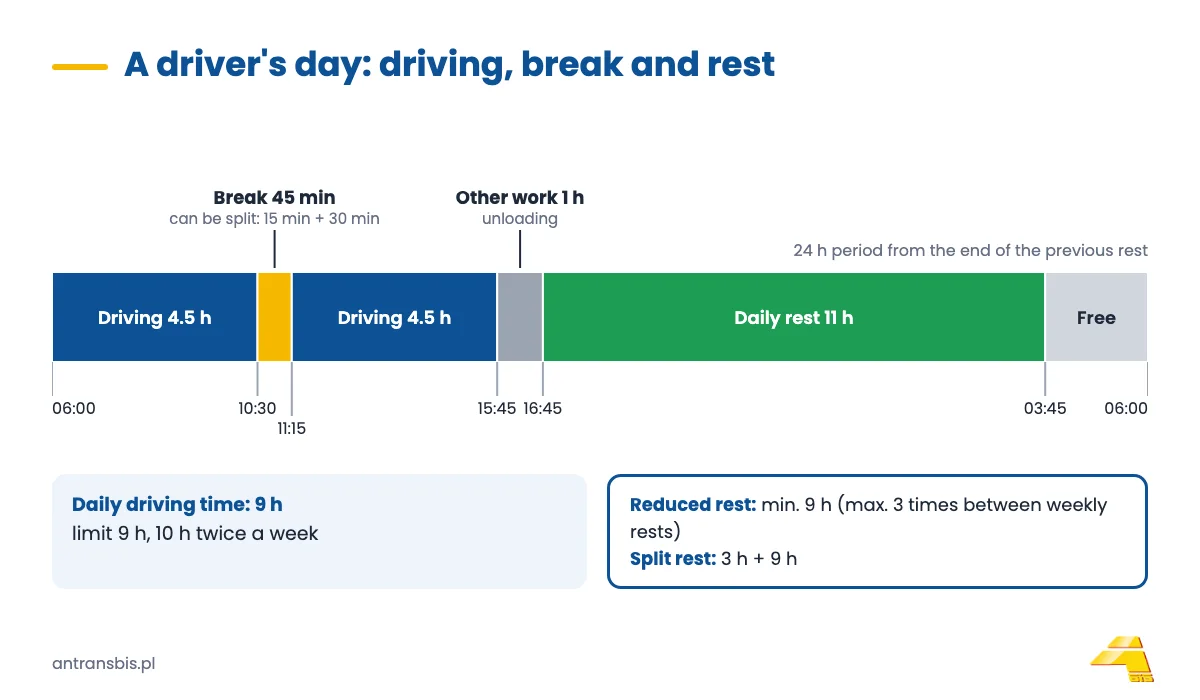
After 4.5 hours of driving, a driver must take an uninterrupted break of at least 45 minutes, unless a rest period starts at that point. The break can be split into two parts: first at least 15 minutes, then at least 30 minutes. The order matters. A 30 + 15 split does not meet the requirement of Article 7, and the second part must end before total driving time exceeds 4.5 hours.
A break is time for rest only. Refuelling, securing the load or paperwork at the loading bay count as other work, not as a break. In a two-driver crew, a driver may take the 45-minute break in the moving vehicle, provided they are not assisting the other driver.
Polish national law adds its own break, counted from working time. After 6 hours of work, a driver is entitled to a break of at least 30 minutes, and at least 45 minutes if the working day is longer than 9 hours (Art. 13). In addition, if daily working time is at least 6 hours, the employer must provide a 15-minute break that counts as working time.
Daily rest period: 11, 9 or 3 + 9 hours
Within each 24-hour period after the end of the previous rest, the driver must take a new daily rest. A regular daily rest lasts at least 11 hours without interruption. It can be split into two parts: the first of at least 3 hours and the second of at least 9 hours, 12 hours in total. A reduced daily rest lasts from 9 to 11 hours and may be taken no more than three times between two weekly rest periods.
Multi-manning follows a different rule: each driver must have at least 9 hours of rest within 30 hours of the end of the previous rest.
Driver weekly rest: 45 hours, 24 hours and compensation
A driver’s weekly rest must start no later than at the end of six 24-hour periods from the end of the previous one. A regular weekly rest lasts at least 45 hours, a reduced one at least 24 hours. In any two consecutive weeks, the driver must take either two regular weekly rests or one regular and one reduced.
Each reduction must be made up in full, in one block, before the end of the third week following the week in which it occurred. The compensation is attached to another rest period of at least 9 hours. Example: a weekly rest reduced to 24 hours means 21 hours to make up.
Since 2020, a driver in international goods transport may take two reduced weekly rests in a row, provided both start outside the employer’s country of establishment and outside the driver’s country of residence. The condition: in any four consecutive weeks, the driver takes at least four weekly rests, at least two of which are regular. Before the next weekly rest, the driver must then take the compensation for both reductions.
A regular weekly rest, and any rest of more than 45 hours taken as compensation, may not be spent in the cab. It requires suitable accommodation with sleeping and sanitary facilities, paid for by the employer (Art. 8(8)). The carrier must also organise work so that the driver can return to the employer’s base in Poland or to their home at least once every 4 consecutive weeks. After two reduced weekly rests in a row, the return must take place before the compensation is taken, which in practice means after 3 weeks. The company keeps records showing how it meets this obligation.
Exceptions: Article 12, two-driver crews and ferries
Article 12 allows a departure from the rules where this is needed to ensure the safety of persons, the vehicle or its load, but only to the extent necessary to reach a suitable stopping place. In exceptional circumstances, a driver may also exceed daily and weekly driving time by one hour to reach the base or home for a weekly rest, or by two hours if they take a 30-minute break immediately beforehand and are on the way to a regular weekly rest. The reason is noted by hand on the tachograph printout, and the extension must be compensated with rest before the end of the third week.
When the truck travels by ferry or train, a regular daily rest or a reduced weekly rest may be interrupted no more than twice, for no more than one hour in total, provided the driver has access to a sleeper cabin or couchette. A regular weekly rest on a ferry is only allowed on a crossing scheduled to last at least 8 hours and with a sleeper cabin.
Driver working time under Polish law
The Polish Act on Drivers’ Working Time (consolidated text, Journal of Laws (Dz.U.) 2026, item 477) implements Directive 2002/15/EC. For a driver employed under an employment contract, the standard is 8 hours a day and an average of 40 hours in a five-day working week, over a settlement period of up to 4 months. In the equivalent working time system, where longer days are balanced by shorter ones, daily working time can be extended to 12 hours. Weekly working time including overtime may not exceed an average of 48 hours, or 60 hours in any single week.
Three terms raise the most questions. On-call duty means being ready to work outside normal hours. It does not count as working time if the driver did no work, and in a two-driver crew, the time spent away from the wheel counts as on-call duty. Periods of availability include, among other things, ferry crossings and waiting at the border. Night work, meaning work within a four-hour window between 00:00 and 07:00, limits working time to 10 hours between rest periods.
The 48- and 60-hour limits and the break rules also apply to business owners who drive their own trucks (Chapter 3a of the Act).
Sample driver’s week on the Poland - Italy route
Let’s assume a full truckload from Małopolska (Lesser Poland) to northern Italy and a return load. The hours are illustrative and show how the calculation works.
| Day | Driving | Other work | Rest after work |
|---|---|---|---|
| Monday | 9 h (4.5 + 45 min break + 4.5) | 1 h loading | 11 h |
| Tuesday | 10 h, first extension | 0.5 h | 9 h, reduced |
| Wednesday | 8 h | 2 h unloading and loading in Italy | 11 h |
| Thursday | 10 h, second extension | 0.5 h | 11 h |
| Friday | 6 h | 1 h unloading in Poland | 45 h regular weekly rest at home |
Total: 43 hours of driving, so in the following week the driver can drive no more than 47 hours (the 90-hour limit for two weeks). Working time came to about 48 hours, so the week stays within the average. Days of 10 or more working hours are possible under the equivalent working time system, which allows up to 12 hours a day. If the two unloadings ran several hours over, the total would exceed 48 hours. That is still allowed up to 60 hours, but the excess has to be balanced out within the settlement period.
You also need to allow for truck driving bans in Italy and Austria, listed on our page truck driving bans in Europe in 2026, while the route itself is described on the Poland - Italy transport page.
What changed in 2024 - 2026
Since 31 December 2024, drivers must carry records for the current day and the previous 56 days, instead of 28 as before. By 31 December 2024, vehicles in international transport within the EU fitted with analogue or first-generation digital tachographs, and by 18 August 2025 vehicles with first-version smart tachographs, had to be fitted with a second-version smart tachograph (G2V2).
Since 1 July 2026, the driving time rules have applied to vehicles over 2.5 t in international goods transport and cabotage. We cover the details for companies running vans in the article tachographs in vans from 2026.
The legal status of one Mobility Package rule has also changed. On 4 October 2024, the Court of Justice of the EU annulled the obligation for trucks to return to the base every 8 weeks. The Court upheld the obligation to enable drivers to return every 4 weeks and the ban on spending the regular weekly rest in the cab. You can read more about the package in our article cabotage and the Mobility Package.
Fines for drivers’ hours infringements in Poland
In Poland, the carrier and the driver are liable separately. The carrier pays an administrative fine of 50 to 12,000 PLN per infringement, but the total of fines from a single roadside check may not exceed 12,000 PLN (Art. 92a of the Polish Road Transport Act). Examples from Annex 3: exceeding the 9-hour driving limit by one to two hours when the driver has already used both extensions costs 150 PLN. Reducing a regular daily rest by more than 2.5 hours costs 350 PLN for each started hour beyond that threshold. The driver faces a fine of up to 2,000 PLN, for example 50 PLN for taking a regular weekly rest in the cab.
Abroad, fines are imposed by the country carrying out the check according to its own penalty scale, including for infringements from the previous 56 days recorded on the tachograph.
Frequently asked questions
How many hours a day can a truck driver drive?
Daily driving time is a maximum of 9 hours. It can be extended to 10 hours twice a week. Regardless of this, the limits of 56 hours a week and 90 hours in two consecutive weeks apply.
How can the 45-minute driver break be split?
The break can be split into two parts: first at least 15 minutes, then at least 30 minutes. Both must fit within the 4.5-hour driving period or end immediately after it. The reverse order, 30 and then 15 minutes, does not meet the requirement.
How long is a driver’s weekly rest?
A regular weekly rest lasts at least 45 hours and a reduced one at least 24 hours. In any two consecutive weeks, the driver must have at least one regular weekly rest. Each reduction is made up in one block before the end of the third week.
Can a driver spend the weekly rest in the cab?
A reduced weekly rest, yes. A regular weekly rest, or compensation of more than 45 hours, may not be spent in the cab. The employer pays for suitable accommodation outside the vehicle.
Does loading count as driver working time?
Yes. Loading, unloading and supervising them count as driver working time under the Polish Act on Drivers’ Working Time. On the tachograph they are recorded as other work, not as a break.
How often does a truck driver have to return home?
The carrier must organise work so that the driver can return to the employer’s base or home within every period of 4 consecutive weeks. After two reduced weekly rests in a row, the return comes earlier, before the compensation is taken. The driver can, however, choose where to spend this rest.
Sources
- Regulation (EC) No 561/2006, consolidated text of 31 December 2024, EUR-Lex
- Regulation (EU) 2020/1054 amending Regulations 561/2006 and 165/2014, EUR-Lex
- Directive 2002/15/EC on the organisation of the working time of persons performing mobile road transport activities, EUR-Lex
- Polish Act on Drivers’ Working Time, consolidated text Dz.U. 2026 item 477, ISAP (in Polish)
- Polish Road Transport Act, consolidated text Dz.U. 2025 item 1490 (penalties, Annexes 1 and 3), ISAP (in Polish)
- Regulation (EU) No 165/2014 on tachographs, consolidated text, EUR-Lex
- GITD (Polish Road Transport Inspectorate): weekly rest after the Mobility Package (in Polish)
- GITD: obligation to replace tachographs currently in use (in Polish)
- CJEU, press release No 173/24 of 4 October 2024 (Mobility Package)
Do you drive C+E and want a job where routes are planned by people who know these rules? Visit our careers page. Running a haulage company? In the carrier zone we describe regular year-round orders and freight forwarders available 24/7 in Polish, English, German and Italian, with whom you can plan each run around the driving and rest time rules.

Managing Director | Antrans BiS, Olkusz
Sebastian Szklarczyk has led the development of Antrans BiS, a transport company operating throughout Europe, for more than 15 years. He started as Head of the Freight Forwarding Department, gaining practical experience in organising international transport and managing a vehicle fleet on European routes.
As Managing Director, he is responsible for the strategic management of a company handling more than 21,000 transport operations a year on its main routes: Poland-Italy, Poland-Germany, Poland-Austria, Spain, the Benelux countries and Scandinavia. Under his leadership, Antrans BiS has expanded its fleet to 220 vehicles, including its own and partners’ vehicles, and achieved an on-time delivery rate of 98%.
Specialisms: international FTL transport throughout Europe, automotive and FMCG logistics, optimisation of European routes, road traffic regulations and driving bans in the EU, and transport documentation (CMR, VAT-UE, INTRASTAT).
On the Antrans BiS blog, he shares practical knowledge about international freight forwarding, transport regulations and the business aspects of running a transport, freight forwarding and logistics company in different European countries.