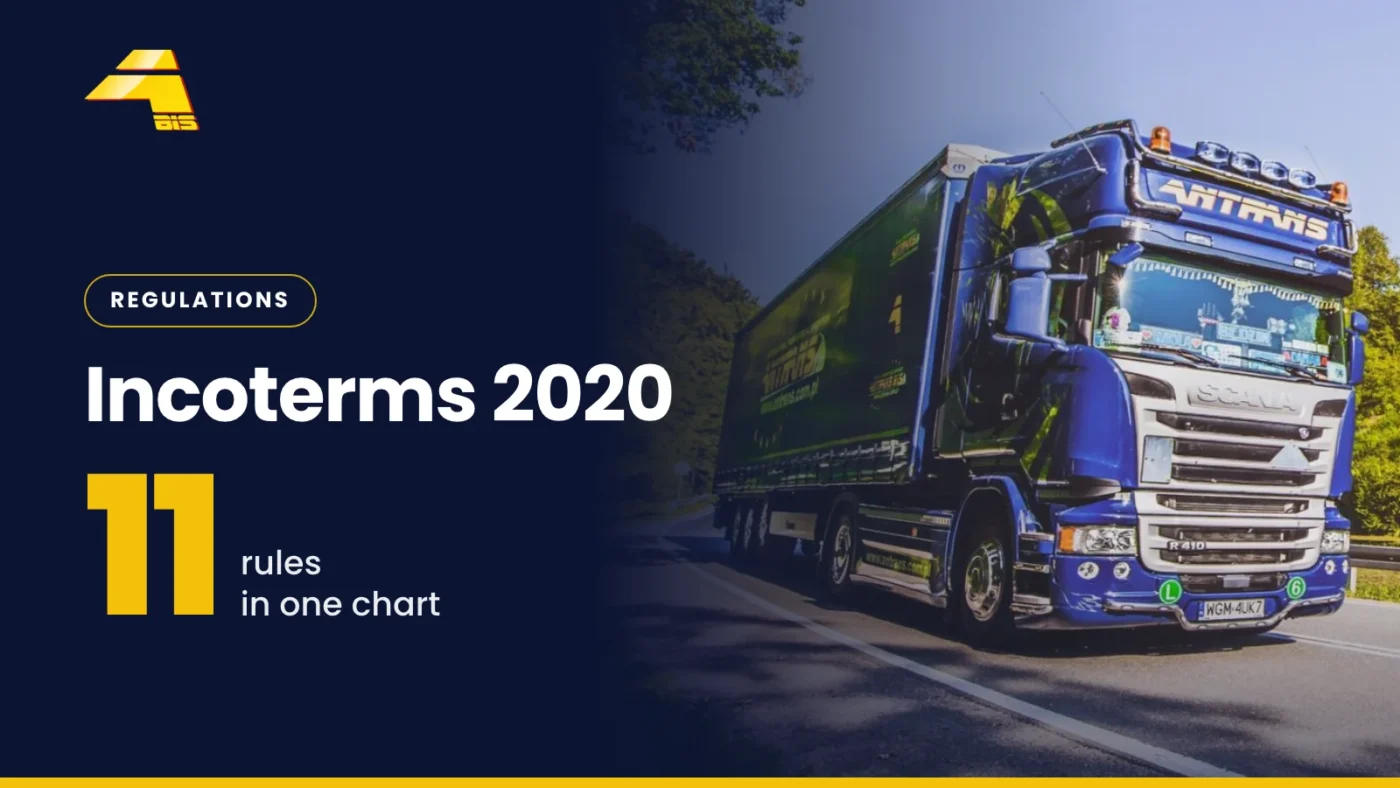
Incoterms are 11 three-letter rules published by the International Chamber of Commerce (ICC) that settle three things in a sales contract: who arranges and pays for transport, at what point the risk of loss of the goods passes from seller to buyer, and who handles customs clearance. As of October 2026, the edition in force is Incoterms 2020. Below you will find a table of all the rules and practical tips on which one to choose for full truckload road transport across Europe.
What Incoterms are and what they do not cover
Incoterms rules are not law. They only apply when the parties write them into the contract together with the named place and the edition, for example “DAP Verona, consignee’s warehouse, Incoterms 2020”. Each rule splits the obligations into 10 points on the seller’s side (A1 - A10) and 10 on the buyer’s side (B1 - B10): delivery, transfer of risk, carriage, insurance, documents, customs clearance and costs.
What Incoterms leave out is just as important. The rules do not say when the buyer becomes the owner of the goods, what the price and payment terms are, or what happens if the contract is breached. Nor do they govern the carrier’s liability for the load. In international road transport, that is set by the CMR Convention, which we cover in a separate article on the CMR consignment note.
Incoterms 2020 or Incoterms 2030: where things stand in October 2026
The edition in force is Incoterms 2020, applicable since 1 January 2020. That is what the ICC states on its rules page (accessed 9 October 2026).
The ICC has already started work on the next edition. According to the Dutch national committee of the ICC (announcement of 31 August 2026), Incoterms 2030 is scheduled for publication at the end of 2029. The Austrian ICC committee states plainly that Incoterms 2020 remain current until then.
The conclusion for businesses is simple. In 2026 and the years immediately ahead, you write “Incoterms 2020” into your contracts. A new edition will not automatically change contracts signed earlier, because the version named in the contract is the one that binds the parties. For the same reason, Incoterms 2010 can still be used if the parties have expressly referred to them.
Incoterms 2020 chart: all 11 rules in one table
Seven rules can be used for any mode of transport, including by truck. The last four (FAS, FOB, CFR, CIF) are intended only for sea and inland waterway transport.
| Rule | Name | Who pays for main carriage | Where risk passes to the buyer | Export clearance | Import clearance | Insurance |
|---|---|---|---|---|---|---|
| EXW | Ex Works | buyer | at the seller’s premises, goods not loaded | buyer | buyer | no obligation |
| FCA | Free Carrier | buyer | on handover to the buyer’s carrier (at the seller’s premises, once loaded) | seller | buyer | no obligation |
| CPT | Carriage Paid To | seller | on handover to the first carrier | seller | buyer | no obligation |
| CIP | Carriage and Insurance Paid To | seller | on handover to the first carrier | seller | buyer | seller, Institute Cargo Clauses (A), min. 110% of value |
| DAP | Delivered at Place | seller | at the place of destination, ready for unloading | seller | buyer | no obligation |
| DPU | Delivered at Place Unloaded | seller | at the place of destination, once unloaded | seller | buyer | no obligation |
| DDP | Delivered Duty Paid | seller | at the place of destination, ready for unloading | seller | seller | no obligation |
| FAS | Free Alongside Ship | buyer | alongside the ship at the port of shipment | seller | buyer | no obligation |
| FOB | Free on Board | buyer | on board the vessel at the port of shipment | seller | buyer | no obligation |
| CFR | Cost and Freight | seller | on board the vessel at the port of shipment | seller | buyer | no obligation |
| CIF | Cost, Insurance and Freight | seller | on board the vessel at the port of shipment | seller | buyer | seller, Institute Cargo Clauses (C), min. 110% of value |
“No obligation” means that neither party has to take out a policy for the other’s benefit. The load is insured by whoever bears the risk on a given leg, if they consider it necessary. Only under CIP and CIF does the seller have to insure the goods for the buyer.
Groups E, F, C and D: how to read the abbreviations
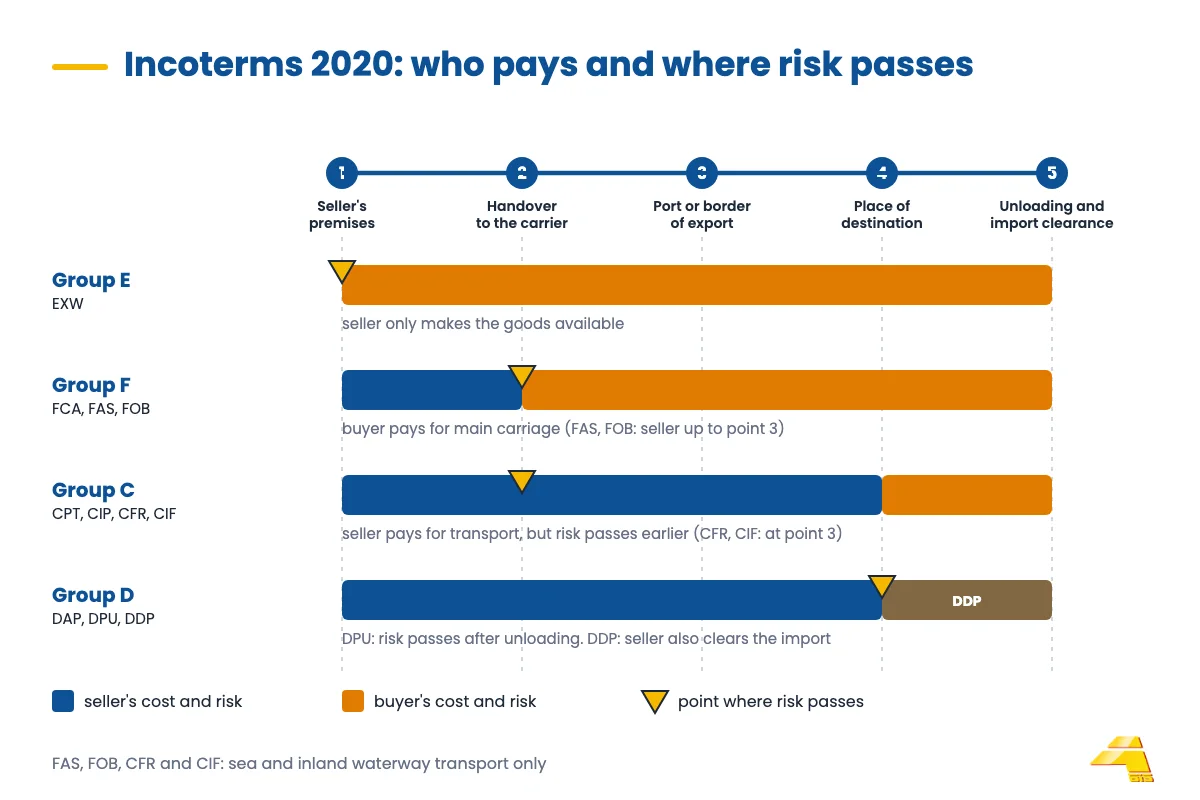
The first letter of the abbreviation tells you how far the seller’s obligations extend.
Group E is EXW alone. The seller makes the goods available at its own premises, and that is where its role ends. Everything after that, including loading and export clearance, is the buyer’s responsibility.
Group F (FCA, FAS, FOB) means that the buyer books and pays for the main carriage. The seller delivers the goods to the buyer’s carrier and handles export clearance.
Group C (CPT, CIP, CFR, CIF) is the one most often misunderstood. The seller pays for transport to the destination, but the risk passes to the buyer at the very start of the journey. If the load is damaged in transit, it is the buyer who pursues the claim, even though the buyer did not book the carrier.
Group D (DAP, DPU, DDP) transfers the risk only at the place of destination. The seller is responsible for the goods for the entire journey.
FCA, DAP, DDP and EXW: the four most commonly chosen rules
EXW looks like the simplest rule, because the seller does almost nothing. In practice, it creates a problem right at the loading dock: the goods are usually loaded by the seller’s forklift, yet the risk of that loading formally lies with the buyer.
FCA solves this problem. When the place of delivery is the seller’s premises, the seller loads the goods onto the vehicle sent by the buyer and clears them for export. When the place of delivery is somewhere else, e.g. a freight forwarder’s terminal, the seller brings the goods there with its own transport and unloading is the buyer’s job. Incoterms 2020 added an option under FCA to agree on a bill of lading with an on-board notation, which matters for letters of credit in sea freight.
DAP is the standard when the seller delivers the goods to the customer. The seller pays for carriage and bears the risk up to the place of destination, while the buyer unloads the truck and handles import clearance, if it is needed.
DDP is the opposite of EXW. The seller takes care of everything, including import clearance, duties and taxes in the buyer’s country. It is the maximum level of obligations, and it only makes sense if the seller really can handle an import in another country.
Which Incoterms rule to choose for FTL road freight in Europe
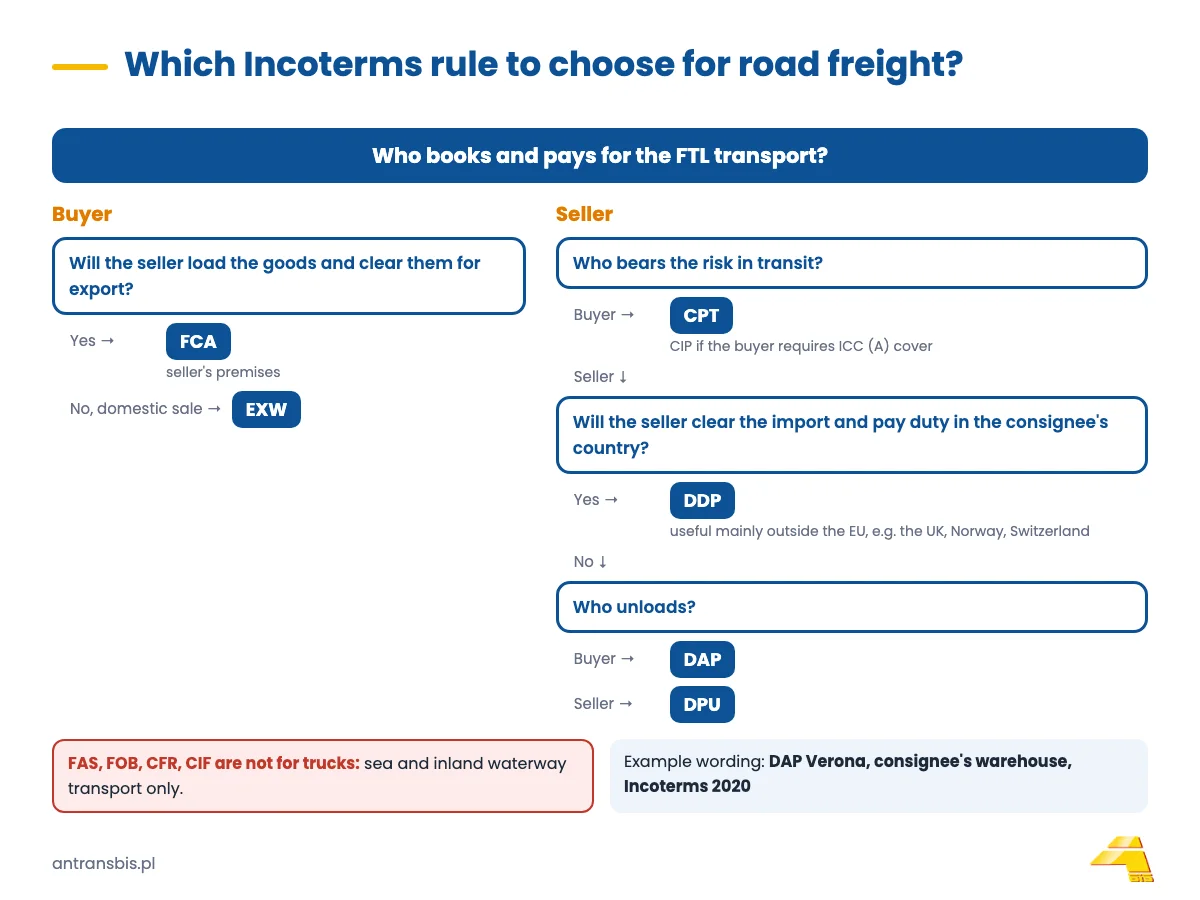
For full truckload transport by road, the choice usually comes down to two questions: who books the transport and who should bear the risk in transit.
The buyer books the transport: FCA instead of EXW
If your customer in Germany or Italy sends its own truck to collect the goods, specify FCA with the address of your premises. You load with your own forklift, so the loading risk should be on your side. When shipping outside the EU, for example to the UK, export clearance falls to you in practice anyway, as an EU-based company. FCA describes this honestly, EXW does not.
The seller books the transport: DAP instead of DDP
If you sell with delivery to the customer, DAP is the safest choice. There is no import clearance within the EU, so DDP adds little and may raise questions about tax settlement on the seller’s side. Outside the EU, DDP means that the seller becomes the importer in the consignee’s country. For road freight from Poland to the UK, this usually requires an EORI number valid in the country of import or a customs representative. Without one, the truck waits at the border, and someone has to pay for the waiting time.
When you book the carriage yourself on D terms, what counts is a fast and reliable price. We will quote FTL and LTL transport to Italy, Germany, France, Benelux or Scandinavia in our client zone. Indicative market rates are described in our article on how much international transport costs.
When to use CPT and when DPU
CPT is chosen by a seller who wants to book and pay for transport but does not want to bear the risk in transit. That is acceptable, but both parties need to know that in the event of damage, it is the buyer who will claim against the carrier. DPU makes sense when unloading is done by the seller’s side, for example a driver with a truck-mounted crane or an installation team. In a typical FTL load on a curtainsider, the consignee’s warehouse does the unloading, so DAP is a better fit.
Incoterms and the transport order
The rule from the sales contract should also go into the order for the carrier or freight forwarder. It determines who is party to the contract of carriage, who pays the freight invoice and whom the driver should call if there is a problem at unloading.
When booking transport, give your freight forwarder a few pieces of information that follow from the rule:
- who loads and who unloads the goods, and whether there is a forklift or loading dock on site,
- whether and where export or import clearance takes place, and who instructs the customs agent,
- the full address of the place of delivery, with the warehouse opening hours,
- the value of the goods, if the load is to be additionally insured,
- who pays for waiting time if the truck is held up at customs clearance or unloading.
With DAP to Italy, the forwarder then knows that the seller books and pays for the carriage and that unloading is up to the consignee. With FCA from a Polish plant, the forwarder knows that the client is the buyer and the seller will do the loading. Fewer phone calls en route mean less downtime and fewer disputes about who pays for the extra hours.
Common Incoterms mistakes in road transport
EXW for exports outside the EU is mistake number one. Formally, export clearance is then the job of the non-EU buyer, who usually cannot carry it out. In practice, the seller does it anyway, just without a clear provision in the contract.
FOB and CIF for truck transport is the second common mistake. Wording such as “FOB Kraków” or “CIF Milan” makes no sense, because under these rules the risk passes on board a vessel. If the goods travel by land, the equivalent of FOB is FCA and the equivalent of CIF is CIP.
A missing place and edition is the third problem. “DAP Germany” does not say whether this means the consignee’s warehouse, a terminal or the border. State the full address and add “Incoterms 2020”.
The fourth mistake is confusing Incoterms with the carrier’s insurance. The DAP rule does not mean that the load is insured. The carrier is liable for damage within the limits of the CMR Convention, and its risk is covered by carrier’s liability insurance (OCP). For valuable goods, the party bearing the risk should consider separate cargo insurance. The documents that have to travel with the load are listed in our guide to transport documents in road haulage.
Frequently asked questions
What does Incoterms mean?
Incoterms is short for International Commercial Terms, the international trade rules published by the International Chamber of Commerce (ICC). Each of the 11 rules defines who pays for transport, where the risk passes to the buyer and who handles customs clearance. They only apply if the parties write them into the contract.
What is the difference between DDP and DAP?
Under both rules, the seller delivers the goods to the place of destination and bears the risk up to that place. The difference concerns the import: under DAP, the buyer takes care of import clearance, duties and taxes, while under DDP the seller does. That is why DDP is chosen only when the seller can handle the import in the consignee’s country.
What is the difference between EXW and FCA?
Under EXW, the seller only makes the goods available at its premises, without loading and without export clearance. Under FCA, the seller loads the goods onto the buyer’s vehicle (when delivery takes place at the seller’s premises) and clears them for export. In international trade, FCA better reflects what the parties actually do at the loading dock.
When should you use DAP and when EXW?
DAP is chosen when the seller arranges transport to the customer and bears the risk in transit. EXW fits when the buyer collects the goods with its own transport and takes over all obligations from the seller’s factory gate. For exports, FCA usually works better than EXW.
Are Incoterms 2020 still valid?
Yes, in October 2026 the current edition is Incoterms 2020. The ICC is working on Incoterms 2030, which it plans to publish at the end of 2029. Until then, contracts refer to the 2020 version.
Do you have to state the Incoterms version in the contract?
Yes, because the editions differ in content, and the one named in the contract is binding. A complete entry contains the rule, the exact place and the edition, for example FCA, address of the seller’s premises, Incoterms 2020. Without the place, the rule loses its meaning, because it is unclear where the risk passes.
Sources
- ICC: Incoterms rules, main page of the rules (accessed 9 October 2026)
- ICC: Incoterms 2020, the rules and changes from the 2010 edition
- ICC Netherlands: Incoterms 2030, announcement of 31 August 2026
- ICC Austria: Incoterms 2030, work schedule
- Biznes.gov.pl (Polish government business portal): Incoterms, international terms of sale
- Trade.gov.pl (PAIH, Polish Investment and Trade Agency): Incoterms 2020
Have you agreed on DAP, CPT or DDP with your trading partner, and are you the one booking the carriage? Describe the load and the route in our client zone or call +48 666 666 863. During business hours we usually reply within 60 minutes, and we provide shippers with cargo insurance of 300,000 EUR per event.

Managing Director | Antrans BiS, Olkusz
Sebastian Szklarczyk has led the development of Antrans BiS, a transport company operating throughout Europe, for more than 15 years. He started as Head of the Freight Forwarding Department, gaining practical experience in organising international transport and managing a vehicle fleet on European routes.
As Managing Director, he is responsible for the strategic management of a company handling more than 21,000 transport operations a year on its main routes: Poland-Italy, Poland-Germany, Poland-Austria, Spain, the Benelux countries and Scandinavia. Under his leadership, Antrans BiS has expanded its fleet to 220 vehicles, including its own and partners’ vehicles, and achieved an on-time delivery rate of 98%.
Specialisms: international FTL transport throughout Europe, automotive and FMCG logistics, optimisation of European routes, road traffic regulations and driving bans in the EU, and transport documentation (CMR, VAT-UE, INTRASTAT).
On the Antrans BiS blog, he shares practical knowledge about international freight forwarding, transport regulations and the business aspects of running a transport, freight forwarding and logistics company in different European countries.