Truck transport price per km: what are the rates in 2026?
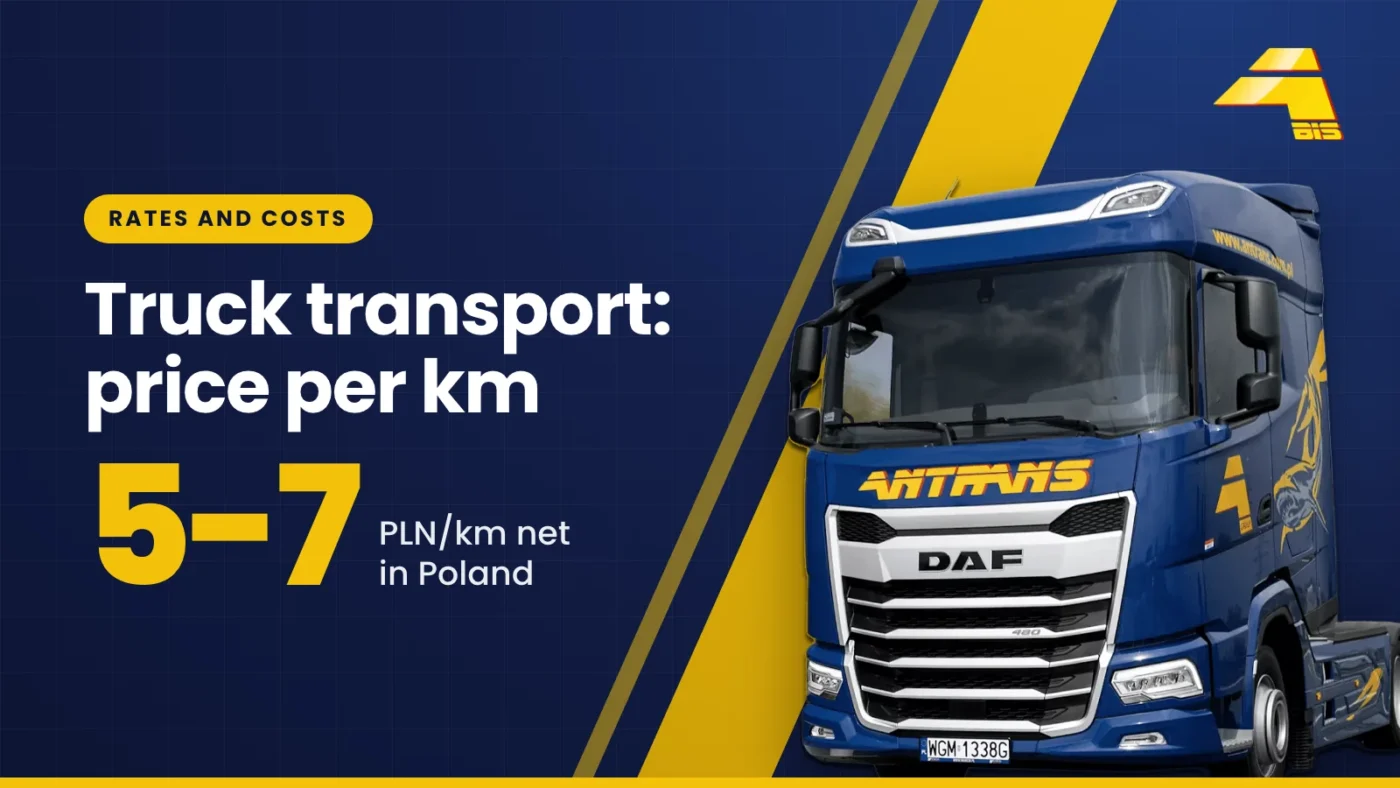
In 2026, truck transport costs on average 5 to 7 PLN net per kilometre for domestic jobs in Poland and 1.25 to 3.50 euros per kilometre for international transport. These rates apply to a standard articulated truck, i.e. a tractor unit with a semi-trailer and a gross vehicle weight of 40 tonnes, carrying palletised or bulk freight.
Two major changes are shaping truck transport prices per km in 2026. The first is the rise in Polish e-TOLL road tolls of around 35 percent from February 2026, combined with the extension of the tolled network by 645 kilometres to a total of around 5,869 kilometres. The second is the increase in the German Toll Collect system, where the rate for Euro 6 vehicles went up from 0.19 to 0.348 euros per kilometre, i.e. by 83 percent, following the introduction of a CO2 emissions component.
How much does truck transport cost per km in 2026?
In domestic transport within Poland, the price per km varies above all with the length of the route. Short distances of up to 150 kilometres carry a higher unit rate of 6 to 8 PLN per kilometre, because fixed costs such as preparing the vehicle and loading time are spread over fewer kilometres.
| Route length | Domestic rate (net) | What it means |
|---|---|---|
| Short route under 150 km | 6-8 PLN/km | Higher unit rate because of fixed costs |
| Medium route 150-400 km | 5-7 PLN/km | Typical domestic routes between major cities |
| Long route over 400 km | 4.5-6 PLN/km | Best value bracket, fixed costs spread more widely |
Medium routes of 150 to 400 kilometres, which dominate domestic transport between Poland’s main cities, cost 5 to 7 PLN per kilometre. Long routes of more than 400 kilometres get the most favourable rates of 4.5 to 6 PLN per kilometre, because the longer distance lets the carrier spread all its fixed costs more effectively.
In international transport, the price per km varies far more depending on the destination and the road tolls along the way. Central Europe, covering Germany, the Czech Republic, Slovakia, Hungary and Austria, comes in at 1.8 to 2.5 euros per kilometre. Western Europe, i.e. France, the Benelux countries and the United Kingdom, calls for a budget of 2.0 to 3.0 euros per kilometre.
Scandinavia is one of the most expensive destinations, at 2.2 to 3.5 euros per kilometre, because of ferry crossings and high operating costs in those countries. Eastern routes to Ukraine, Belarus or the Baltic states are the cheapest at 1.0 to 1.8 euros per kilometre, although they involve longer customs clearance times and greater operational risk.
A note on all-in prices. The rates quoted here are indicative market prices offered to shippers. Always check whether the rate includes Polish e-TOLL charges and foreign road tolls, or whether these are invoiced separately. The difference between an “all-in” offer and a “net excluding tolls” offer can be as much as 15-25 percent of the final price.
Sample prices for popular truck routes in 2026
Specific examples show the real cost of truck transport on the most frequently served domestic routes in Poland. The table below gives indicative prices for a standard tarpaulin semi-trailer carrying palletised goods.
| Domestic route | Distance | Rate | Net cost |
|---|---|---|---|
| Warszawa - Gdańsk | ~300 km | 5.5-7 PLN/km | 1,650-2,100 PLN |
| Warszawa - Kraków | ~290 km | 5.5-7 PLN/km | 1,600-2,030 PLN |
| Warszawa - Wrocław | ~350 km | 5-6.5 PLN/km | 1,750-2,275 PLN |
| Warszawa - Katowice | ~310 km | 5.5-7 PLN/km | 1,705-2,170 PLN |
| Gdańsk - Wrocław | ~450 km | 5-6.5 PLN/km | 2,250-2,925 PLN |
| Kraków - Poznań | ~420 km | 5-6.5 PLN/km | 2,100-2,730 PLN |
On international routes the price per km is considerably higher, mainly because of road tolls in Western European countries. The Warszawa - Berlin route of around 580 kilometres costs 1,160 to 1,624 euros net at a rate of 2.0 to 2.8 euros per kilometre. Warszawa - Amsterdam is around 1,200 kilometres and costs 2,400 to 3,360 euros net.
Long-distance routes such as Warszawa - Paris or Warszawa - Milan, each around 1,500 kilometres, require a budget of 3,300 to 4,500 euros net. The Warszawa - Madrid route of around 2,800 kilometres costs 7,000 to 9,800 euros net, which makes it one of the most expensive regularly served routes in Europe.
The prices shown are indicative market rates. The actual price per km in 2026 depends on current fuel costs, vehicle availability, the direction of the return load and seasonality. Always ask for a detailed quote that includes all additional costs.
Why are truck rates higher in 2026?
Truck transport prices per km have risen in 2026 compared with previous years because of three key cost changes. The first and most important is the reform of road tolls in Poland and in several Western European countries.
Change one: e-TOLL in Poland
From 1 February 2026, e-TOLL rates rose by an average of around 35 percent compared with 2025. Prices per km in 2026 reflect the increase in road tolls from around 0.30 PLN to 0.45-0.65 PLN per kilometre, depending on the road class and the vehicle category. In addition, the tolled network was extended by 645 kilometres of new sections, giving a total of around 5,869 kilometres covered by the toll system.
The new tolled sections include the A2 motorway between Kałuszyn and Siedlce and stretches of the S1, S3, S5, S7, S11, S12, S14, S16, S17, S52 and S61 expressways. A 500-kilometre trip on toll roads now costs an extra 75-95 PLN in e-TOLL charges compared with 2025. Projected budget revenue from e-TOLL is set to rise from 3.9 billion PLN in 2025 to 6.6 billion PLN in 2026, an increase of 70 percent.
Change two: Toll Collect in Germany
Germany’s Toll Collect system has added a CO2 emissions component to the toll calculation. For Euro 6 vehicles, the rate rose from 0.19 to 0.348 euros per kilometre, an increase of 83 percent. Vehicles registered before July 2019 were placed in the most expensive emission class.
Similar increases were introduced in Austria and the Czech Republic from March 2024. On the Warszawa - Berlin route, where around 400 kilometres run on German motorways, this now means around 60 euros more in Toll Collect charges than in 2023. That feeds directly into higher rates for all transit traffic through Germany.
Change three: structural market factors
Truck transport prices per km are also rising for reasons not directly linked to road tolls. A demographic staffing crisis in the transport and logistics sector is causing a driver shortage, which pushes up wages and labour costs. Carriers are cautious about investing in new vehicles because of high prices and market uncertainty, and this reduces the capacity available.
Carriers have changed their mindset from “drive as much as possible” to “drive at a profit”, which means fewer cheap spot offers on the market. The 2026 rates per km reflect a more rational economic approach by transport companies, which are no longer willing to work at the edge of profitability or below their own costs.
What makes up a truck rate? The carrier’s cost structure
Understanding a carrier’s cost structure helps you judge which offers are realistic and which may lead to problems with service quality. For a combination with a Euro 6 engine, the 2026 price per km is built from the following cost components.
| Cost category | Cost per 1 km | Share of total |
|---|---|---|
| Fuel (diesel) | 2.0-2.8 PLN | ~40% |
| e-TOLL and road tolls | 0.35-0.60 PLN | ~10% |
| Driver pay incl. travel allowances | 0.9-1.5 PLN | ~22% |
| Leasing / vehicle depreciation | 0.5-0.8 PLN | ~12% |
| Insurance (motor liability, own damage, carrier’s liability OCP) | 0.15-0.25 PLN | ~4% |
| Servicing, tyres, repairs | 0.20-0.35 PLN | ~5% |
| GPS, administration, other | 0.15-0.25 PLN | ~4% |
| TOTAL own costs | 4.25-6.55 PLN | 100% |
| + Carrier margin 10-20% | 0.45-1.30 PLN | |
| = Market rate | ~5-7 PLN/km |
Fuel is the largest single item in the cost structure, at 2.0 to 2.8 PLN per kilometre. The price per km is very sensitive to swings in diesel prices, because an articulated truck uses 28 to 35 litres per 100 kilometres. Every 0.10 PLN change in the price per litre translates into a change of around 0.03 to 0.04 PLN in the cost per kilometre.
The e-TOLL system is the second-largest cost item at 0.35 to 0.60 PLN per kilometre after the February 2026 increase. The price per km also covers the pay of a category C+E driver holding a Driver CPC (Certificate of Professional Competence), which costs 0.9 to 1.5 PLN per kilometre in domestic transport. On international routes, labour costs are higher because of foreign travel allowances.
The key problem of empty running
The price per km is significantly higher on routes with no chance of finding a return load. Coming back with an empty trailer doubles the unit cost of the job, because the carrier has to cover the costs of both directions from the revenue of a single trip. That is why the Poland - Spain route is more expensive than Spain - Poland, where a return load is easier to find.
Seven key factors that affect truck transport prices
The price per km is not fixed and depends on many market variables. Knowing these factors helps you plan your logistics budget better and negotiate more favourable terms.
1. Route length and economies of scale
The longer the route, the lower the rate per kilometre, because fixed costs are spread more widely. Over 150 kilometres the price is around 7-8 PLN per km, while a 500-kilometre route costs just 5-6 PLN per kilometre. Fixed costs such as preparing documents, loading and positioning the vehicle are the same whatever the length of the route.
2. Fuel price fluctuations
Fuel accounts for around 40 percent of a carrier’s own costs. The price per km reacts immediately to changes in diesel prices. A rise of 0.10 PLN per litre of diesel pushes the rate up by around 0.03-0.04 PLN per kilometre. Many companies use a fuel adjustment mechanism that automatically aligns rates with current pump prices.
3. Domestic and foreign road tolls
The 35 percent e-TOLL increase from February 2026 has a direct impact on truck transport prices per km. An extra 0.15-0.19 PLN per kilometre on toll roads is a significant cost increase. In Germany, Toll Collect currently charges 0.348 euros per kilometre for Euro 6 vehicles, which makes routes through Germany particularly expensive.
4. Type of cargo and special requirements
A standard palletised load in a tarpaulin trailer sets the base price. For ADR dangerous goods, the price per km is 20-50 percent higher because of certificates, training and the obligation to appoint a dangerous goods safety adviser (DGSA). Refrigerated transport costs 15-30 percent more, because the refrigeration unit burns an extra 3-5 litres of fuel per hour.
5. Lane balance and return loads
The chance of a return load brings the price down dramatically. Truck transport from Germany to Poland is cheaper than from Poland to Germany, because the eastbound direction is better balanced. Routes to Spain or Portugal with no guaranteed return load can be 30-40 percent more expensive.
6. Seasonality and fluctuating demand
The fourth quarter is the peak of the transport season. From October to December, prices per km rise by 15-30 percent because of pre-Christmas shopping and limited vehicle availability. January and February are the cheapest months, with the lowest demand of the whole year.
7. Lead time and urgency
Express transport delivered within 24 hours costs 20-40 percent more. For last-minute orders, the price per km reflects the need to disrupt the carrier’s schedule or provide an additional truck. Planning 3-5 days ahead gets you the best rates.
FTL versus LTL
The price per km applies mainly to FTL (full truckload), where the whole vehicle is at the disposal of one customer. The job is charged per kilometre driven or as a flat rate per trip. This model is best for loads over 15 tonnes or 20 Euro pallets, where transit usually takes 1-2 days and the cargo stays safe with no transhipment.
LTL (less than truckload) means part loads or groupage, where several shippers share space in one trailer. The rate per km does not apply to LTL, because charges are based on pallets, loading metres or tonnes of goods. This system is best for shipments under 8-10 tonnes or 15 pallets, where a transit time 1-3 days longer is acceptable. We show how to calculate loading metres and compare the two services using the example of 6 and 18 Euro pallets in our article on FTL and LTL transport.
A practical rule of thumb: with 15-16 pallets or more, FTL transport is the more economical choice. FTL pricing per km also gives you full control over timing and routing. With fewer than 10 pallets, LTL is worth considering, as it is 30-50 percent cheaper, although it involves transhipment and longer delivery times.
How to calculate the cost of truck transport: formula and examples
Calculating the cost of transport means taking into account not only the rate per kilometre but also a range of additional charges. The price per km is the base, to which extra items are added depending on the specifics of the order.
Basic formula:
Total cost = (Number of kilometres × Rate per km) + Additional charges
Additional charges in truck transport include the following items. Loading and unloading cost 100 to 400 PLN per stop if they are not included in an all-in rate. Waiting time beyond the free period, which is usually 1-2 hours, costs 50 to 150 PLN per hour. Cargo insurance costs 0.1 to 0.3 percent of the value of the goods and may be required by the shipper or the insurer.
A fuel surcharge is applied when diesel prices rise sharply and can amount to 5 to 15 percent of the base rate. For ADR dangerous goods, the price per km also includes a surcharge of 20 to 50 percent or a flat fee of 500 to 2,000 PLN per domestic trip.
Example 1: simple domestic transport
Route: Warszawa → Wrocław, 360 km, rate 6 PLN/km all-in
Cost = 360 × 6 = 2,160 PLN net
Polish VAT 23% = 497 PLN
Total gross: 2,657 PLN
Example 2: domestic transport with surcharges
Route: Gdańsk → Kraków, 560 km, rate 5.5 PLN/km + unloading 200 PLN
Cost = (560 × 5.5) + 200 = 3,080 + 200 = 3,280 PLN net
Polish VAT 23% = 754 PLN
Total gross: 4,034 PLN
Example 3: international transport
Route: Warszawa → Paris, 1,500 km, rate 2.5 EUR/km all-in
Cost = 1,500 × 2.5 = 3,750 EUR net
International transport invoiced in euros is zero-rated for Polish VAT (0%)
Always ask the carrier for an all-in quote that covers every cost. A “bare” rate per km without e-TOLL and additional charges may look attractive, but the final price will turn out much higher once all the components are added.
How to negotiate truck transport rates: five effective methods
Companies that ship regularly can get much better terms than those buying on the spot market. There is room to negotiate the price per km when certain conditions are met.
Plan your transport in advance
Booking a vehicle at the last minute raises the price per km by 20-40 percent because of organisational costs and risk. Placing the order 3-7 days ahead gives the carrier time to plan a return load and optimise the route, which means a lower rate for you.
Offer regular loads under a contract
Steady business of 3-5 full trailers a month is a strong argument for a 10-20 percent rate reduction. An annual contract with a guaranteed minimum volume gives you the lowest rates on the market and the certainty of vehicle availability in peak season.
Be flexible on dates and days of the week
Tuesday and Wednesday are the days with the best vehicle availability and lower spot rates. Prices per km are highest on Monday mornings and Friday afternoons because of peak demand at the start and end of the working week. Flexibility on the loading date can cut the price by 10-15 percent.
Give accurate cargo details
Precise information on weight, number of pallets and dimensions removes the carrier’s uncertainty buffer. The price per km is lower when the shipper provides real data instead of estimates with a wide margin. Declaring 24 tonnes when the actual weight is 20 tonnes means paying for unused capacity.
Use freight exchanges and compare offers
Platforms such as Trans.eu, Timocom and LOAD24 give you access to carriers looking for return loads. Prices per km on freight exchanges can be 10-30 percent lower than rates quoted over the phone, especially for available trucks heading back with an empty trailer. Always check references and OCP insurance certificates before placing an order, though.
Red flags when choosing a carrier
A price per km more than 30 percent below the market average is a warning sign. It may point to problems with insurance, licensing or service quality. The absence of mandatory carrier’s liability insurance (OCP) is an absolute reason to reject an offer, even if the price looks attractive.
Find the best offer for truck transport
Looking for a reliable carrier for regular domestic or international routes? Your price per km can be much lower when you work with the right logistics partner. Contact us and see how easy it is to organise professional full truckload transport.
Useful articles: How to start a transport company in Poland in 8 steps | How to get haulage work: 5 effective ways to win new loads | Road transport grants in Poland: funding for transport businesses in 2026 | Transport documents in road haulage in 2026
FAQ: common questions about truck transport prices per km in 2026
Below you will find answers to the most common questions about truck transport prices per km in 2026. We have gathered the key information on current rates, the factors that affect transport costs and how domestic and international routes are priced.
How much does truck transport cost per kilometre in 2026?
In 2026, domestic truck transport in Poland costs on average 5 to 7 PLN net per kilometre. On short routes of up to 150 km, rates are usually higher and reach 6-8 PLN/km. On long routes over 400 km, the price more often drops to 4.5-6 PLN/km. The final quote also depends on road tolls, the type of cargo and the lead time.
How much does international truck transport cost per km?
International truck transport in 2026 usually costs 1.25 to 3.50 euros per kilometre. Eastern destinations tend to be the cheapest, while Scandinavia and Western Europe are the most expensive. Foreign road tolls, the length of the route and the chance of finding a return load all have a big impact. The destination country and the current market situation also matter.
What does the price per km of truck transport depend on?
The price per km depends mainly on route length, fuel and road tolls. Cargo type, season, urgency of the order and vehicle availability also play a part. Higher rates apply to ADR and refrigerated transport and to routes with no return load. The price also depends on whether the offer is all-in or whether additional costs have to be added on top.
Are road tolls already included in the rate per kilometre?
The price per km does not always include e-TOLL and foreign road tolls. Some carriers quote an all-in rate, others only a base price per kilometre. That is why you need to check before placing an order whether the offer already covers all costs. The difference between the two can easily reach double-digit percentages of the total quote.
How do you calculate the cost of truck transport on a specific route?
The simplest way is to multiply the number of kilometres by the rate per kilometre and add any additional charges. These surcharges may include loading, unloading, waiting time, cargo insurance or a fuel surcharge. In practice, it is best to ask for a full all-in quote. This makes it easier to compare offers and avoid hidden costs.
How can you lower the price per km of truck transport?
You can lower the price per km by planning the order in advance and providing accurate cargo details. Better rates are also available for regular business or a flexible loading date. The direction of the route and the chance of arranging a return load matter too. In practice, it is best to compare several offers, but not to automatically go for the cheapest.

Managing Director | Antrans BiS, Olkusz
Sebastian Szklarczyk has led the development of Antrans BiS, a transport company operating throughout Europe, for more than 15 years. He started as Head of the Freight Forwarding Department, gaining practical experience in organising international transport and managing a vehicle fleet on European routes.
As Managing Director, he is responsible for the strategic management of a company handling more than 21,000 transport operations a year on its main routes: Poland-Italy, Poland-Germany, Poland-Austria, Spain, the Benelux countries and Scandinavia. Under his leadership, Antrans BiS has expanded its fleet to 220 vehicles, including its own and partners’ vehicles, and achieved an on-time delivery rate of 98%.
Specialisms: international FTL transport throughout Europe, automotive and FMCG logistics, optimisation of European routes, road traffic regulations and driving bans in the EU, and transport documentation (CMR, VAT-UE, INTRASTAT).
On the Antrans BiS blog, he shares practical knowledge about international freight forwarding, transport regulations and the business aspects of running a transport, freight forwarding and logistics company in different European countries.