PKD 49.41.Z for a transport company in Poland
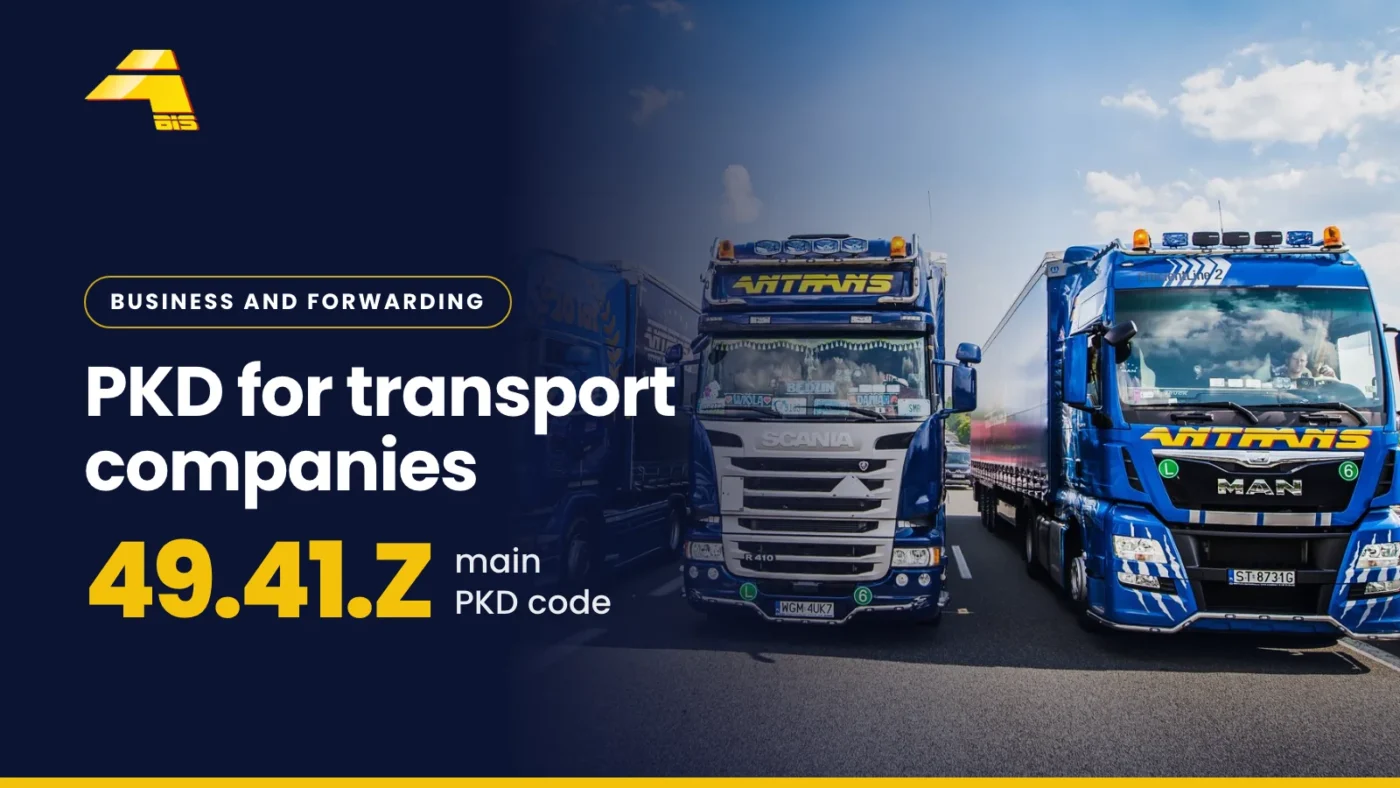
For most transport companies that carry goods, the right code is PKD 49.41.Z, but it is not the only option and not every activity fits under it. The wrong PKD code is more than a formal slip in the registration: for a transport company it means a real risk of problems with tenders, grants, VAT settlements and tax audits. What a transport company does and how it differs from freight forwarding is explained in a separate guide.
Every business in Poland has to state its PKD code when it registers, both in CEIDG (the Polish business register for sole traders) and in KRS (the National Court Register for companies). The legal basis for the classification is the Regulation of the Council of Ministers of 24 December 2007 (Journal of Laws, Dz.U. No. 251, item 1885). Since 1 January 2025 an updated version has applied under the Regulation of 18 December 2024 (Dz.U. item 1936), but code 49.41.Z has not changed at all and remains the main code for the TSL (transport, shipping and logistics) sector.
This article answers your questions about what exactly PKD 49.41.Z covers, when you need additional codes, how to declare PKD codes correctly when registering a transport company and what tax consequences come with that choice.
What is a PKD code and why does it matter for a transport company?
PKD (Polska Klasyfikacja Działalności, the Polish Classification of Activities) is the official system for classifying types of business activity and the Polish counterpart of the EU’s NACE classification. It is used for the REGON number (the Polish statistical business ID) and for statistical and accounting purposes. Every transport company in Poland has to state at least one PKD code on registration and use it in official documents.
PKD has a five-level structure. It starts with a section marked by a letter, then moves through a division (two digits), a group (three digits) and a class (four digits), down to a subclass marked with five characters. For a transport company that carries goods, the full path looks like this: Section H is Transportation and storage, Division 49 is Land transport, Class 49.41 is Freight transport by road, and Subclass 49.41.Z is the final code that appears in the register.
Why does the choice of PKD code have real consequences for a transport company? First, issuing an invoice for a service that is not covered by a registered PKD code breaches the rules and exposes the company to the tax office challenging its costs. Second, the PKD code directly determines access to grants and tenders, because most support programmes and requests for quotation are aimed at companies with a specific PKD subclass. Third, PKD affects the obligation to register for VAT, the use of a fiscal cash register and the forms of taxation available to you.
What exactly does PKD 49.41.Z cover for a transport company?
PKD 49.41.Z is the subclass officially named “Freight transport by road” (in Polish: Transport drogowy towarów), and it is the PKD code most often chosen by transport companies in Poland. It covers a wide range of services, and its breadth often surprises new business owners.
This code covers the transport of heavy goods, bulk cargo and long loads, the carriage of live animals, the transport of frozen and chilled goods in refrigerated vehicles, tanker transport (including milk collected from farms), the transport of cars on car transporters, the transport of waste and recyclable materials, truck hire with a driver, and even transport by human-powered or animal-drawn vehicles.
One of the most important features of this PKD code for a transport company is that it covers both domestic and international transport. There is no separate code for international routes, for FTL or for LTL. A company delivering all over Europe operates under the same PKD code as a carrier that serves local routes only.
Scope of PKD code 49.41.Z
Transport of heavy and bulk goods, reefers, tankers, car transporters, waste, truck hire with a driver, domestic and international transport, FTL and LTL. One code covers the entire freight transport sector.
What PKD 49.41.Z does not cover
When you choose a PKD code for a transport company, what a code leaves out matters just as much as what it includes. Several typical activities that intuitively feel like transport have been assigned to entirely different subclasses.
Distributing water by tanker belongs to code 36.00.Z, not 49.41.Z. Waste transport that is an integral part of waste collection is classified under codes 38.11.Z or 38.12.Z. Operating cargo handling terminals is 52.21.Z. Packing goods for transport is classified under group 52.29. Courier and postal activities fall under subclasses 53.10.Z or 53.20.Z. Vehicle hire without a driver belongs to groups 77.1 or 77.3. Maintenance and repair of vehicles is code 45.20.Z.
If your transport company provides any of these services as a separate business line, you should register the appropriate additional PKD code before you issue the first invoice for it.
Which PKD codes should a transport company choose?
The TSL sector is broad, and not every transport company is limited to moving goods by truck. Below we have put together a complete map of the PKD codes that most often apply to transport and logistics companies in Poland.
| PKD code | Name | When to use it |
|---|---|---|
| 49.41.Z | Freight transport by road | The main PKD code for any transport company carrying goods. Covers domestic and international transport. |
| 49.42.Z | Removal services | Transport companies that offer home and office moves. Often combined with 49.41.Z. |
| 49.39.Z | Other non-scheduled passenger transport | Excursions, school and staff minibuses, airport transfers. The most common code for minibus operators. |
| 49.31.Z | Urban and suburban passenger land transport | Regular routes running to a timetable. Requires a separate permit for regular passenger services. |
| 53.20.Z | Other postal and courier activities | Parcels, express shipments, e-commerce deliveries. Used by courier companies. |
| 52.29.C | Activities of other transport agencies | Freight forwarding and transport brokerage. The core PKD code for a freight forwarder, not a carrier. |
| 52.10.B | Warehousing and storage of other goods | Transport companies that run their own warehouse or offer storage as an additional service. |
| 52.21.Z | Service activities incidental to land transport | Transhipment terminals, truck parks, transport infrastructure services. |
PKD for road freight transport: when is 49.41.Z not enough?
PKD 49.41.Z on its own is enough if your transport company only carries goods. Problems start when you expand into new services or plan a broader business from day one.
Add 49.42.Z to 49.41.Z before you earn your first revenue from removals. Both codes can run side by side in CEIDG without any restrictions.
Freight forwarding has a completely different PKD code from carriage. A transport company that also acts as a freight forwarder has to register code 52.29.C. Without it, an invoice issued for organising transport may be challenged.
Warehousing requires code 52.10.B. Transport companies that grow by adding their own warehouses often skip this step, which becomes a problem at the first audit or grant application.
If you serve e-commerce and deliver parcels to private customers, you should consider adding code 53.20.Z alongside the core 49.41.Z.
The key rule for every transport company is simple: additional codes are registered before you earn the first revenue from a new service, not after the invoice has been issued. Changing the PKD code retroactively does not remove the tax risk attached to earlier transactions.
PKD codes for passenger and specialist transport
Passenger transport follows different rules from freight and requires different PKD codes, licences and a different approach to fiscal cash registers. The two most frequently confused codes are 49.31.Z and 49.39.Z.
Code 49.31.Z covers urban and suburban passenger land transport, i.e. buses and minibuses running to a timetable on fixed routes. It requires a permit for regular passenger services and is rare among private transport companies. 49.39.Z, on the other hand, covers other non-scheduled passenger transport, and this is the core PKD code for minibus operators and for companies offering excursions, airport transfers, school and staff transport. It does not require a permit for regular services, but it is still subject to a passenger transport licence.
Transport companies moving into the passenger segment should remember that passenger transport comes with the obligation to use a fiscal cash register from the first sale to private individuals who do not run a business, with no turnover threshold at all.
Main PKD code vs additional PKD codes
Every transport company has one main PKD code, the one that generates the largest share of its revenue. This code is listed first in the register, and for a transport company carrying goods it should be code 49.41.Z from Section H. Besides the main code, you can register any number of additional codes.
The rules differ, however, depending on the legal form of the transport company. For sole proprietorships (JDG) and civil-law partnerships, which are registered in CEIDG, the number of additional codes is unlimited. You enter them in section 06.2 of the CEIDG-1 form and can change them free of charge at any time via biznes.gov.pl (the Polish government business portal).
For limited liability companies (sp. z o.o.) and other companies registered in KRS, there is a limit of 10 PKD codes disclosed in the register. What is more, the codes must match the business objects set out in the articles of association. Adding a code outside those objects means amending the articles, which involves notary fees. This is an important difference to consider as early as the drafting of the articles, especially if you plan to expand your transport company into logistics and warehousing services.
A trap for limited companies
If your transport company is a limited liability company (sp. z o.o.) and you want to add a new PKD code that falls outside the business objects in the articles of association, filing with KRS alone is not enough. You first have to amend the articles before a notary, which costs anything from a few hundred to a few thousand PLN depending on the scope of the changes.
How do you declare PKD codes when registering a transport company?
The process depends on the legal form, but in both cases choosing the PKD code for a transport company is one of the first steps of registration.
Sole proprietorship and civil-law partnership via CEIDG
You register via biznes.gov.pl with a trusted signature (the free Polish e-ID signature) or a qualified electronic signature, in person at the municipal office or by registered post. In the CEIDG-1 form you fill in section 06.2, entering the main code first. For a transport company carrying goods, the main code is 49.41.Z. Below it you can add any number of additional codes. Registration is free, and changing the codes later costs nothing either.
Limited liability company and other companies via KRS
PKD codes are disclosed in KRS when the company is registered. Remember the limit of 10 codes and the requirement that they match the business objects in the articles of association. If you are planning a transport company that offers freight forwarding and warehousing alongside carriage, include the relevant codes in the articles from the start. Amending the articles after registration costs money.
Additional requirements for a transport company with vehicles over 3.5 t
Entering the PKD code is not the whole story. A transport company operating vehicles with a GVW above 3.5 t needs a permit issued by the starosta, the head of the district administration (1,000 PLN for the first permit, 100 PLN for each additional vehicle, 10 PLN per certified copy), as well as a national transport licence or, for international transport, a Community licence issued by GITD (the Polish Road Transport Inspectorate). Vehicles up to 3.5 t do not require a licence.
PKD codes, taxes, VAT and cash registers in a transport company
For a transport company, the PKD code is not just a registration formality. It has a direct impact on tax settlements, the obligation to register for VAT and access to preferential forms of taxation.
As far as VAT is concerned, services provided under PKD 49.41.Z to other businesses, i.e. in the B2B model, are taxed at 23%. Registering as an active VAT payer is strongly recommended, because clients in the TSL sector are almost exclusively VAT-registered businesses that want to deduct input VAT. Transport companies can use the small business VAT exemption until their turnover exceeds 200,000 PLN a year, but in practice the sector rarely takes advantage of it.
A fiscal cash register becomes mandatory for a transport company providing services to private individuals once revenue from such transactions exceeds 20,000 PLN a year. In B2B transport this obligation rarely arises, but companies serving private customers have to keep an eye on it.
For transport companies paying the Polish lump-sum tax on recorded revenue, the rate for services under PKD 49.41.Z is 8.5% on revenue up to 100,000 PLN a year and 12.5% on the excess above that amount. A lump-sum taxpayer also has to determine the correct PKWiU symbol (Polish Classification of Products and Services) for tax purposes, which is a separate step from registering the PKD code.
Finally, grants. Most support programmes for transport companies, including grants from PUP (Polish district labour offices) and LGD (Local Action Groups) as well as public tenders, require a specific PKD code as an eligibility condition. A company without 49.41.Z registered has practically no chance of funding from sector programmes.
How do you change or add a PKD code in a transport company?
A transport company needs to update its PKD code more often than owners expect when they set up the business. A change is necessary before you earn the first revenue from a new service, when you expand into freight forwarding or warehousing, and when you change the main profile of your transport company. The rules give you 7 days from the date of the change.
In CEIDG the change is simple, free and fully online via biznes.gov.pl. All you need to do is log in with your trusted profile or a qualified signature, edit section 06.2 and submit the update. The new code appears in the register on the next working day. The number of codes remains unlimited.
In KRS the change is more expensive. If the new PKD code falls within the business objects described in the articles of association, a filing with the register is enough. If it goes beyond them, the articles have to be amended first, which requires a notarial deed or minutes of the shareholders’ meeting. The limit of 10 codes disclosed in KRS still applies.
The non-negotiable rule
Changing the PKD code retroactively, after issuing an invoice under a code that was not registered, does not remove the tax risk. The tax office may challenge that invoice and refuse to recognise the cost on the client’s side. The rule is simple: register the PKD code first, then provide the service and issue the invoice.
Register your company and start taking on loads
Once you have chosen your PKD code and know how to register a transport company, the next step is to understand what the business really costs and when it starts to make money. Read the article Running a transport company: earnings and costs in the industry, where we break down the full structure of fixed and variable costs, typical margins and the break-even point for a small fleet.
It is also worth reading Transport documents in road haulage in 2026 well in advance. The right PKD code opens the door to orders and tenders, but from your very first job you need a full set of documents: the CMR consignment note, the delivery note (WZ), the licence carried in the vehicle and others that a roadside inspection can check at any time. How to fill in a CMR consignment note is explained in a separate guide.
The right PKD code is the foundation of operating legally and a condition for access to orders, tenders and grants. Once the paperwork is behind you, it is time for your first loads. See how we connect carriers with regular shippers.
FAQ: common questions about PKD codes for transport companies
The most common questions about PKD codes for a transport company. Below you will find answers to the questions most often asked by people setting up a transport company or expanding it with new services.
Does PKD 49.41.Z cover international transport?
Yes, a transport company with PKD code 49.41.Z can legally carry out both domestic and international transport. There is no separate PKD code for international transport or for specific routes. The difference only appears at licence level: international transport requires a Community licence issued by GITD, while domestic transport only requires a permit from the starosta for vehicles over 3.5 t.
How many PKD codes can a transport company have?
It depends on the legal form. Sole proprietorships and civil-law partnerships registered in CEIDG can have an unlimited number of PKD codes, free of charge. Companies registered in KRS have a limit of 10 codes disclosed in the register. In both cases the codes must reflect the activity actually carried out and should not be added just in case.
Can you change the PKD code once your transport company is up and running?
Yes, you can change the PKD code of an operating transport company at any time. In CEIDG the change is free and takes effect on the next working day after you file it via biznes.gov.pl. In KRS it can be costly if it requires amending the articles of association first. Remember that the change has to be made before you issue the first invoice for the new activity, not after the fact.
Does a transport company have to be registered for VAT?
Formally, a transport company can use the small business VAT exemption until its turnover exceeds 200,000 PLN a year. In practice, however, almost no carrier uses this exemption, because clients in the TSL sector are VAT-registered businesses that want to deduct the VAT on transport invoices. Issuing invoices without VAT means the client has nothing to deduct, which in many cases rules the transport company out of tenders and requests for quotation.
Which PKD code should a transport company with vehicles up to 3.5 tonnes choose?
A transport company carrying goods in vehicles up to 3.5 t uses the same PKD code 49.41.Z as carriers operating heavy trucks. The code does not distinguish between vehicle weights. The difference lies only in the licensing requirements, because vehicles up to 3.5 t are exempt from the obligation to hold a transport licence. However, if you provide courier services or parcel deliveries, it is worth adding code 53.20.Z as a supplementary code.
Do a freight forwarder and a carrier have the same PKD code?
No, a freight forwarder and a carrier have different PKD codes because they carry out different activities. A carrier that physically performs the transport registers code 49.41.Z. A freight forwarder that organises transport and acts as an intermediary between the shipper and the carrier should register code 52.29.C. A transport company that is both a carrier and a freight forwarder should have both codes registered before it invoices either type of service.

Managing Director | Antrans BiS, Olkusz
Sebastian Szklarczyk has led the development of Antrans BiS, a transport company operating throughout Europe, for more than 15 years. He started as Head of the Freight Forwarding Department, gaining practical experience in organising international transport and managing a vehicle fleet on European routes.
As Managing Director, he is responsible for the strategic management of a company handling more than 21,000 transport operations a year on its main routes: Poland-Italy, Poland-Germany, Poland-Austria, Spain, the Benelux countries and Scandinavia. Under his leadership, Antrans BiS has expanded its fleet to 220 vehicles, including its own and partners’ vehicles, and achieved an on-time delivery rate of 98%.
Specialisms: international FTL transport throughout Europe, automotive and FMCG logistics, optimisation of European routes, road traffic regulations and driving bans in the EU, and transport documentation (CMR, VAT-UE, INTRASTAT).
On the Antrans BiS blog, he shares practical knowledge about international freight forwarding, transport regulations and the business aspects of running a transport, freight forwarding and logistics company in different European countries.