How much does it cost per km to transport 10 tonnes in 2026?
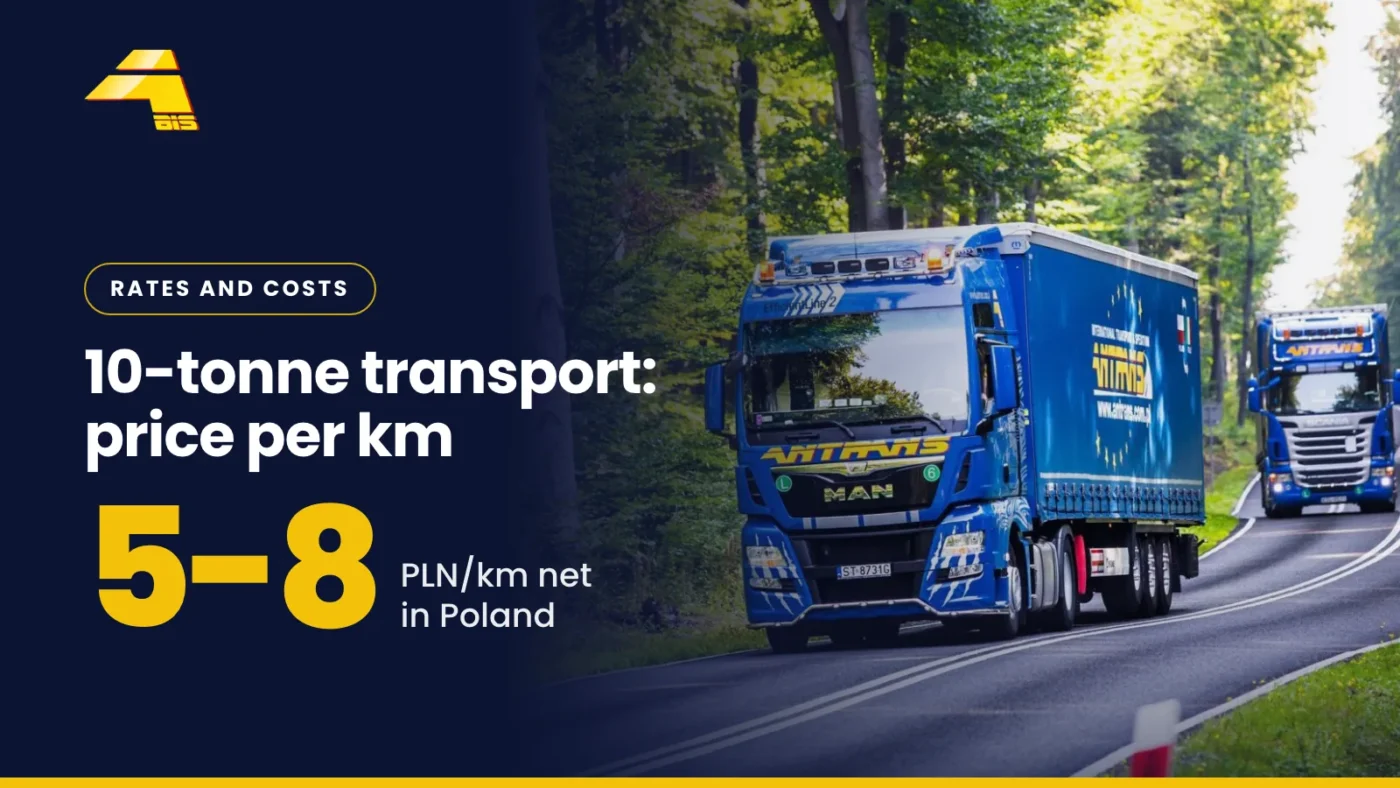
In 2026, transporting 10 tonnes within Poland costs on average 5 to 8 PLN net per kilometre with a rigid truck. On international routes, rates range from 1.5 to 2.5 euros per kilometre. These prices apply to standard loads carried by a single-unit (rigid) vehicle of category N2 or N3.
Prices for moving 10 tonnes per km are rising in 2026 because of three key factors. The first is an increase of about 40% in e-TOLL rates (Poland’s electronic toll system), with viaTOLL now covering a further 645 kilometres of new roads. The second is higher driver labour costs caused by the shortage of drivers. The third is the new EU rules introduced by the Mobility Package and the inclusion of CO2 emission standards in road tolls. In Germany, the Toll Collect system has raised rates by 83% for Euro 6 vehicles.
What vehicle is used to transport 10 tonnes?
A 10-tonne load is most often carried by a rigid truck, i.e. a single-unit vehicle of category N2 or N3 with a gross vehicle weight (GVW) of 12 to 18 tonnes. The payload of such a vehicle is usually 8 to 12 tonnes, depending on its kerb weight and equipment. It is the best choice for loads that do not need a full-size semi-trailer.
An alternative for smaller loads is a van with a trailer driven on a category B+E licence. This configuration can carry 6 to 10 tonnes and is becoming increasingly popular following the changes introduced by the Mobility Package in 2026. The advantage of a B+E combination is that it can be driven by drivers without a category C licence and costs less to run than a truck.
For bulky loads weighing 10 tonnes, you may need a tractor unit with a shorter semi-trailer, although a standard 13.6-metre semi-trailer is not necessary. A rigid truck is much cheaper to run than a full articulated HGV, which is why carriers offer lower rates per kilometre. However, the payload limit of a rigid means that above 12 tonnes it becomes more cost-effective to use a tractor unit with a semi-trailer.
| Vehicle type | Payload | Indicative domestic rate per km (Poland) |
|---|---|---|
| Van with trailer (B+E) | 6 - 10 tonnes | 4.5 - 7 PLN/km net |
| Rigid truck | 8 - 12 tonnes | 5 - 8 PLN/km net |
| Tractor unit with semi-trailer (HGV) | up to 24 tonnes | 5 - 7 PLN/km net (domestic) |
How much does it cost per km to transport 10 tonnes in Poland in 2026?
Domestic rates for 10-tonne transport in 2026 depend primarily on the length of the route. The longer the route, the lower the rate per kilometre, because the carrier’s fixed costs are spread over more kilometres. This is a fundamental principle of pricing in road haulage.
Short routes of up to 150 kilometres cost between 6 and 9 PLN net per kilometre. The higher rates are due to fixed costs such as vehicle preparation, loading and unloading being spread over a short distance. Medium routes of 150 to 400 kilometres cost 5 to 7 PLN net per kilometre. Long routes over 400 kilometres fall into the most favourable price band of 4.5 to 6 PLN net per kilometre, as the longer distance makes it easier to absorb all costs.
Specific routes with estimated costs for transporting 10 tonnes in 2026 show the real expenses you can expect on the market:
- Warsaw - Gdańsk (approx. 300 km) costs 1,500 to 2,100 PLN net, i.e. 5 - 7 PLN per kilometre on average
- Warsaw - Kraków (approx. 290 km) requires a budget of 1,450 to 2,000 PLN net
- Warsaw - Wrocław (approx. 350 km) means spending 1,575 to 2,450 PLN net
- Łódź - Tricity (Gdańsk, Gdynia, Sopot; approx. 370 km) costs 1,665 to 2,590 PLN net
A note on VAT: All rates quoted are net prices. For domestic transport services in Poland, 23% VAT must be added to the cost of transporting 10 tonnes, while the 0% rate applies to exports and intra-Community transport. This means that the actual gross price for domestic transport is almost a quarter higher.
The formula for calculating the cost of transporting 10 tonnes is relatively simple. You multiply the number of kilometres by the rate per kilometre and add extra charges such as e-TOLL, loading and unloading costs and freight insurance. Each of these items can significantly affect the final price, so keep them in mind when planning your transport budget.
10-tonne transport cost per km: international rates in 2026
International transport of 10 tonnes is priced in euros per kilometre, and rates vary considerably by destination. Central Europe, including Czechia, Slovakia, Hungary and Romania, is the cheapest region, with prices of 1.2 to 1.8 euros per kilometre.
Western Europe, i.e. Germany, France, the Benelux countries and Austria, requires a much higher budget of 1.8 to 2.8 euros per kilometre. The main reason is the high road tolls in these countries. In 2026, Germany’s Toll Collect system raised the base rate for Euro 6 vehicles from 0.19 to 0.348 euros per kilometre, taking into account the CO2 emission component. This is an increase of around 83%, which has fed directly into the cost of German routes and of all transit through Germany.
Northern Europe and Scandinavia are the most expensive destinations, with prices of 2.0 to 3.0 euros per kilometre. The high rates result from ferry crossing costs, high road tolls and low backhaul rates, which force carriers to factor an empty return into their calculations. Eastern routes to Ukraine and Moldova offer lower prices of 0.8 to 1.4 euros per kilometre, but involve greater risk and longer customs clearance.
What goes into the cost of transporting 10 tonnes? A breakdown of carrier costs
Understanding a carrier’s cost structure helps explain why prices sit at a certain level. This is particularly important for companies negotiating rates and looking for room to bring prices down. Below is a full breakdown of the carrier’s own costs per kilometre for a rigid truck with a 12-tonne payload and a Euro 6 engine.
Fuel is the largest single cost in transport, at 1.8 to 2.5 PLN per kilometre. A rigid truck uses about 22 to 28 litres of diesel per 100 kilometres, and with diesel at 5.5 to 6.5 PLN per litre this is a significant burden on the carrier’s budget. Every change of 0.10 PLN per litre in the diesel price raises or lowers the cost by 0.02 to 0.03 PLN per kilometre.
| Cost component | Cost per 1 km (PLN) | Share of total (%) |
|---|---|---|
| Fuel | 1.8 - 2.5 PLN | ~40% |
| e-TOLL (40% higher from 2026) | 0.35 - 0.55 PLN | ~8% |
| Driver pay | 0.8 - 1.4 PLN | ~20% |
| Depreciation / vehicle leasing | 0.4 - 0.7 PLN | ~11% |
| Insurance (motor third-party, own damage, carrier’s liability) | 0.15 - 0.25 PLN | ~4% |
| Servicing and tyres | 0.15 - 0.25 PLN | ~4% |
| Other (GPS, admin, margin) | 0.3 - 0.6 PLN | ~8% |
| TOTAL own costs | 3.8 - 6.2 PLN | 100% |
The e-TOLL system is the second-largest operating cost in 2026. Since February 2026, rates have gone up by about 40% and a further 645 kilometres of new roads have been brought into the system, including sections of the A2 motorway, the S1, S3, S5, S7, S11, S12, S14, S16, S17, S52 and S61 expressways and selected national roads. e-TOLL now costs 0.35 to 0.55 PLN per kilometre, depending on the route and vehicle category.
Driver pay amounts to 0.8 to 1.4 PLN per kilometre and depends on the length of the route and working time. Vehicle depreciation or the lease instalment adds another 0.4 to 0.7 PLN per kilometre. Compulsory and optional insurance costs 0.15 to 0.25 PLN, and servicing and tyre replacement about the same. Other costs, covering GPS tracking, administration and the carrier’s margin, come to 0.3 to 0.6 PLN per kilometre.
Adding up all the components gives the carrier’s own costs of 3.8 to 6.2 PLN per kilometre. Adding a carrier margin of 10 to 30% gives a final market rate of 5 to 8 PLN per kilometre for 10-tonne transport. Government forecasts indicate that e-TOLL revenue will rise from 3.9 billion PLN to 6.6 billion PLN in 2026, an increase of 70%. Carriers have to pass this cost on to their customers through higher rates.
What affects the price of transporting 10 tonnes? Seven key factors
The price of transporting 10 tonnes is not fixed. It depends on many variables that are worth knowing when you plan your logistics budget. Below are the seven most important factors that affect the cost of freight.
1. Route length
The longer the route, the lower the rate per kilometre. This is because fixed costs are spread over more kilometres. A short 100-kilometre route may cost 7 - 9 PLN per kilometre, while a 500-kilometre route comes to just 4.5 - 6 PLN per kilometre.
2. Diesel price
Every change of 0.10 PLN per litre in the diesel price changes the rate by about 0.02 to 0.03 PLN per kilometre for a rigid truck. Fuel accounts for around 40% of all vehicle operating costs, so fluctuations at the pump feed directly into carriers’ rates.
3. e-TOLL and road tolls in 2026
The new e-TOLL rates, 40% higher, and the 645 kilometres of new tolled sections from February 2026 directly increase transport costs. The system applies to all vehicles with a GVW over 3.5 tonnes, which includes the rigid trucks used to transport 10 tonnes.
4. Type of load
A standard tarpaulin truck is the cheapest option. Refrigerated transport costs 20 to 30% more because of the cost of maintaining a constant temperature. ADR transport, i.e. the carriage of dangerous goods, costs 30 to 50% more because of additional safety requirements. Oversize loads can cost more than 50% extra.
5. Deadline and urgency
Express or same-day transport costs 30 to 50% more than standard transport with a 2-3 day lead time. The carrier has to break its planned schedule or provide an extra vehicle, which drives costs up.
6. Destination and return load
A route with an empty return, known as empty running, significantly increases the rate, because the carrier has to factor in the cost of returning without revenue. Balanced routes with loads in both directions are cheaper, as every kilometre earns money. The difference can reach 30 - 40%.
7. Seasonality
The fourth quarter, especially October to December, is the peak of the transport season, driven by pre-Christmas preparations. The pre-Christmas peak can push rates up by 10 to 25% due to high demand and limited vehicle availability. Transport is usually cheapest in January and February.
Rate comparison: 10-tonne vs 24-tonne transport
Companies ordering transport often face the dilemma of whether to hire a rigid truck for 10 tonnes or a full articulated HGV with a semi-trailer, even though they will not use all of its payload. The comparison below will help you make the best business decision.
A van of up to 3.5 tonnes with a maximum payload of about 1.5 tonnes costs 4.5 to 7 PLN per kilometre. A rigid truck with a payload of 10 to 12 tonnes costs 5 to 8 PLN per kilometre. A full articulated HGV with a semi-trailer carrying up to 24 tonnes of goods costs 5 to 7 PLN per kilometre in domestic transport or 1.2 to 3 euros per kilometre on international routes.
The key conclusion is this. The price per kilometre of a rigid truck and a full articulated HGV is very similar, but the articulated HGV carries twice the load. If you have 10 tonnes of goods and the market offers an articulated HGV at 5 PLN per kilometre, the freight cost will be the same as for a rigid truck. The difference is that the rest of the load space in the semi-trailer will be wasted. That is why the best option for transporting 10 tonnes is a rigid truck or an LTL (part load) shipment.
FTL vs LTL: two approaches to road freight
FTL (Full Truck Load) means hiring the entire vehicle exclusively for your load. You have full control over timing and route, but you pay for the whole load space whether you use it or not.
LTL (Less than Truck Load) is a system in which you only pay for the space you occupy in a vehicle that also carries other companies’ goods. It is 30 to 50% cheaper, but transit time increases by 1 to 2 days because of additional loading and unloading points.
For companies regularly shipping loads of around 10 tonnes, the best option is a long-term partnership with a carrier that operates rigid trucks. This lets you secure better contract rates and ensures a vehicle is available when you need it. LTL, on the other hand, works well for less urgent deliveries where cost savings matter more than speed.
How do you calculate the cost of transporting 10 tonnes? Formula and example
Calculating the cost of transporting 10 tonnes means taking into account not only the rate per kilometre but also a number of additional charges. The basic formula is: number of kilometres × rate per kilometre + additional charges. Below is a worked example that you can adapt to your own needs.
Before signing a contract, check the following additional charges with the carrier. Loading and unloading cost 100 to 400 PLN, depending on how long the operation takes and the equipment needed. Cargo insurance usually costs 0.1 to 0.3% of the value of the goods carried. Waiting time at loading beyond the free period costs 50 to 150 PLN per hour. A special permit for loads exceeding standard dimensions can cost from 200 to over 500 PLN.
Example calculation for a specific route:
Let’s assume 10 tonnes of goods are to be carried from Warsaw to Wrocław, a distance of 350 kilometres. The carrier offers a rigid truck at 6.5 PLN per kilometre. The goods are worth 10,000 PLN and require cargo insurance at 0.2% of their value. Loading takes place at a loading dock and costs 200 PLN.
Calculation: 350 km × 6.5 PLN = 2,275 PLN
Insurance: 10,000 PLN × 0.2% = 20 PLN
Loading: 200 PLN
Total net: 2,495 PLN
VAT 23%: 574 PLN
Total gross: 3,069 PLN
The final cost of transporting 10 tonnes on this route will therefore be 3,069 PLN gross. It is worth using the calculators available on platforms such as Trans.eu or other freight exchanges, which take current fuel prices into account and automatically work out every cost component.
How can you reduce the cost of transporting 10 tonnes? Five effective ways
Companies that order transport regularly can cut their logistics spend significantly by using proven optimisation methods. Below are five practical ways to get cheaper freight.
1. Plan ahead
Last-minute freight, i.e. booked urgently, costs 20 to 40% more than standard rates. Booking transport 3 to 5 days in advance gives the carrier time to arrange a return load, which lowers costs. The carrier can also combine your order with other routes and make the trip more economical.
2. Optimise your order size
If you regularly ship 5 to 8 tonnes of goods several times a week, consider consolidating them into one full load a week instead of several smaller shipments. One trip with 10 tonnes is much cheaper than two trips with 5 tonnes each, because you only pay the fixed costs once.
3. Long-term partnership with a carrier
Long-term contracts on regular lanes offer rates 10 to 20% lower than the spot market. They also remove the risk of steep price rises at peak season, when vehicle availability is limited. The carrier gets guaranteed regular revenue and can offer better terms.
4. LTL instead of FTL for less urgent deliveries
Groupage, i.e. consolidated LTL shipments, is 30 to 50% cheaper than hiring a whole vehicle. The downside is a transit time 1 to 2 days longer because of additional transhipment points. If the delivery date is not critical, LTL can bring significant savings.
5. Flexible delivery dates
Avoid peak times such as Monday morning or Friday afternoon. Choose midweek, when vehicle availability is better and spot rates are lower. Flexibility on dates can reduce the cost by 10 to 15% compared with a fixed date at peak demand.
Find a vehicle to transport 10 tonnes at a good price
Looking for a carrier for regular transport of 10 tonnes of goods at a competitive price? The Antrans BiS platform gives you access to verified carriers from all over Poland, transparent rates and the ability to compare multiple offers in one place. Get a quick quote, book a vehicle and track your order in real time.
Whether you need domestic or international transport, regular runs or occasional shipments, you will find the right logistics partner for your needs. Contact us and see how easy it is to organise professional 10-tonne transport at the best market price.
Useful articles: How to start a transport company in Poland in 8 steps | How to get haulage work: 5 effective ways to win new loads | Road transport grants in Poland: funding for transport businesses in 2026 | Transport documents in road haulage in 2026
FAQ: common questions about the cost per km of transporting 10 tonnes in 2026
Below you will find clear answers to the most important questions about the cost of transporting 10 tonnes in 2026. We explain current domestic and international rates, the impact of the e-TOLL increase, the differences between a rigid truck and an articulated HGV, and practical ways to cut freight costs.
How much does it cost per km to transport 10 tonnes in 2026?
In 2026, transporting 10 tonnes costs on average 5 to 8 PLN net per km, so a 100-kilometre route costs 500 to 800 PLN net. The exact price depends on the route length, and short distances of up to 150 kilometres are more expensive, reaching as much as 6 - 9 PLN per kilometre. On a short 100-kilometre route, moving 10 tonnes therefore costs 600 to 900 PLN net, plus 23% VAT for domestic transport in Poland. The final gross cost will therefore be around 740 to 1,110 PLN. These rates apply to a standard rigid truck in domestic transport without special requirements such as refrigeration or ADR. Additional charges such as loading, unloading or cargo insurance can add another 100 - 400 PLN.
Will e-TOLL change the price of transporting 10 tonnes in 2026?
Yes, transporting 10 tonnes per km is more expensive in 2026 precisely because e-TOLL charges went up by about 40% from February 2026. In addition, viaTOLL was extended to a further 645 kilometres of new roads, including sections of the A2 motorway and the S1, S3, S5, S7, S11, S12, S14, S16, S17, S52 and S61 expressways. The e-TOLL cost per kilometre has risen from about 0.25 PLN to 0.35 - 0.55 PLN, depending on the route. Carriers’ 2026 rates for 10-tonne transport include these increases, as they have had to pass the extra costs on to customers. Government forecasts indicate that e-TOLL revenue will rise from 3.9 billion PLN to 6.6 billion PLN in 2026, an increase of 70%. Most transport companies have raised their rates by 10 - 15% compared with 2025 for this very reason.
What is the difference between a rigid truck and an articulated HGV for 10 tonnes?
In 2026, moving 10 tonnes by rigid truck costs about the same per km as using a full articulated HGV, but the difference lies in how the load space is used. A rigid truck with a 10 - 12 tonne payload is priced at 5 to 8 PLN per kilometre in domestic transport. A full articulated HGV with a semi-trailer carrying up to 24 tonnes of goods costs 5 to 7 PLN per kilometre. A rigid truck is the best choice for 10 tonnes, because you use all the available load space. If you choose an articulated HGV for 10 tonnes, you waste half of its payload while paying a similar rate per kilometre. For regular 10-tonne shipments, a rigid truck or LTL is much more cost-effective, as with LTL you only pay for the space you occupy in a semi-trailer carrying other companies’ goods.
Is transporting 10 tonnes abroad more expensive than within Poland?
Yes, in 2026 international transport of 10 tonnes costs 1.5 to 2.5 euros per kilometre, which is more than domestic rates. At the current exchange rate of about 4.3 PLN to the euro, this means 6.5 to 10.8 PLN per kilometre, while domestic transport costs 5 - 8 PLN. Transport to Western Europe, especially Germany, France and the Benelux countries, can reach 1.8 - 2.8 euros per kilometre because of high road tolls. Germany’s Toll Collect system has raised rates by 83% for Euro 6 vehicles, which has had a direct impact on costs. Central Europe is cheaper, at 1.2 to 1.8 euros per kilometre. Eastern routes to Ukraine or Moldova are the cheapest option at 0.8 to 1.4 euros per kilometre, but involve longer customs clearance.
How quickly can I get a quote for transporting 10 tonnes?
You can price a 10-tonne shipment instantly in 2026 through transport platforms or online freight exchanges. Systems such as Trans.eu, TimoCom and Polish logistics platforms offer calculators that take into account current fuel prices, road tolls and market rates. Enter the route, weight and type of load and you get an indicative price within seconds. You can also contact a carrier directly, who will send you an offer within a few hours. Freight forwarders and transport brokers prepare quotes within 1 to 24 hours, depending on the complexity of the order. For standard domestic routes without special requirements, the quote is almost instant.
Does the price per km depend on the type of goods?
Yes, in 2026 the price per km for transporting 10 tonnes varies considerably depending on the type of load and any special requirements. A standard tarpaulin truck with ordinary palletised goods is the cheapest option, at 5 - 8 PLN per kilometre. Moving 10 tonnes in a refrigerated vehicle costs 20 - 30% more because of temperature control costs and the higher price of the vehicle itself. Dangerous goods requiring ADR cost 30 - 50% more because of additional certificates, training and insurance. Oversize loads can cost more than 50% extra, as they require permits, escort vehicles and special routes. High-value goods that need additional cargo insurance also raise the price by a few percent of the load’s value.

Managing Director | Antrans BiS, Olkusz
Sebastian Szklarczyk has led the development of Antrans BiS, a transport company operating throughout Europe, for more than 15 years. He started as Head of the Freight Forwarding Department, gaining practical experience in organising international transport and managing a vehicle fleet on European routes.
As Managing Director, he is responsible for the strategic management of a company handling more than 21,000 transport operations a year on its main routes: Poland-Italy, Poland-Germany, Poland-Austria, Spain, the Benelux countries and Scandinavia. Under his leadership, Antrans BiS has expanded its fleet to 220 vehicles, including its own and partners’ vehicles, and achieved an on-time delivery rate of 98%.
Specialisms: international FTL transport throughout Europe, automotive and FMCG logistics, optimisation of European routes, road traffic regulations and driving bans in the EU, and transport documentation (CMR, VAT-UE, INTRASTAT).
On the Antrans BiS blog, he shares practical knowledge about international freight forwarding, transport regulations and the business aspects of running a transport, freight forwarding and logistics company in different European countries.