How much does refrigerated transport cost per km in 2026? Rates, ATP/FRC classes, price table.
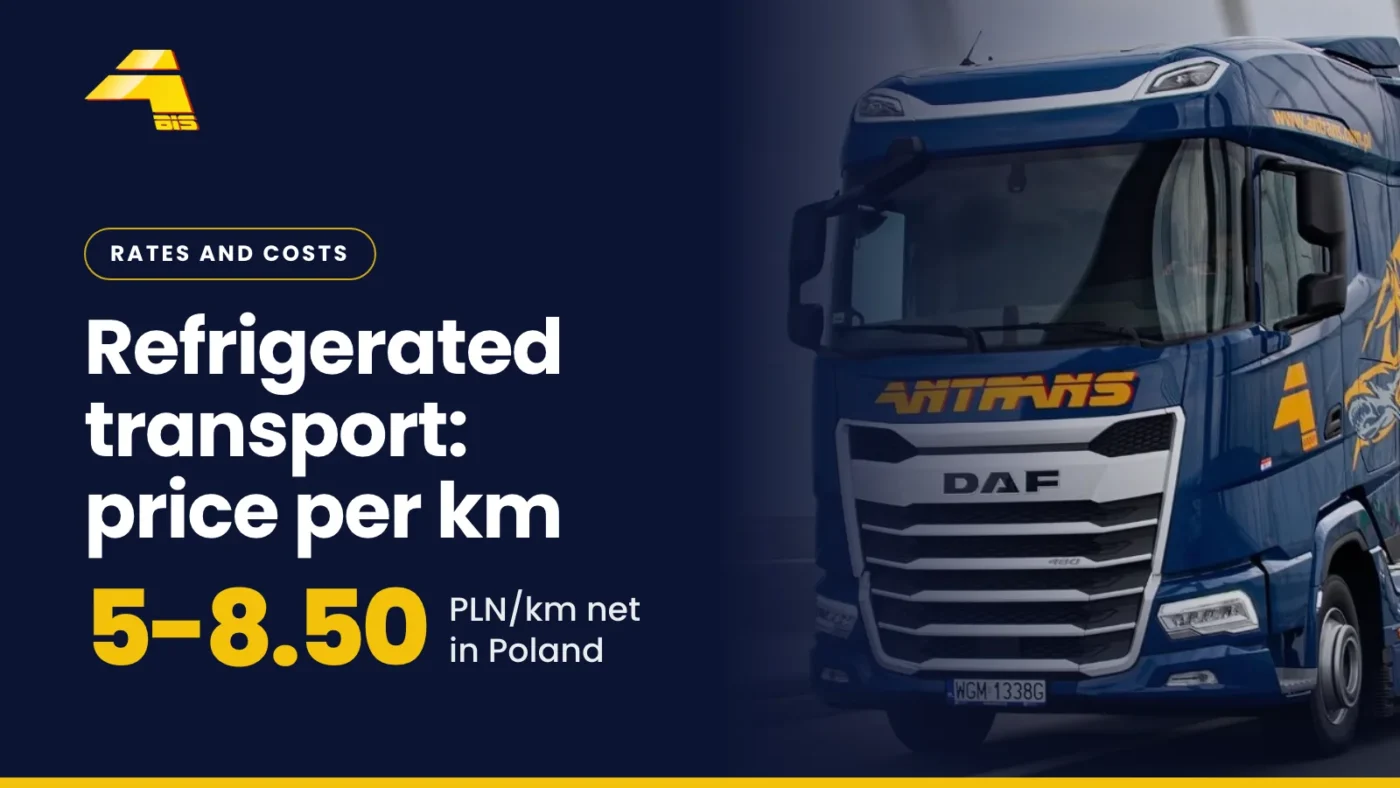
In 2026, refrigerated transport in Poland costs on average 5-8.50 PLN net per km on domestic routes and 1.2-3.3 EUR/km on international ones. Higher rates apply to pharmaceuticals and frozen goods that need an FRC-class vehicle, which cost 20-50% more than standard palletised freight. What you will pay in a specific case depends on the type of goods and the required temperature, the ATP vehicle class, the length of the route and current e-TOLL charges (the Polish electronic road toll system).
In this article you will find a table of rates by type of goods and vehicle class, an explanation of ATP and FRC requirements, the reasons why refrigerated transport costs more than standard haulage, the impact of the 2026 e-TOLL increases on costs, and a calculation formula with three sample quotes.
Refrigerated transport cost in 2026: current rates per km
Below are two tables with current rates: one for domestic routes and one for international routes. This is the overview logistics managers and buyers look for most often when planning their budgets.
Table 1 - Domestic refrigerated transport cost in Poland by type of goods and vehicle class (2026, PLN net/km)
| Type of goods / vehicle class | Rate per km | Temperature range |
|---|---|---|
| Fresh produce (fruit, vegetables, dairy) - FNA | 5.00-7.00 PLN/km | 0°C to +12°C, standard |
| Meat, fish, cured meats - FRC class A/B | 6.00-8.00 PLN/km | 0°C to -10°C |
| Frozen food, ice cream - FRC class C | 7.00-8.50 PLN/km | down to -20°C, higher energy consumption |
| Pharmaceuticals, medicines, vaccines | 8.00-12.00 PLN/km | +2°C to +8°C, GDP requirements |
| Short route under 100 km | minimum charge 300-800 PLN per trip | no per-km rate |
* Net rates for 2026. Refrigerated transport costs 40-50% more than standard palletised transport (tarpaulin trailer). Every quote is individual.
Table 2 - International refrigerated transport cost by destination (2026, EUR/km)
| Destination | Rate per km | Notes |
|---|---|---|
| Central Europe (CZ, SK, HU, RO) | 1.20-1.80 EUR/km | cheapest destination |
| Western Europe (DE, FR, NL, BE, AT) | 1.60-2.50 EUR/km | highest order volume |
| Scandinavia (SE, NO, FI, DK) | 2.50-3.30 EUR/km | most expensive destination |
| United Kingdom | 2.50-3.30 EUR/km + ferry | ferry cost charged separately |
| Pharmaceuticals (any destination) | +30-50% on the base rate | GDP requirements, temperature monitoring |
* Net rates for 2026. Every order is priced individually based on the load and route parameters.
What is refrigerated transport and when is it required?
Refrigerated transport is the carriage of temperature-sensitive goods in vehicles fitted with a refrigeration unit and an insulated body, able to hold a constant temperature between +12°C and -20°C depending on the vehicle class. The cost of refrigerated transport follows directly from the vehicle class your goods require and how deep the cooling needs to be.
Refrigerated transport is mandatory for meat, fish and seafood (required temperature ≤4°C, or -18°C for frozen products), dairy (+2°C to +6°C), frozen food and ice cream (-18°C or lower), pharmaceuticals such as insulin, vaccines and biological products (+2°C to +8°C, GDP requirements), flowers and plants (+4°C to +8°C), and juices and concentrates in line with the manufacturer’s requirements.
Insulated vs refrigerated trailer - an important cost difference. An insulated vehicle (IN/IR) has insulation only, with no active cooling, and can hold the temperature for about 12 hours at an outside temperature of +30°C. It is not suitable for longer routes or for meat and frozen goods. A refrigerated trailer (FNA/FRC) has a refrigeration unit that actively controls the temperature for the entire journey. An insulated vehicle is cheaper to buy and run, hence a lower rate per km than a fully refrigerated one.
ATP certificate and FRC/FNA vehicle classes
ATP and FRC are the biggest gap in most guides to refrigerated transport. Yet it is the ATP vehicle class that directly determines how much refrigerated transport costs for a given product.
The ATP Agreement (French: Accord relatif aux transports internationaux de denrées périssables) is an international convention from 1970 that governs the carriage of perishable foodstuffs. Poland has been a party to it since 1984. For international food transport between contracting states, an ATP certificate is mandatory. For domestic transport within Poland it is not formally required, but most large retail chains (Lidl, Biedronka, Kaufland) and pharmaceutical companies make it a tender condition. Without the certificate you are out of the tender, even if technically you are not breaking the law.
Table 3 - ATP classes of refrigerated vehicles and their uses
| Vehicle class | Temperature range | Typical use |
|---|---|---|
| IR (insulated) | no active cooling | short trips, no ATP |
| FNA | 0°C to +12°C | fruit, vegetables, dairy, flowers |
| FRC class A/B | 0°C to -10°C | meat, fish, cured meats |
| FRC class C | down to -20°C | frozen food, ice cream, frozen fish |
* Classes and temperature requirements in line with the ATP Agreement (consolidated text in the Polish Journal of Laws: Dz.U. 2022, item 1824).
In Poland, ATP certificates are issued only by COCH, the Central Refrigeration Centre in Kraków, accredited by the Polish Centre for Accreditation (No. AB 308). A new vehicle receives a certificate valid for 6 years. A periodic inspection is required after 3 years. After 6 years, a full technical test and a new certificate are required. Major technical changes (replacing the refrigeration unit or insulation panels, rebuilding the cargo space) call for a new test regardless of the certificate’s expiry date.
Penalty for not having an ATP certificate: Carrying perishable goods without a valid ATP certificate exposes the carrier to a fine of up to 8,000 PLN in Poland. Abroad (Germany, France), it can mean a fine and the vehicle being detained until the documents are produced.
Why is refrigerated transport more expensive than standard haulage?
Why does refrigerated transport cost what it does? Every buyer comparing quotes against a tarpaulin trailer asks this question. The 40-50% difference does not come out of nowhere. Here are the specific reasons.
Refrigeration unit. This is the single biggest component of the higher price. The unit burns 5 to 8 litres of diesel for every 100 km of operation, on top of the fuel used by the vehicle itself. With diesel at around 6 PLN/l, that adds 30 to 48 PLN per 100 km, or 0.30-0.48 PLN/km just for running the unit. In summer, when outside temperatures exceed 30°C, consumption rises by a further 10-20%.
Specialised trailer. A new FRC class C trailer costs 200,000-350,000 PLN, compared with 120,000-180,000 PLN for a standard tarpaulin trailer. The higher purchase and leasing cost feeds directly into the rate per km.
Documentation requirements. The temperature recorder (thermograph) must be calibrated at least once a year in accordance with Annex 2 to the ATP Agreement. On top of that come HACCP requirements, vehicle sanitary certificates and, for pharmaceuticals, full GDP (Good Distribution Practice) documentation, including audits and reports for every shipment.
Harder route optimisation. Deliveries to food stores and hospitals often come with narrow time windows, which makes full route optimisation impossible. More empty kilometres and waiting time at loading bays push up the effective cost of the job.
Difficulty finding a return load. On many routes (especially to Scandinavia), an FRC-class return load is hard to find. Empty return kilometres are built into the rate, pushing it up.
What affects the price of refrigerated transport in 2026? 7 factors
The cost of refrigerated transport depends on several variables, each of which can raise or lower the final price by 10-40%.
1. Type of goods and required temperature. Frozen goods kept at -20°C use more energy than vegetables carried at +8°C. Pharmaceuticals that require GDP documentation add another 20-40% to the base rate.
2. ATP vehicle class. FNA (down to 0°C) means a cheaper trailer and lower fuel consumption by the unit. FRC class C (down to -20°C) means more expensive equipment and a larger unit that works harder. The rate difference between FNA and FRC class C is around 1.5-2.0 PLN/km.
3. Route length. Under 100 km, a minimum charge of 300-800 PLN per trip applies, regardless of the number of kilometres. On 200-500 km routes the rate is 5-8 PLN/km. Above 500 km, economies of scale bring the price down to 5-7 PLN/km.
4. e-TOLL charges in 2026. From 1 February 2026, e-TOLL rates went up by 40-42%, and the tolled road network grew by 645 km to a total of around 5,869 km. A refrigerated trailer combination with a GVW of about 40 t falls into one of the higher charge brackets. e-TOLL on a 300 km route now costs 400-600 PLN. Current rates are available in the calculator at etoll.gov.pl.
5. Seasonality. Summer (June-August) is peak season for fresh fruit, vegetables, drinks and ice cream. With limited availability of FRC vehicles, rates rise by 10-25% compared with winter. Easter and Christmas are further periods of heavy food traffic.
6. Route direction and return load. Routes with a good return load (e.g. PL-DE-PL) allow a lower rate. Destinations where return loads are hard to come by, such as Scandinavia, cost 15-25% more precisely because of empty return kilometres.
7. Additional client requirements. Online temperature monitoring with app access costs 50-100 PLN per trip. Full GDP documentation for pharmaceuticals raises the rate by 5-15%. Multi-drop transport with several unloading points is charged at a higher rate for each additional stop.
e-TOLL 2026 and refrigerated transport costs in Poland: what has changed?
Since 1 February 2026, new e-TOLL rates have applied, 40-42% higher depending on the Euro emission class and road category. At the same time, the tolled road network grew by 645 km.
For refrigerated trailers with a GVW of about 40 t the increase is particularly noticeable, as these vehicles fall into a higher charge bracket. A practical example: an FRC trailer, Euro 5, 300 km route. Before the increase, e-TOLL cost around 300-420 PLN. Since 1 February 2026 the same journey costs around 420-590 PLN, an increase of about 40%. On a 300 km route, that means around 0.40-0.55 PLN more for every kilometre from road tolls alone.
Euro 6 vehicles pay lower rates than older ones. A modern fleet means genuinely lower e-TOLL costs, so it is worth asking the carrier about the emission standard of the vehicles it uses.
How do you calculate refrigerated transport costs? Formula and 3 worked examples
The easiest way to check what refrigerated transport will cost in practice is to use the formula below and plug in your own figures.
Total cost = (rate per km × number of km) + additional costs
Additional costs = e-TOLL + loading/unloading + documentation + cargo insurance
Example 1 - fresh vegetables and fruit, domestic (standard):
8 pallets of mixed vegetables, Poznań-Gdańsk (approx. 320 km), FNA trailer.
Rate 5.50 PLN/km × 320 km = 1,760 PLN, e-TOLL approx. 250 PLN, loading/unloading 0 PLN (loading bays at both shipper and consignee).
Total: approx. 2,010 PLN net. Effective rate: approx. 6.28 PLN/km.
Example 2 - frozen food, full FRC class C trailer, transport to Germany:
22 pallets of frozen food (-20°C), Łódź-Berlin (approx. 620 km), FRC trailer.
Rate 2.00 EUR/km × 620 km = 1,240 EUR, German motorway toll (Toll Collect) approx. 100 EUR, Polish e-TOLL approx. 80 EUR.
Total: approx. 1,420 EUR net (approx. 5,900 PLN at an exchange rate of 4.15). Effective rate: approx. 2.29 EUR/km.
Example 3 - pharmaceuticals with GDP documentation, domestic:
4 pallets of vaccines (+2°C to +8°C), Warszawa-Wrocław (approx. 350 km).
Rate 9.00 PLN/km × 350 km = 3,150 PLN, online monitoring + temperature report + GDP documentation: 250 PLN, e-TOLL approx. 280 PLN.
Total: approx. 3,680 PLN net. Effective rate: approx. 10.51 PLN/km.
Good to know: Quotes “from 5 PLN/km” that leave out e-TOLL, loading and documentation can differ from the final invoice by 30-50%. Always ask for an all-in quote with an itemised breakdown.
Refrigerated vs standard transport: cost comparison for 2026
Table 4 - Refrigerated transport cost compared with other types of transport (2026, domestic, Poland)
| Type of transport | Domestic rate (PLN/km) | More expensive by | When to choose it |
|---|---|---|---|
| Tarpaulin trailer (curtainsider) | 4.50-7.00 | baseline | dry palletised goods |
| Insulated (IR/IN) | 5.00-7.50 | +0-15% | short runs, temperature-sensitive goods |
| Refrigerated FNA | 5.00-7.00 | +10-25% | fresh fruit, dairy, flowers |
| Refrigerated FRC (A/B) | 6.00-8.00 | +25-40% | meat, fish, cured meats |
| Freezer FRC class C | 7.00-8.50 | +40-60% | frozen food, ice cream, frozen fish |
| Pharmaceuticals (GDP) | 8.00-12.00 | +60-80% | medicines, vaccines, biological products |
* Net rates for 2026 for domestic transport on 200-500 km routes. e-TOLL, loading and documentation costs are not included in the rate per km.
On top of the costs shown in the table come costs specific to temperature-controlled transport: temperature monitoring with online access (50-150 PLN per trip), HACCP or GDP documentation (100-300 PLN per trip), vehicle washing required by FMCG clients (100-200 PLN) and a sanitary inspection of the cargo space at the client’s request. Industry data on the Polish transport market, including the refrigerated segment, is published regularly by Transport and Logistics Poland (TLP), the Polish employers’ association.
Get a refrigerated transport quote: free offer within 24 hours
What refrigerated transport will cost in your specific case depends on too many variables to give a single rate without analysing the order. Vehicle class, type of goods, route, documentation requirements and delivery deadline all affect the final price. The fastest way to an accurate quote is to contact a freight forwarder with its own ATP/FRC fleet.
We run our own fleet of FNA and FRC class C refrigerated trailers (frozen goods down to -20°C), with the ATP certificate displayed on every vehicle and temperature monitoring available to clients via an app 24/7. We handle domestic and international transport, including to Scandinavia and the United Kingdom. We have experience in GDP-compliant pharmaceutical transport. Quotes are free and ready within 24 hours. Contact us and tell us the type of goods, required temperature, route, date and number of pallets, and we will prepare an all-in offer with no hidden surcharges.
Useful articles: How to start a transport company in Poland in 8 steps | How to get haulage work: 5 effective ways to win new loads | Road transport grants in Poland: funding for transport businesses in 2026 | Transport documents in road haulage in 2026
FAQ: common questions about refrigerated transport and its prices
We have gathered the questions that come up most often when planning a refrigerated shipment. Here you will find answers on rates per km for specific goods, the difference between FNA and FRC, when an ATP certificate is required, how e-TOLL 2026 affects costs and whether refrigerated transport is more expensive in summer.
How much does refrigerated transport cost per km in Poland in 2026?
In 2026, domestic refrigerated transport in Poland costs on average 5-8.50 PLN net per km. The exact rate depends on the vehicle class and the type of goods: fruit and vegetables in an FNA vehicle cost 5-7 PLN/km, meat and fish in an FRC vehicle 6-8 PLN/km, frozen goods requiring -20°C 7-8.50 PLN/km, while pharmaceuticals with GDP documentation can cost 8-12 PLN/km. On routes under 100 km, a minimum charge of 300-800 PLN per trip applies.
What is the difference between FNA and FRC refrigerated trailers, and how does it affect the price?
An FNA unit keeps temperatures from 0°C to +12°C and is suitable for fresh fruit, vegetables, dairy and flowers. An FRC unit keeps temperatures down to -20°C and is required for meat, fish and frozen food. An FRC trailer is more expensive to buy and run, and its refrigeration unit works harder, so the rate per km is around 1.50-2.00 PLN higher than with FNA.
Does refrigerated transport require an ATP certificate?
For international food transport between countries that are parties to the convention, an ATP certificate is mandatory. For domestic transport in Poland it is not formally required by law, but most large retail chains and pharmaceutical companies make it a prerequisite in tenders. Operating without a valid certificate carries a fine of up to 8,000 PLN in Poland, and abroad it can lead to the vehicle being detained and unloading being refused.
Why is refrigerated transport more expensive than standard transport?
Refrigerated transport costs 40-60% more than standard tarpaulin-trailer transport for several reasons. The refrigeration unit uses 5 to 8 litres of diesel per 100 km on top of the vehicle’s own fuel, which adds 0.30-0.48 PLN to every km. An FRC trailer costs twice as much to buy as a tarpaulin trailer. On top of that come mandatory thermograph calibration, the ATP certificate and, for pharmaceuticals, full GDP documentation. It is also harder to find an FRC-class return load, so empty return kilometres are built into the rate.
Is refrigerated transport more expensive in summer?
Yes, for two reasons. Higher outside temperatures (30-40°C) make the refrigeration unit work harder and burn 10-20% more fuel than in winter. At the same time, demand for transporting fruit, vegetables, drinks and ice cream rises in summer while FRC vehicles are in short supply, pushing market rates up by 10-25% compared with winter. When planning summer deliveries, book transport at least a week in advance.
What does the full cost of refrigerated transport include besides the rate per km?
On top of the rate per km, add e-TOLL charges (depending on the vehicle combination’s GVW and the route), online temperature monitoring (50-150 PLN per trip), HACCP or GDP documentation for pharmaceuticals (100-300 PLN), vehicle washing required by FMCG chains (100-200 PLN) and cargo insurance. When comparing offers, always ask for an all-in quote with an itemised breakdown, because quotes “from 5 PLN/km” can differ from the final invoice by 30-50%.

Managing Director | Antrans BiS, Olkusz
Sebastian Szklarczyk has led the development of Antrans BiS, a transport company operating throughout Europe, for more than 15 years. He started as Head of the Freight Forwarding Department, gaining practical experience in organising international transport and managing a vehicle fleet on European routes.
As Managing Director, he is responsible for the strategic management of a company handling more than 21,000 transport operations a year on its main routes: Poland-Italy, Poland-Germany, Poland-Austria, Spain, the Benelux countries and Scandinavia. Under his leadership, Antrans BiS has expanded its fleet to 220 vehicles, including its own and partners’ vehicles, and achieved an on-time delivery rate of 98%.
Specialisms: international FTL transport throughout Europe, automotive and FMCG logistics, optimisation of European routes, road traffic regulations and driving bans in the EU, and transport documentation (CMR, VAT-UE, INTRASTAT).
On the Antrans BiS blog, he shares practical knowledge about international freight forwarding, transport regulations and the business aspects of running a transport, freight forwarding and logistics company in different European countries.