How much does wood chip transport cost in 2026? Rates, walking floor trailers, particle sizes and price tables
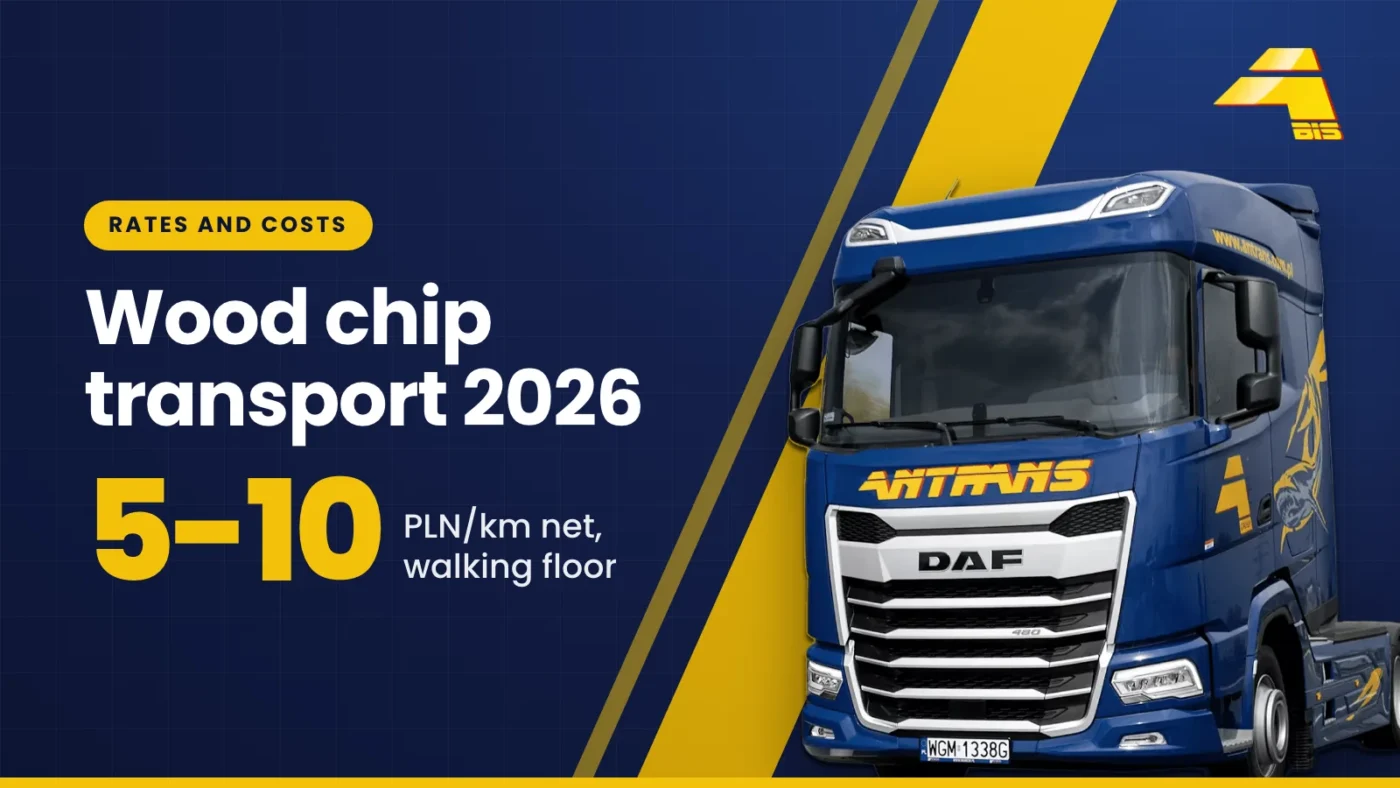
In 2026, transporting wood chips within Poland costs on average 5-10 PLN net per km on domestic routes with a walking floor semi-trailer, or 100-180 PLN net per tonne for dry W20 chips. What you pay depends heavily on moisture content: dry chips (W20-W30) are lighter, which means a lower cost per tonne but a higher cost per MWh of energy delivered. Wet chips (W45-W55) are heavier, so they are cheaper per tonne, but they need more trips to deliver the same amount of energy.
In this article you will find rate tables by route and moisture content, an overview of vehicle types (walking floor vs tipper), the particle size classes of EN ISO 17225-4 and what they mean for logistics, 7 factors that affect the price, a calculation formula with three worked examples, and a comparison of transport costs for wood chips, pellets and sawdust.
How much does wood chip transport cost in 2026? Rates per km and per tonne
The two tables below show current price ranges. The cost of moving wood chips depends on both the length of the route and the moisture content of the material, because moisture directly determines how many tonnes the vehicle can actually carry.
Table 1: Wood chip transport cost per km by route length (2026, PLN net)
| Route length | Vehicle type | Rate per km | Notes |
|---|---|---|---|
| under 50 km | tipper or walking floor | 8-10 PLN/km | minimum charge per trip: 600-1,000 PLN |
| 50-150 km | walking floor (moving floor) | 6-8 PLN/km | optimal range for biomass |
| 150-300 km | walking floor or half-pipe tipper | 5-7 PLN/km | full semi-trailer of 80-90 m³ |
| over 300 km | walking floor | 4.50-6 PLN/km | economies of scale |
* Net rates for 2026. Every order is priced individually. e-TOLL charges (Poland’s electronic road toll system) must be added to the amounts shown.
Table 2: Wood chip transport cost per tonne by moisture content (2026)
| Moisture content | Weight per m³ | Payload per 80 m³ | Rate per tonne |
|---|---|---|---|
| W20 (dry, ≤20%) | ~0.20-0.25 t/m³ | 14-18 t | 130-180 PLN/t |
| W30 (semi-dry, ≤30%) | ~0.25-0.30 t/m³ | 18-22 t | 110-150 PLN/t |
| W40 (wet, ≤40%) | ~0.30-0.35 t/m³ | 22-26 t | 90-120 PLN/t |
| W50+ (fresh, >40%) | ~0.35-0.45 t/m³ | 26-30 t | 75-100 PLN/t |
* Dry chips cost more per tonne (they weigh little and take up a lot of space), wet chips cost less per tonne but more per MWh of energy delivered. Always price wood chip transport in PLN/MWh, not just in PLN/t.
What are wood chips and when do you need specialist transport?
Wood chips are small pieces of wood produced by chipping branches, sawmill residues, energy wood or logging residues. As a solid biofuel they fall under the PN-EN ISO 17225-4 standard, which classifies them by particle size, moisture content and purity.
The main uses of wood chips are municipal and industrial heating plants and combined heat and power (CHP) plants (the largest bulk buyers), biomass boilers in homes, schools and hospitals (G30/G50 particle size), pellet and briquette production as a raw material for pelletising, animal bedding (bark chips), as well as composting facilities and land reclamation.
Because wood chips are bulky and free-flowing, the cost of transporting them depends largely on the choice of vehicle. A standard tarpaulin trailer or reefer is out of the question. You need a walking floor semi-trailer or a tipper, and the choice between the two has a direct impact on the number of trips and the price per tonne.
BDO (Polish waste register) and wood chip transport: Chips made from commercial timber (sawmill, forest, energy plantation) are a product, not waste, so BDO registration is not required. Chips from urban green-space maintenance or from scrapped furniture and pallets may count as waste (code 20 02 01 or 03 01 05) and require a waste transfer note (KPO) issued in the BDO system (bdo.mos.gov.pl). Always check the waste status of the material with the producer before ordering transport.
Wood chip particle size classes under EN ISO 17225-4: what do heating plants expect from transport?
PN-EN ISO 17225-4 classifies wood chips by particle size (particle size classes) and water content (moisture classes). Heating plants and CHP plants write the requirements of this standard into their supply agreements as contract clauses, even though applying the standard is voluntary.
Table 3: Wood chip particle size classes under EN ISO 17225-4 and their impact on transport
| Particle size class | Main fraction size | Typical use |
|---|---|---|
| P31S | ≤8 mm | domestic boilers above 20 kW, small heating plants |
| P45S (G30) | ≤16 mm (approx. 30 mm) | industrial boilers, local heating plants |
| P63M (G50) | ≤31.5 mm (approx. 50 mm) | heating plants, CHP plants up to 5 MW |
| P100M (G100) | ≤100 mm | large CHP plants above 10 MW |
* Moisture classes: M20 (≤20%), M30 (≤30%), M40 (≤40%), M55 (≤55%). Large CHP plants can accept M55, while small boiler houses usually require M30 or lower.
Why do particle size and moisture matter when planning transport? Dry G30/G50 chips (W20-W30) from sawmills are lighter, so a walking floor trailer carries 12-18 t. Wet G100 chips (W40-W55) from the forest are heavier and the vehicle carries 22-28 t. Under contracts with CHP plants, the driver may be required to hand over a quality certificate (moisture, particle size) together with the WZ (Polish goods dispatch note) or the CMR consignment note. Chips that do not meet the particle size specification can be rejected at unloading, which means the whole load goes back to the shipper at the shipper’s expense.
Which vehicle is used to transport wood chips? Walking floor vs tipper
The choice of vehicle is one of the key factors that determine what wood chip transport costs per trip and per tonne.
Table 4: Walking floor vs tipper, compared for wood chip transport
| Vehicle | Capacity | Advantages | When to choose it |
|---|---|---|---|
| Walking floor (moving floor) semi-trailer | 80-100 m³ | fast unloading without tipping, dust-free, large capacity | heating plants, CHP plants, long routes, silos |
| Half-pipe tipper semi-trailer (articulated tipper) | 40-55 m³ | lower base rate, quick tipping (5-10 min) | wet chips, short routes, delivery to an open yard |
| Rigid tipper truck | 15-25 m³ | access to tight spots and building sites | small deliveries, schools, buildings with restricted access |
| Hook-lift container | 15-25 m³ | the driver does not need to be present during unloading | biomass buying points, forest storage sheds |
* A walking floor unloads in 20-35 minutes (a hydraulic system moves the load towards the rear). Tipper: 5-10 minutes. With hundreds of trips a month, unloading time has a significant effect on vehicle turnaround.
Why does the walking floor dominate wood chip transport? Dry chips (W20) have a density of approx. 0.20-0.25 t/m³. A 90 m³ walking floor trailer carries approx. 18-22 t and is full by volume. A 55 m³ half-pipe tipper carries approx. 12 t of the same chips. One walking floor trip therefore replaces approx. 1.5-1.6 tipper trips, which directly lowers the cost per tonne. CHP plants often have silos and bunkers that a tipper cannot reach, while a walking floor discharges the material horizontally straight into the reception hall.
What affects the price of wood chip transport in 2026? 7 key factors
The cost of wood chip transport depends on several variables, each of which can raise or lower the final price by 15-40%.
1. Moisture content. This is the most important factor when pricing wood chip transport per tonne. W50 chips have a density of approx. 0.40 t/m³, so a 90 m³ trailer quickly hits the weight limit set by GVW (24 t) before it is full. W20 chips have a density of approx. 0.22 t/m³ and the trailer is full by volume at just 20 t. With dry chips you pay more per trip and more per tonne, but you deliver more energy. With wet chips it is the other way round.
2. Vehicle type. A walking floor trailer costs more to buy and lease than a tipper, so its base rate is 10-20% higher. However, its larger capacity (90 m³ vs 55 m³) means that with light, dry chips one walking floor trip replaces 1.5-1.6 tipper trips. The cost per tonne is then lower despite the higher rate per km.
3. Route length and vehicle availability in the region. Below 50 km, a minimum charge of 600-1,000 PLN applies. On 50-200 km routes the rate is 6-8 PLN/km. Above 200 km it levels off at 5-6 PLN/km. Walking floor trailers are harder to find in any given region than tippers, which pushes rates up in areas with a small biomass fleet.
4. e-TOLL charges in 2026. From 1 February 2026, e-TOLL rates rose by 40-42% and the tolled road network in Poland grew by 645 km. A walking floor trailer with a tractor unit at a GVW of approx. 40 t falls into the high charge band. On a 200 km route with tolled sections, e-TOLL comes to approx. 250-380 PLN, which adds approx. 1.25-1.90 PLN/km to the effective rate. You can check current rates in the calculator at etoll.gov.pl.
5. Loading and unloading. Loading with a wheel loader on the client’s side is usually included in the rate. Loading by conveyor from a storage yard or directly from a mobile forest chipper does not incur extra charges if it takes no more than 30 minutes. Beyond that, carriers charge a waiting fee of 100-200 PLN/h. Unloading into a silo with a walking floor takes 20-35 minutes, which limits vehicle turnaround when trip volumes are high.
6. Seasonality. Winter (October-March) is peak season for biomass fuel. Higher demand with the same number of vehicles available drives rates up by 10-15%. Spring and summer bring lower demand and a chance to renegotiate contracts. Harvest time (July-August) carries a risk of higher rates, because agriculture competes for the same vehicles.
7. Annual contract vs spot order. A long-term contract for, say, 1,000 trips a year usually gets you a rate 10-20% lower than a one-off order on a freight exchange. Municipal heating plants tender their biomass transport every year. It pays to negotiate a full-year package in summer, when rates are lower and vehicles easier to secure. Market data on costs in the biomass transport sector is published by Transport and Logistics Poland (TLP), the Polish employers’ association.
How to calculate wood chip transport costs: formula and 3 pricing examples
What wood chip transport costs in practice comes down to the combination of the rate per km, the moisture content of the material and any additional costs. The formula below lets you work it out yourself.
Total cost = (rate per km × km) + additional costs
Cost per tonne = total cost ÷ tonnes of material loaded
Cost per MWh = total cost ÷ (tonnes × calorific value in MWh/t)
Example 1 - dry W20 chips from a sawmill to a local heating plant:
18 t of W20 chips (density 0.22 t/m³, approx. 82 m³), sawmill to heating plant 120 km, walking floor trailer.
Rate 7 PLN/km × 120 km = 840 PLN, e-TOLL approx. 130 PLN.
Total: approx. 970 PLN net. Cost per tonne: 53.90 PLN/t. Calorific value of W20: approx. 4.2 MWh/t → transport cost: approx. 12.80 PLN/MWh.
Example 2 - wet W45 chips from the forest to a CHP plant:
24 t of W45 chips (density 0.38 t/m³, approx. 63 m³), mobile forest chipper to CHP plant 250 km, walking floor.
Rate 6 PLN/km × 250 km = 1,500 PLN, e-TOLL approx. 280 PLN.
Total: approx. 1,780 PLN net. Cost per tonne: 74.20 PLN/t. Calorific value of W45: approx. 2.5 MWh/t → transport cost: approx. 29.68 PLN/MWh.
Example 3 - small delivery to a school with a wood chip boiler:
8 t of G50 W30 chips, biomass yard to school 60 km, small rigid truck.
Minimum charge: 800 PLN, e-TOLL approx. 60 PLN.
Total: approx. 860 PLN net. Cost per tonne: 107.50 PLN/t.
Key takeaway from examples 1 and 2: Transporting dry chips (W20) costs 12.80 PLN/MWh, wet chips (W45) as much as 29.68 PLN/MWh, more than twice as much in terms of energy. For a heating plant, dry sawmill chips are far more cost-effective, despite the higher purchase price per tonne. Always price wood chip transport in PLN/MWh, not just in PLN/t.
Wood chips vs pellets vs sawdust: transport costs and logistics compared
Table 5: Wood chip transport costs compared with pellets and sawdust (2026)
| Parameter | Wood chips (G50 W30) | Wood pellets | Sawdust (wet) |
|---|---|---|---|
| Bulk density | ~0.25-0.30 t/m³ | ~0.60-0.65 t/m³ | ~0.15-0.20 t/m³ |
| Tonnes per 90 m³ walking floor | 20-25 t | max. 24 t (GVW limit) | 13-17 t |
| Transport cost per km (avg.) | 5-10 PLN/km | 5-8 PLN/km | 7-12 PLN/km |
| Transport cost per tonne (200 km) | 80-130 PLN/t | 50-80 PLN/t | 100-180 PLN/t |
| Calorific value | 2.8-3.5 MWh/t (W30) | 4.8-5.0 MWh/t | 1.5-2.0 MWh/t (wet) |
| Transport cost per MWh | 22-46 PLN/MWh | 10-17 PLN/MWh | 50-120 PLN/MWh |
| Quality requirements | EN ISO 17225-4 | EN ISO 17225-2 | no trade standard |
* Pellets have the lowest transport cost per MWh. Wood chips are cheaper to buy and more readily available locally. Sawdust has the lowest purchase cost as a raw material but the highest transport cost per MWh. For more on the biomass market in Poland, see the Polish trade portal Magazyn Biomasa (magazynbiomasa.pl).
Order wood chip transport: walking floor trailers, large volumes, heating plant contracts
What wood chip transport will cost in your particular case depends on the moisture content, particle size, route length and the availability of walking floor trailers in the region. The cheapest transport does not always mean the cheapest energy. That is why, before you sign a contract with a carrier, you should work out the cost not only in PLN/t but also in PLN/MWh.
We operate a fleet of walking floor semi-trailers with a capacity of 80-95 m³, handle heating plant contracts and supply CHP plants (regular biomass deliveries), carry out domestic transport within Poland, provide a WZ dispatch note with every trip and take care of BDO paperwork for biomass from municipal green waste. Quotes are free and ready within 24 hours. Contact us with the type of wood chips, their moisture content or particle size, the volume (tonnes/year), the route and the type of consignee, and we will prepare an offer broken down into cost per km, per tonne and per MWh.
Useful articles: How to start a transport company in Poland in 8 steps | How to get haulage work: 5 effective ways to win new loads | Road transport grants in Poland: funding for transport businesses | Transport documents in road haulage in 2026
FAQ: common questions about wood chip transport costs
We have gathered the questions that come up most often when planning biomass deliveries. Here you will find answers on rates per km and per tonne, how moisture content affects the total cost, choosing the right vehicle, and why calculating wood chip transport costs in PLN/MWh gives a better picture of cost-effectiveness than the price per tonne alone.
How much does wood chip transport cost per km in Poland in 2026?
In 2026, wood chip transport costs from 4.50 to 10 PLN net per km, depending on route length and vehicle type. On short routes under 50 km, a minimum charge of 600-1,000 PLN per trip applies, which effectively works out at 8-10 PLN/km. On 50-150 km routes the rate is 6-8 PLN/km, and above 300 km it falls to 4.50-6 PLN/km thanks to economies of scale. e-TOLL charges must always be added to these amounts.
How much does wood chip transport cost per tonne and what does it depend on?
The cost of transporting wood chips per tonne depends above all on the moisture content of the material. Dry W20 chips are light and the trailer fills up by volume at approx. 14-18 t, hence the higher rate of 130-180 PLN/t. Wet W50 chips are heavier and the vehicle carries 26-30 t, so the cost drops to 75-100 PLN/t. The paradox is that wet chips, although cheaper per tonne, deliver less energy and need more trips for the same number of MWh. It is always worth calculating wood chip transport costs in PLN/MWh, not just in PLN/t.
Walking floor or tipper: which is cheaper for transporting wood chips?
A tipper has a lower base rate per km but a smaller capacity (40-55 m³ vs 80-100 m³ for a walking floor). With dry W20 chips, one walking floor trip replaces approx. 1.5-1.6 tipper trips, so the transport cost per tonne comes out lower despite the higher rate. A tipper pays off for heavy, wet chips on short routes with unloading onto an open yard. A walking floor is essential for deliveries into the silos and bunkers of heating plants, where tipping is not possible.
Why are wet wood chips cheaper per tonne but more expensive per unit of energy?
Wet chips weigh more per m³, so more tonnes can be carried per trip, which lowers the transport cost per tonne. However, wet chips have a low calorific value: approx. 2.0-2.5 MWh/t at W50 compared with approx. 4.0-4.5 MWh/t at W20. To deliver the same 1,000 MWh of energy, you need twice as many trips with wet chips as with dry ones. At 1,200 PLN per trip: 12 trips of dry chips = 14,400 PLN, but 20 trips of wet chips = 24,000 PLN for the same amount of energy.
How has e-TOLL in 2026 affected the cost of wood chip transport?
From 1 February 2026, e-TOLL rates rose by 40-42% and the tolled road network grew by 645 km. A walking floor trailer with a tractor unit at a GVW of approx. 40 t falls into the high charge band. On a 200 km route, e-TOLL comes to approx. 250-380 PLN, which adds approx. 1.25-1.90 PLN to every kilometre from road tolls alone. This is one of the reasons why wood chip transport costs more in 2026 than in previous years.
Does wood chip transport require BDO registration?
It depends on where the material comes from. Chips from a sawmill, forest or energy plantation are a product, not waste, so BDO registration is not required. Chips from urban green-space maintenance or from scrapped furniture and pallets may count as waste, and then the carrier must be entered in the BDO register and an electronic waste transfer note must be issued. Always check the waste status of the material with the producer before ordering wood chip transport.

Managing Director | Antrans BiS, Olkusz
Sebastian Szklarczyk has led the development of Antrans BiS, a transport company operating throughout Europe, for more than 15 years. He started as Head of the Freight Forwarding Department, gaining practical experience in organising international transport and managing a vehicle fleet on European routes.
As Managing Director, he is responsible for the strategic management of a company handling more than 21,000 transport operations a year on its main routes: Poland-Italy, Poland-Germany, Poland-Austria, Spain, the Benelux countries and Scandinavia. Under his leadership, Antrans BiS has expanded its fleet to 220 vehicles, including its own and partners’ vehicles, and achieved an on-time delivery rate of 98%.
Specialisms: international FTL transport throughout Europe, automotive and FMCG logistics, optimisation of European routes, road traffic regulations and driving bans in the EU, and transport documentation (CMR, VAT-UE, INTRASTAT).
On the Antrans BiS blog, he shares practical knowledge about international freight forwarding, transport regulations and the business aspects of running a transport, freight forwarding and logistics company in different European countries.