Bulk material transport: price per km in 2026 (tippers, tipper trailers, BDO, rate tables)
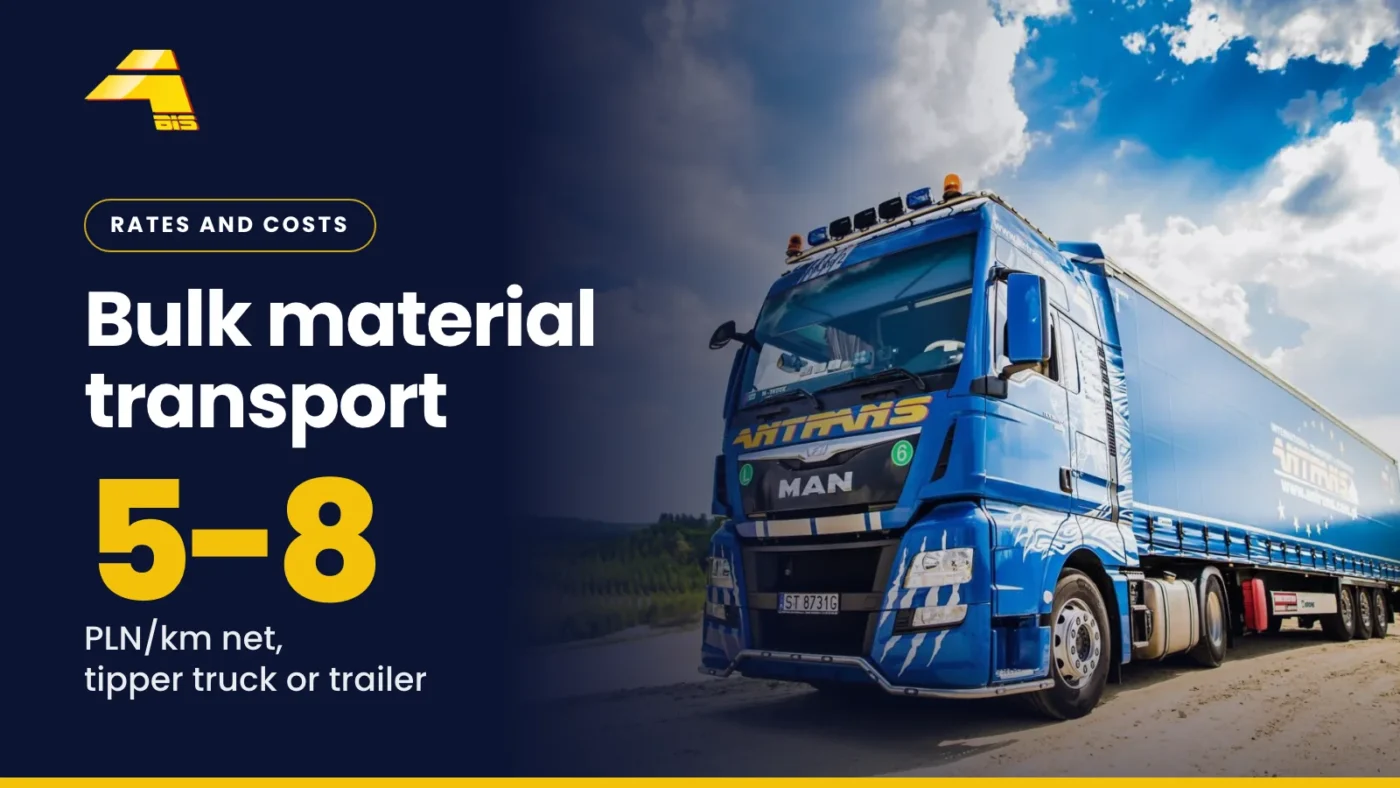
How much does it cost to transport bulk materials in 2026? For domestic haulage in Poland, the average rate is 5-8 PLN net per km with a tipper truck or tipper trailer. The rate depends on the type of material, the trailer type, the length of the route and whether the load needs BDO paperwork (BDO is Poland’s national waste database). Hauling construction waste such as rubble or excavated soil costs more than moving aggregates or grain, because on top of the per-km rate you pay for handling the waste transfer note (KPO) in the BDO system.
In this article you will find a rate table by material and vehicle type, an overview of trailer types with their payloads, a BDO section explaining when the paperwork is mandatory and what you risk without it, the impact of e-TOLL 2026 on prices, and a cost formula with three worked quotes.
How much does bulk material transport cost in 2026?
Below are two tables with current price ranges. The cost of moving bulk materials depends on both the type of material and the length of the route, so it is worth checking both tables before you send a request for a quote.
Table 1 - Domestic bulk material transport in Poland: rates by type of load (2026, PLN net/km)
| Material | Vehicle | Rate per km | Notes |
|---|---|---|---|
| Sand, gravel, aggregate (up to 24 t) | tipper trailer / articulated tipper | 5.00-7.00 PLN/km | the most common job, no BDO |
| Cement, lime, gypsum in bulk | silo / bulk powder tanker | 6.00-9.00 PLN/km | specialist vehicle, pneumatic discharge |
| Grain, rapeseed, animal feed | grain tipper trailer / silo | 5.00-7.50 PLN/km | seasonal: 10-25% dearer at harvest time |
| Rubble, construction waste (no BDO) | tipper | 5.00-7.00 PLN/km | up to 24 t, no waste paperwork |
| Waste requiring BDO (codes 17xx, 19xx) | tipper with KPO | 6.00-9.00 PLN/km | + BDO handling fee of 100-300 PLN per trip |
| Coal, wood pellets, eco-pea coal | tipper trailer / tipper | 5.50-7.50 PLN/km | seasonal swings, dearer in winter |
| Aggregate by rigid truck (up to 10 t) | dropside truck | 4.50-6.50 PLN/km | short runs, building sites |
* Net rates for 2026. Short runs under 30 km: minimum charge of 400-1,000 PLN per trip. Every job is quoted individually.
Table 2 - International bulk material transport: rates (2026, EUR/km)
| Destination | Rate per km | Notes |
|---|---|---|
| Central Europe (CZ, SK, HU) | 1.20-1.80 EUR/km | aggregates, grain |
| Western Europe (DE, NL, BE) | 1.80-2.50 EUR/km | higher road tolls in Germany |
| Scandinavia | 2.50-3.50 EUR/km | specialist transport |
* Net rates for 2026. Every job is quoted individually.
Which vehicles carry bulk materials? Trailer types and payload
What you pay for bulk transport depends directly on the vehicle you choose. Each trailer type has a different volume, payload and unloading method, which affects the number of trips and the total cost of the job.
Table 3 - Vehicle types for bulk material transport: payload and typical use
| Vehicle type | Payload | Volume | Typical use |
|---|---|---|---|
| Tipper trailer (half-pipe tipping semi-trailer) | up to 24 t | 40-55 m³ | aggregate, gravel, sand, rubble, grain; rear or side tipping |
| Silo (bulk powder tanker) | up to 24 t | 35-60 m³ | cement, flour, sugar, lime in bulk; pneumatic discharge |
| Rigid tipper (two-axle) | up to 10-15 t | 10-20 m³ | short runs, building sites, sites with difficult access |
| Moving floor trailer (walking floor) | up to 24 t | 90-100 m³ | sawdust, wood chips, loose pellets, light bulky waste |
| Grain tipper trailer | up to 24 t | 50-65 m³ | grain, rapeseed, feed, meal; net cover instead of a tarpaulin, higher sides |
* A common mistake when ordering: giving the volume instead of the weight. With gravel (density approx. 1.6 t/m³), a 40 m³ tipper trailer already reaches its limit with just 15 m³ on board (25 t would take the truck over its GVW). Always order bulk material transport in tonnes, not cubic metres.
Tipper trailer or tipper truck: what is the difference and which should you choose?
A tipper trailer is a specific type of self-unloading semi-trailer coupled to a tractor unit, which together make up an articulated truck. It is designed mainly for bulk materials such as sand, gravel, aggregate, soil or wood chips. It usually holds around 40-55 m³ and carries up to about 24 tonnes, so it works well for larger volumes and longer routes.
Tipper, on the other hand, is a broader and more colloquial term. It can mean any self-unloading vehicle, from a smaller rigid truck to a large half-pipe tipper trailer. In practice, someone who says “I need a tipper” may mean a 2-, 3- or 4-axle truck for site work or a full articulated rig carrying a large quantity of material.
The main difference, then, lies in design and use. A tipper trailer is usually the choice for larger loads, when capacity and cost-efficiency over the route matter. A rigid tipper does better where space is tight, access is difficult, or there is frequent loading and unloading on building sites, in towns or over short distances. It is more agile and easier to manoeuvre on site than a complete articulated combination.
The most practical rule is simple. For routes over 50 km and loads above 15 tonnes, a tipper trailer is usually the better choice. On urban building sites, narrow roads and short runs of up to 30 km, a rigid tipper often works better, because it is more agile and needs far less room to manoeuvre than a combination around 25 metres long. When you send an enquiry, always state the tonnage, the unloading method (rear or side tipping) and whether an articulated truck can get to the site.
Bulk transport and BDO: when is it required and what are the penalties for missing paperwork?
BDO is the biggest gap in most guides to bulk haulage. Yet missing BDO paperwork is the most common cause of problems at roadside checks by ITD (the Polish Road Transport Inspection) and of landfills refusing to accept a load. Bulk transport with BDO costs more than without it, but the risk of travelling without the documents costs far more.
BDO (Baza Danych o Odpadach, the Polish waste database) is the electronic system that is mandatory for transporting waste in Poland, run under the Polish Waste Act of 14 December 2012, as amended. The official system is available at bdo.mos.gov.pl.
When BDO is required for bulk transport: construction rubble (waste codes 17 01 01, 17 05 04 and others in group 17xx), fly ash from combined heat and power plants (codes 19xx), excavated soil containing hazardous substances, metallurgical slag and other industrial waste. Since 1 January 2025 there has also been a requirement to segregate construction waste into at least six fractions, which directly affects the transport paperwork.
When BDO is not required: sand, gravel and aggregate (natural materials, not waste), grain, feed and flour, cement and lime (commercial products), pellets and coal (fuels). Clean excavated soil (code 17 05 04) sent for R5 recovery can formally be treated as a product, but the line between “waste” and “product” is a fine one. If in doubt, it is always safer to require a KPO from the carrier.
Table 4 - Documents required for transporting bulk waste under BDO (2026)
| Document | Issued by | Notes |
|---|---|---|
| Waste transfer note (KPO) | the waste producer (client), online in the BDO system | electronic version only since 2021 |
| KPO confirmation from BDO | generated by the driver from the system | must be in the vehicle during transport (printout or PDF) |
| Carrier’s BDO registration number | assigned on registration in BDO | the carrier must be entered in the BDO register as a waste transporter |
| ODPADY (WASTE) signs | fitted to the vehicle by the carrier | front and rear of the vehicle, under the 2016 regulation of the Polish Minister of the Environment |
* The waste producer (client), not the carrier, is responsible for the KPO being correct. The carrier is responsible for having the KPO confirmation on board and for delivering the load to the destination stated on the note.
Penalties for missing BDO paperwork: a fine for the driver under the Polish Code of Petty Offences, an administrative penalty of up to several thousand PLN for the carrier, refusal to accept the waste at the landfill or sorting plant and, in serious cases, the risk of the business being suspended. When choosing a carrier for bulk waste, always check its BDO registration number and make sure the vehicle displays ODPADY (WASTE) signs.
What affects the price of bulk material transport in 2026? 7 key factors
The cost of bulk transport depends on several variables, each of which can raise or lower the final price by 15-40%.
1. Type of material and its density. Density determines tonnage, and tonnage determines price. Gravel has a density of approx. 1.6 t/m³, so a 40 m³ tipper trailer reaches its permitted payload (24 t) with only about 15 m³ loaded. Pellets have a density of approx. 0.65 t/m³, so you can fill all 40 m³. The carrier charges by weight, not volume, so always give tonnes, not cubic metres.
2. Route length. Under 30 km: a flat rate of 400-800 PLN per trip (effectively 15-30 PLN/km). Routes of 30-100 km: 6-8 PLN/km. Routes of 100-300 km: 5-7 PLN/km. Over 300 km: 4.50-6 PLN/km thanks to economies of scale.
3. Trailer type. A tipper trailer (24 t) is the cheapest option on long routes. A pneumatic silo trailer costs 10-20% more than a tipper trailer, but it is faster for large volumes of cement. A walking floor trailer is a more expensive vehicle that pays off for light, bulky materials.
4. Loading and unloading. Tipping takes 5 minutes and carries no surcharge. Pneumatic discharge from a silo is usually included in the rate. Loading by excavator at the client’s site fits within the standard 30 minutes. Waiting time beyond that costs an extra 100-200 PLN/h.
5. e-TOLL charges in 2026. From 1 February 2026, rates in e-TOLL (Poland’s electronic toll system) rose by 40-42%, and the tolled network grew by 645 km to approx. 5,869 km. A vehicle with a GVW of 40 t falls into the highest charge band. On a 200 km route with tolled sections, e-TOLL comes to approx. 250-400 PLN, which effectively adds 1.25-2.00 PLN/km to the rate. Current rates are published at etoll.gov.pl.
6. BDO paperwork. Transporting bulk waste with KPO handling costs 100-300 PLN more per trip than moving aggregate or grain. Companies without their own BDO registration subcontract the paperwork, which pushes the cost up. When planning your budget, always include this item separately.
7. Seasonality. Harvest (July-August): grain tippers are hard to find and rates rise by 10-25%. Winter (October-February): high demand for pellets, eco-pea coal and road salt, so rates are higher. Construction season (April-October): peak demand for aggregates and rubble. If you are planning bulk transport at the height of the season, book vehicles 2-3 weeks in advance. Market data on transport costs is published by Transport and Logistics Poland (TLP), the Polish employers’ association.
How do you calculate the cost of bulk material transport? Formula and 3 worked quotes
The easiest way to see what bulk transport will cost in practice is to plug your own figures into the formula below.
Total cost = (rate per km × km) + additional charges
Additional charges = e-TOLL + waiting time (if applicable) + BDO handling (if applicable)
Example 1 - aggregate for a road construction site (typical case):
22 t of gravel (0-4 mm sand), Katowice-Gliwice (approx. 35 km), articulated tipper trailer.
Short route, flat rate of 700 PLN, e-TOLL approx. 50 PLN.
Total: approx. 750 PLN net. Effective rate: approx. 21 PLN/km (a flat rate makes the job worthwhile for the carrier over this distance).
Example 2 - construction rubble with BDO:
18 t of concrete rubble (code 17 01 01), Wrocław to a landfill 80 km away, tipper with KPO.
Rate 6.50 PLN/km × 80 km = 520 PLN, e-TOLL approx. 100 PLN, BDO handling (KPO + paperwork) 150 PLN.
Total: approx. 770 PLN net. Effective rate: approx. 9.60 PLN/km.
Example 3 - grain over a long route at harvest time:
24 t of wheat, Poznań to a mill in Gdańsk (approx. 310 km), grain tipper trailer.
Rate 6.00 PLN/km × 310 km = 1,860 PLN, e-TOLL approx. 300 PLN.
Total: approx. 2,160 PLN net. Effective rate: approx. 6.97 PLN/km.
Rule of thumb: For short routes up to 50 km, ask for a flat price per trip, not per km. For long routes over 100 km, a per-km rate is more predictable. For waste, always ask whether the company has a BDO number and issues KPOs itself.
Bulk material transport vs other methods: cost comparison
Table 5 - Bulk material transport by road compared with the alternatives (2026)
| Method | Indicative cost | When it pays off | When NOT to choose it |
|---|---|---|---|
| Road tipper / tipper trailer | 5-8 PLN/km | 10-500 t, 20-300 km, door-to-door | very large volumes above 1,000 t/month |
| Rail (wagon) | 0.15-0.35 PLN/t·km | over 500 t, routes over 200 km | no rail siding at the consignee / shipper |
| Inland waterway (barge) | cheapest above 1,000 t | bulk raw materials, ports and rivers | no access to a waterway; slow |
| Own vehicle up to 10 t | 3-5 PLN/km (own cost) | over 400-500 trips/year on fixed routes | irregular jobs; depreciation and a driver often cost more than outsourcing |
* For typical construction and agricultural quantities (10-500 t, 20-300 km), a road tipper or tipper trailer remains the cheapest and most flexible option.
Order bulk material transport: tippers, tipper trailers, BDO handling
What bulk transport will cost in your case depends on the material, the distance and the paperwork required. Too many variables affect the final price to quote a single rate without knowing the details of the job. The fastest and most accurate way to get a price for bulk material transport is to contact a freight forwarder with its own fleet and BDO registration.
We run our own fleet of tippers and tipper trailers (2-, 3- and 4-axle), we are entered in the BDO register and we handle KPOs for construction waste in-house. We carry out domestic and international transport (aggregates, grain, industrial waste), operate silos for bulk cement and feed, and cover seasonal deliveries (harvest, construction season). Contact us and tell us the material, tonnage, route, date and whether BDO is required. The quote is free.
Useful articles: How to start a transport company in Poland in 8 steps | Finding transport orders: 5 effective ways to win new loads | Funding for road transport: grants for transport businesses | Transport documents in road haulage in 2026
FAQ: common questions about the cost of bulk material transport
We have collected the questions that come up most often when planning the transport of aggregate, rubble, grain and other bulk materials. Here you will find answers about per-km rates, the difference between a tipper trailer and a tipper truck, when BDO is required and how many tonnes actually fit on an articulated truck.
How much does bulk material transport cost per km in Poland in 2026?
In 2026, bulk material transport costs on average 5-8 PLN net per km with a tipper truck or articulated tipper trailer. The exact rate depends on the material: aggregate, gravel and sand cost 5-7 PLN/km, grain and rapeseed 5-7.50 PLN/km, cement by silo 6-9 PLN/km, and construction waste requiring BDO 6-9 PLN/km plus the cost of handling the paperwork. On routes under 30 km, a minimum charge of 400-1,000 PLN per trip applies regardless of distance.
How much does rubble removal by tipper cost in 2026?
Removing rubble with an articulated tipper (approx. 20-22 t) costs roughly 600-1,200 PLN net per trip within 50 km of the landfill. The price depends mainly on whether the rubble requires BDO paperwork (concrete rubble with code 17 01 01 does), the distance to the landfill or crushing plant and the waiting time at loading. Always add e-TOLL to the per-trip price, as it has gone up by approx. 40% since February 2026.
How many tonnes of sand or gravel fit on an articulated truck?
A tipper trailer with a volume of 40-55 m³ can carry a maximum of 24 t. With dry sand (density approx. 1.5 t/m³) that is only about 16 m³ of load, and with wet sand approx. 12 m³. So the trailer will look half empty. A common mistake when ordering bulk material transport is giving the volume instead of the weight. Always order in tonnes, not cubic metres, because the carrier charges by tonnage anyway.
When does bulk material transport require BDO?
BDO is required when the material has the status of waste. This applies to construction rubble (codes 17xx), fly ash (codes 19xx), excavated soil containing hazardous substances and industrial slag. BDO is not required for transporting aggregate, sand, gravel, grain, cement, pellets or coal, because these are commercial products, not waste. If in doubt, for example with clean excavated soil, it is always safer to require the carrier to have a BDO number and to be able to issue a KPO.
What is the difference between a tipper trailer and a tipper truck, and which is best for bulk transport?
A tipper trailer is a self-unloading semi-trailer pulled by a tractor unit (articulated truck), with a volume of 40-55 m³ and a payload of up to 24 t. Tipper is the everyday name for any self-unloading vehicle, both a two-axle rigid truck (up to 10-15 t) and an articulated half-pipe tipper trailer. For routes over 50 km with loads above 15 t, a tipper trailer is the better choice. For tight building sites, narrow roads and routes under 30 km, a rigid tipper is better, because an articulated combination is about 25 m long in total and needs a lot of room to manoeuvre.
Is bulk material transport more expensive in summer or in winter?
It depends on the material. Aggregates and sand get more expensive in spring and summer (April-September) because of the peak construction season. Grain and rapeseed are most expensive in July and August during the harvest, when grain tippers are almost fully booked. Pellets, coal and eco-pea coal get dearer in autumn and winter (October-February) as demand for heating fuel rises. When planning large deliveries at the height of the season, book vehicles 2-3 weeks in advance, because tipper availability then drops by 20-30%.

Managing Director | Antrans BiS, Olkusz
Sebastian Szklarczyk has led the development of Antrans BiS, a transport company operating throughout Europe, for more than 15 years. He started as Head of the Freight Forwarding Department, gaining practical experience in organising international transport and managing a vehicle fleet on European routes.
As Managing Director, he is responsible for the strategic management of a company handling more than 21,000 transport operations a year on its main routes: Poland-Italy, Poland-Germany, Poland-Austria, Spain, the Benelux countries and Scandinavia. Under his leadership, Antrans BiS has expanded its fleet to 220 vehicles, including its own and partners’ vehicles, and achieved an on-time delivery rate of 98%.
Specialisms: international FTL transport throughout Europe, automotive and FMCG logistics, optimisation of European routes, road traffic regulations and driving bans in the EU, and transport documentation (CMR, VAT-UE, INTRASTAT).
On the Antrans BiS blog, he shares practical knowledge about international freight forwarding, transport regulations and the business aspects of running a transport, freight forwarding and logistics company in different European countries.