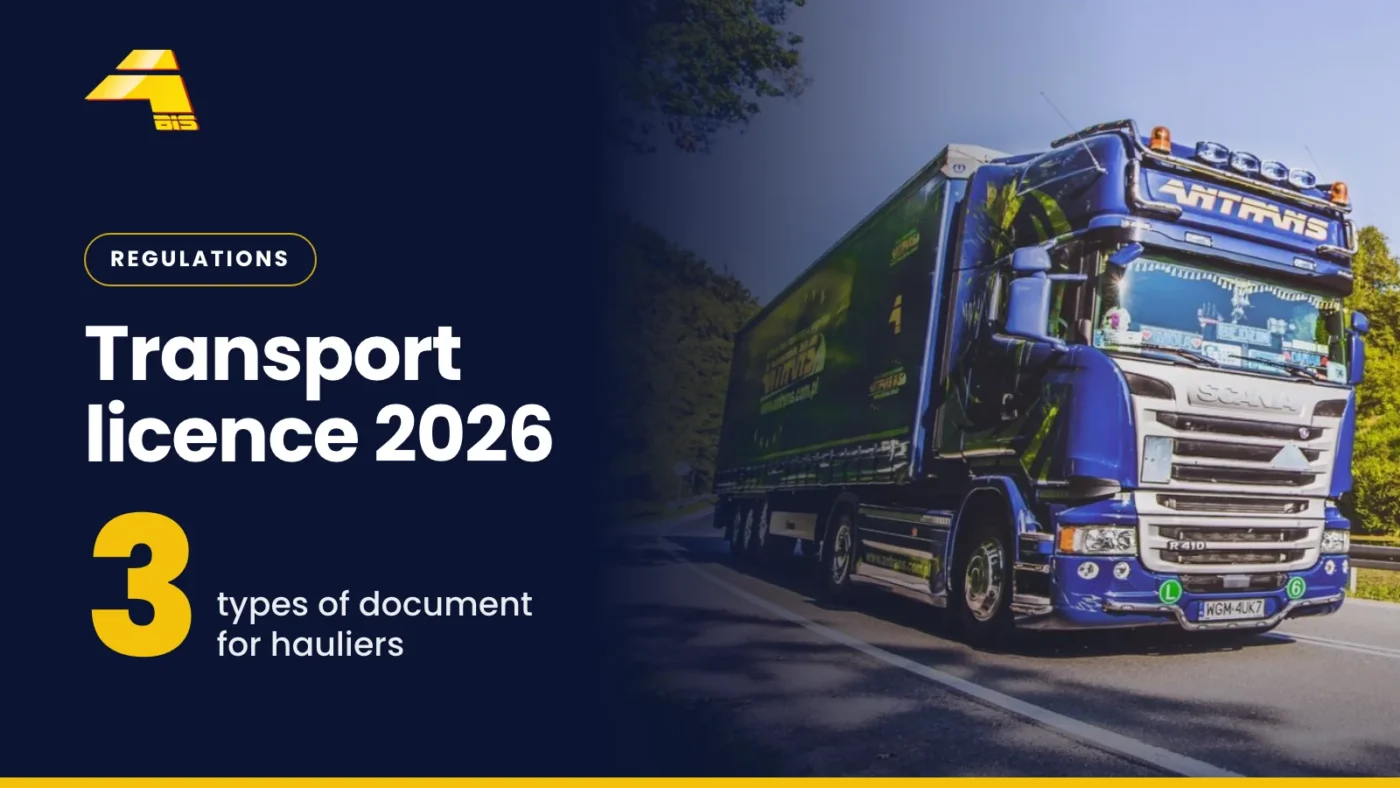
Transport licence in Poland in 2026
You do not need a transport licence in every case. Whether you need documents authorising you to operate as a road haulier depends on three key factors. The first is the gross vehicle weight (GVW) of the vehicle you use. The second is the type of transport, i.e. whether you operate domestically or internationally. The third is the nature of your business: whether you carry goods for hire or reward, or only move goods for your own company’s needs.
In this article we take a detailed look at the three types of document that regulate the road transport market in Poland. The first is the permit to pursue the occupation of road transport operator, commonly called the national licence, which is issued by the starosta (head of the district authority). The second is the Community licence, which authorises international transport and is issued by GITD (the Polish Road Transport Inspectorate). The third is the own-account transport certificate, an alternative for companies that do not provide transport services for hire or reward.
The legal basis is the Polish Road Transport Act of 6 September 2001 and Regulation (EC) No 1071/2009, which lays down common rules on admission to the occupation of road transport operator in the European Union.
Is a transport licence always required?
No. Whether you need a transport licence depends mainly on the vehicle weight, the geographical scope of your operations and whether you provide transport for hire or reward or only carry goods for your own company.
The table below shows at a glance when a transport licence is required and when a standard business registration is enough.
| Type of transport | Vehicle GVW | Required document |
|---|---|---|
| Domestic, for hire or reward | Over 3.5 tonnes | Permit to pursue the occupation of road transport operator |
| Domestic, for hire or reward | Under 3.5 tonnes | No licence, a standard registered business is enough |
| International, for hire or reward | Over 2.5 tonnes | Community licence |
| International, for hire or reward | Under 2.5 tonnes | No licence |
| Own account | Over 3.5 tonnes | Certificate (not a licence) |
Key change from May 2022. The implementation of the Mobility Package lowered the licensing threshold for international transport from 3.5 to 2.5 tonnes GVW. This means that van operators running cross-border work are now subject to the same requirements as HGV hauliers.
National transport licence
In domestic transport, a transport licence is required above all for the carriage of goods for hire or reward by a vehicle or vehicle combination with a GVW over 3.5 tonnes. In that case you need a permit to pursue the occupation of road transport operator. The same applies to the carriage of passengers for hire or reward in a vehicle designed to carry more than 9 people including the driver, i.e. a bus or coach.
If, on the other hand, you carry goods for hire or reward within Poland in a vehicle under 3.5 tonnes GVW, no transport licence is required. A standard business registration is enough. For own-account carriage of goods in a vehicle over 3.5 tonnes GVW, you need a certificate issued by the district office (starostwo), but this is neither a permit nor a licence.
One important detail is worth stressing. Under Article 5(3) of the Polish Road Transport Act, the national transport licence is issued for an unlimited period, so you do not have to renew it. It remains valid until the company stops meeting the requirements or loses its good repute.
International transport licence: the Community licence and the Mobility Package
If you plan to carry goods beyond Poland’s borders, you need a Community licence. The requirements for an international transport licence changed in two stages. Before 21 May 2022, a Community licence was required for vehicles over 3.5 tonnes GVW in international transport.
Since 21 May 2022, with the implementation of the Mobility Package, an international transport licence is required even for vehicles with a GVW of 2.5 to 3.5 tonnes in international transport for hire or reward. Van operators running international routes became subject to the same regulatory regime as heavy haulage. The Community licence also entitles you to cabotage, but only under strictly defined conditions.
The key rule is this. A Community licence automatically covers domestic transport as well, so you do not need two separate documents. However, to obtain a Community licence you must already hold the national permit or apply to GITD for both documents at the same time.
Transport licence requirements you must meet
Under Article 3 of Regulation (EC) No 1071/2009, every company applying for a transport licence must meet four mandatory conditions. The first requirement is an effective and stable establishment in the European Union. The company must have access to the original documents and have at least one vehicle at its disposal.
The second condition is good repute. This means no final conviction for a serious criminal offence or for infringements of transport, employment or tax law. There must also be no ban on carrying out transport operations.
The third requirement for a transport licence is financial standing. The company must show minimum capital of 9,000 EUR for the first vehicle and 5,000 EUR for each additional vehicle. This is checked every year. The fourth is professional competence, meaning that at least one person managing transport in the company holds a Certificate of Professional Competence.
Certificate of Professional Competence (CPC)
The Certificate of Professional Competence (CPC, in Polish CKZ) is a document confirming knowledge of how to manage a transport business. It is enough for one person in the company, either the owner or an employed manager, to hold the certificate. It is also possible to rely on the CPC of an external person who acts as the formal transport manager.
The exam is held at the Motor Transport Institute (ITS), ul. Jagiellońska 80 in Warsaw. It consists of two parts. The theory part is 64 multiple-choice questions with four possible answers, and you have two hours for it. The practical part covers two tasks, including calculating salaries and a balance sheet and preparing a driver’s working time schedule, also within two hours.
The pass requirement is as follows. You must score at least 50% in each part and at least 60% overall. The exam fee is 500 PLN and issuing the certificate costs another 300 PLN, which comes to 800 PLN in total. If you have to resit, you pay 500 PLN again.
People with a master’s degree or a postgraduate diploma whose programme covers the subjects listed in Annex I to Regulation 1071/2009 are exempt from the exam. The certificate has no expiry date, but it can be withdrawn if the holder loses good repute. The recommended preparation time is at least three to four weeks of self-study.
Financial standing: a key requirement for a transport licence
Under Article 7 of Regulation (EC) 1071/2009, obtaining a transport licence requires proof of an appropriate level of capital and reserves. For the first vehicle you need at least 9,000 EUR, and each additional vehicle requires a further 5,000 EUR. This is checked every year.
| Number of vehicles | Required capital (EUR) | Approx. in PLN (rate 4.2) |
|---|---|---|
| 1 vehicle | 9,000 EUR | ~37,800 PLN |
| 3 vehicles | 19,000 EUR | ~79,800 PLN |
| 5 vehicles | 29,000 EUR | ~121,800 PLN |
| 10 vehicles | 54,000 EUR | ~226,800 PLN |
There are several ways to prove financial standing when applying for a transport licence. The first is annual financial statements certified by a statutory auditor, which is the standard for limited companies. The second is a bank guarantee for the required amount. The third is carrier’s professional liability insurance, which is especially popular with sole traders as a cheap and simple way to get started.
New companies that cannot yet present full financial statements can also use a creditworthiness assessment from a bank under Article 70a of the Polish Banking Act. Remember that financial standing is checked every year, so you must maintain the required level of capital for as long as you run the business.
Operating centre: what does a transport licence require?
An operating centre is a place at the operator’s disposal that is suitable for running transport operations in an organised and continuous way. The requirements are relatively flexible. It must include at least a parking place for the vehicles or a place for loading, unloading or consolidating goods.
A few important points about this transport licence requirement are worth highlighting. The operating centre does not have to be owned by the company; a rental or lease agreement is enough. The registered office and the operating centre can be at different addresses, although both must be stated in the application. In the application documents you give the address of the operating centre and attach proof of your right to use it, i.e. a rental agreement or a title deed.
Operating centre rental services are available on the market and are a popular option for start-ups that do not yet have their own yard or warehouse. Such a service usually costs a few hundred PLN a month.
Transport licence costs in Poland in 2026
Below is a complete breakdown of how much a transport licence costs in 2025. This is the information that future hauliers planning to start a business look for most often.
| Item | Cost |
|---|---|
| National permit (national licence) | |
| Fee for issuing the permit | 1,000 PLN |
| Certified copy of the permit per vehicle (vehicle declared) | 10 PLN/vehicle |
| Certified copy of the permit (vehicle not declared) | 110 PLN/vehicle |
| Community licence (international) | |
| Community licence for 5 years | 4,000 PLN |
| Community licence for 10 years | 8,000 PLN |
| Certified copy per vehicle (5 years) | 440 PLN/vehicle |
| Certified copy per vehicle (10 years) | 880 PLN/vehicle |
| Certificate of Professional Competence | |
| Exam at ITS | 500 PLN |
| Issuing the certificate | 300 PLN |
| CPC TOTAL | 800 PLN |
Transport licence costs: sample calculations for one vehicle.
Option with a national and an international licence for 5 years: national permit 1,000 PLN, Community licence 4,000 PLN, certified copy per vehicle 440 PLN and CPC 800 PLN. Total 6,240 PLN.
Option with a national licence only: national permit 1,000 PLN, certified copy per vehicle 10 PLN and CPC 800 PLN. Total 1,810 PLN.
The transport licence costs above do not include the cost of proving financial standing, renting an operating centre, or buying or leasing a vehicle.
How to apply for a transport licence in Poland: step by step
The application process for a transport licence differs depending on the type of document. Below we outline both routes together with the documents you need.
National transport licence
The national transport licence is issued by the starosta responsible for the area of the company’s registered office or by the mayor of a city with district status. You can submit the application online via the biznes.gov.pl platform or in person at the district office (starostwo powiatowe).
With your transport licence application you must enclose a criminal record certificate for the business owner and for the transport manager, and the transport manager’s Certificate of Professional Competence. You also need proof of financial standing, which can be carrier’s professional liability insurance, a bank guarantee or financial statements.
In addition, you submit a document confirming your right to use the operating centre, i.e. a rental agreement or a title deed, a list of the vehicles at the company’s disposal and proof of payment of the 1,000 PLN fee.
Community transport licence
The international transport licence is issued by the General Inspectorate of Road Transport (GITD) in Warsaw. You submit the application directly at the GITD head office. You can file a single application for the national permit and the Community licence at the same time, which speeds up the process considerably and cuts down the paperwork.
An additional requirement is to hold the permit to pursue the occupation of road transport operator, i.e. the national licence, or to apply for it at the same time. The documents are the same as for the national licence, and the fee you must show you have paid is 4,000 PLN for a 5-year licence or 8,000 PLN for a 10-year licence.
An important restriction applies to transferring a transport licence. It cannot be assigned or transferred to another business. The exceptions are a merger, a demerger or a change in the company’s legal form.
How long does it take to get a transport licence?
Realistic waiting times for a transport licence in 2026 are as follows. A national licence issued by the starosta usually takes two to four weeks from the submission of a complete application. A Community licence from GITD calls for a little more patience, from a few weeks to two or three months, depending on how complete your documents are.
If your transport licence application is incomplete, the authority will ask you to supply what is missing, and the time limit only starts once you have resubmitted the complete documents. It is worth bearing this in mind when planning your schedule.
A practical warning about transport licence timelines. Obtaining the Certificate of Professional Competence is often the longest stage on the critical path. Exams at ITS are held on set dates, and waiting for a free exam slot can take several weeks. After you pass, issuing the certificate takes another two to three weeks.
Penalties for operating without a transport licence
Carrying out road transport for hire or reward without the required transport licence has serious legal and financial consequences. The Polish Road Transport Act provides for substantial fines.
Operating without a national transport licence means a fine of up to 12,000 PLN. Operating internationally without a Community licence means a fine of well over ten thousand PLN. In addition, the inspector may order the vehicle to be taken to a guarded car park until the paperwork is in order.
Repeated infringements lead to a ban on carrying out transport operations in the country concerned, i.e. the loss of so-called good repute, which makes it impossible to obtain a transport licence again. International companies check their logistics partners’ licences before signing contracts, so being turned down by foreign clients is a common consequence.
Start a legal transport business with a transport licence
A transport licence is the foundation of operating legally and your ticket to domestic and international work. Logistics companies, freight exchanges and large clients check credentials before they start working with you. Without the right documents, you will not earn the market’s trust.
Useful articles: How to start a transport company in Poland in 8 steps | Finding transport orders: 5 effective ways to win new loads | Funding for road transport: grants for transport businesses | Transport documents in road haulage in 2026
FAQ: common questions about transport licences
Below you will find clear answers to the key questions about transport licences. We cover exact costs and price ranges for the different types of licence, waiting times for the documents, formal and capital requirements, the differences between the national and the Community licence, and the consequences of operating without the required authorisation.
How much does a transport licence cost in 2025?
Transport licence costs start at 1,810 PLN for domestic transport and go up to 6,240 PLN for domestic and international operations. A national transport licence means a 1,000 PLN permit fee, 10 PLN for a certified copy per vehicle and 800 PLN for the Certificate of Professional Competence. A Community transport licence costs 4,000 PLN for 5 years or 8,000 PLN for 10 years, plus 440 PLN or 880 PLN for a certified copy per vehicle. According to the European Commission, Polish transport licence fees are among the lowest in the EU (Germany: 2,500-3,400 PLN, France: 6,300 PLN).
How long does it take to get a transport licence?
A transport licence takes 2-4 weeks to be issued for a national licence and 6-12 weeks for a Community licence. Most district offices process national transport licence applications in 2-3 weeks. GITD needs 6-12 weeks for an international licence, although when applications pile up it can take 3 months. The longest part is obtaining the CPC: waiting for the exam takes 3-8 weeks and issuing the certificate another 2-3 weeks. According to data from the Polish Ministry of Infrastructure, the average time from the decision to the first run with a transport licence is 3.5 months.
What are the basic requirements for a transport licence?
A transport licence requires four conditions set out in Regulation (EC) 1071/2009: an effective establishment in the EU, good repute, financial standing of at least 9,000 EUR and professional competence (CPC). An effective establishment means an operating centre and at least one vehicle. Good repute means no convictions for criminal offences or infringements of transport rules. Financial standing means 9,000 EUR for the first vehicle (about 37,800 PLN), which you can prove with professional liability insurance, a bank guarantee or financial statements. Professional competence means having a person with a CPC in the company.
What is the difference between a national and a Community transport licence?
A national transport licence only covers transport within Poland, while a Community licence covers the whole EU and automatically includes domestic transport. The national licence is required for vehicles over 3.5 tonnes, is issued by the starosta, costs 1,000 PLN and has no expiry date. The Community transport licence applies to vehicles over 2.5 tonnes, is issued by GITD, costs 4,000-8,000 PLN and has to be renewed every 5-10 years. According to GITD, 68% of companies hold both licences. With a Community licence you do not need a national one: you can automatically operate in Poland and across the EU.
Can you run a transport company without a licence?
Yes, a transport licence is not required for vehicles under 3.5 tonnes GVW in domestic transport or under 2.5 tonnes internationally. Domestic transport with vans up to 3.5 tonnes only requires a registered business with the Polish activity code PKD 49.41.Z (road freight transport). Carrying goods for hire or reward above these thresholds without a transport licence is an offence punishable by a fine of up to 12,000 PLN (national) or 15,000 PLN (Community).
How long is the CPC exam required for a transport licence?
The Certificate of Professional Competence exam, which is mandatory for a transport licence, lasts 4 hours: 2 hours for the theory part (64 questions) and 2 hours for the practical part (2 calculation tasks). To pass, you need at least 50% in each part and 60% overall. Exams at ITS are held every month, and slots fill up 6-8 weeks ahead. The cost is 800 PLN (500 PLN for the exam + 300 PLN for the certificate). Statistics show that 65-70% of candidates pass at the first attempt. Once you pass, you will receive the certificate by post within 2-3 weeks.

Managing Director | Antrans BiS, Olkusz
Sebastian Szklarczyk has led the development of Antrans BiS, a transport company operating throughout Europe, for more than 15 years. He started as Head of the Freight Forwarding Department, gaining practical experience in organising international transport and managing a vehicle fleet on European routes.
As Managing Director, he is responsible for the strategic management of a company handling more than 21,000 transport operations a year on its main routes: Poland-Italy, Poland-Germany, Poland-Austria, Spain, the Benelux countries and Scandinavia. Under his leadership, Antrans BiS has expanded its fleet to 220 vehicles, including its own and partners’ vehicles, and achieved an on-time delivery rate of 98%.
Specialisms: international FTL transport throughout Europe, automotive and FMCG logistics, optimisation of European routes, road traffic regulations and driving bans in the EU, and transport documentation (CMR, VAT-UE, INTRASTAT).
On the Antrans BiS blog, he shares practical knowledge about international freight forwarding, transport regulations and the business aspects of running a transport, freight forwarding and logistics company in different European countries.