Oversize transport in 2026
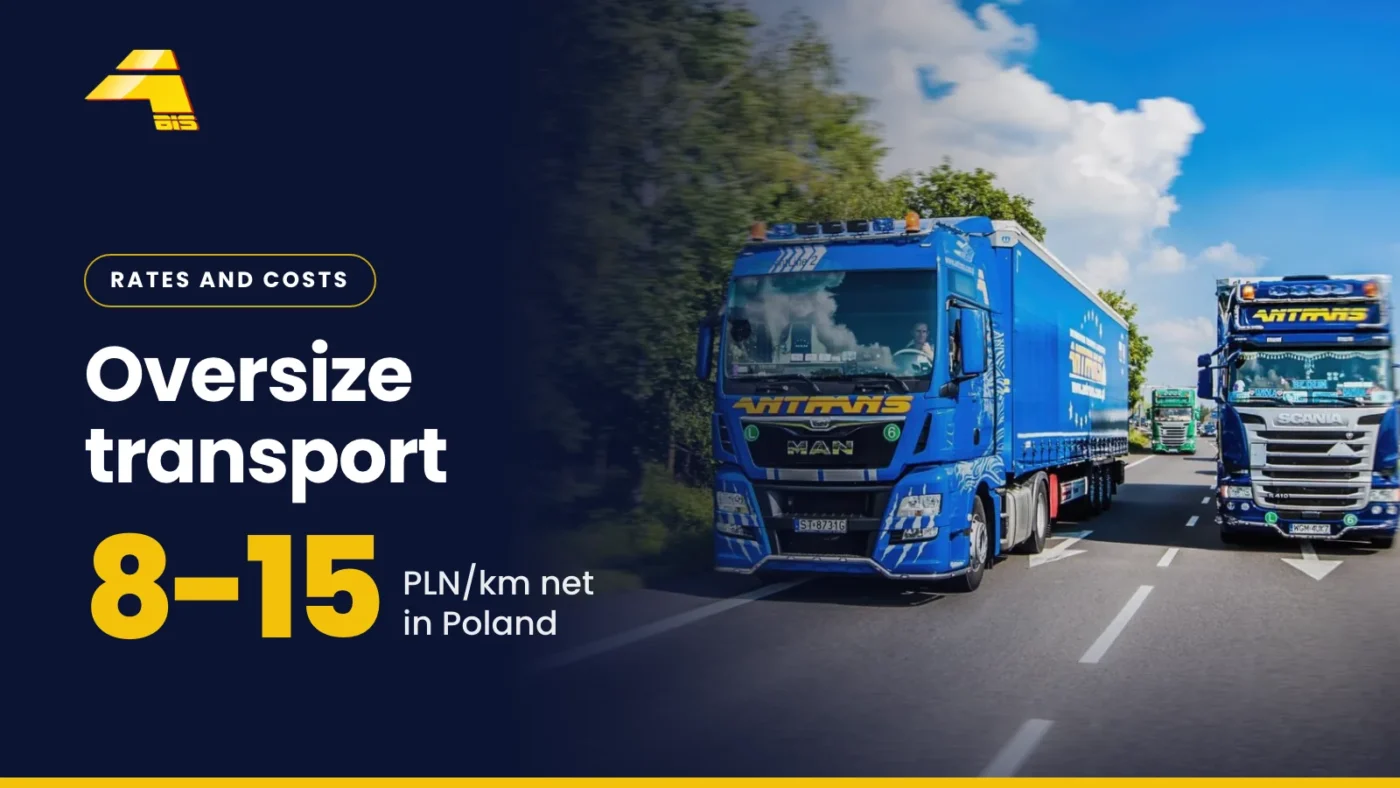
Oversize transport in Poland costs from 8 to 15 PLN net per km on domestic routes and from 2 to 4.5 EUR per km on international jobs. Every quote is individual and depends on the dimensions of the load, the route and the permits required. In this article you will find current rates for 2026, a breakdown of all the factors that affect the cost, a formula for working out the price yourself with worked examples, and a comparison with other types of transport.
What is oversize transport?
Oversize transport, also referred to as abnormal load or non-standard transport, is the carriage of loads that exceed the permitted dimensions or weights set out in road traffic law. Every such movement needs an individual permit, and often a pilot car escort as well.
Under EU rules and the Polish Public Roads Act, a load counts as oversize as soon as it exceeds even one of the legal limits for width, length, height or weight.
The loads moved most often include construction and agricultural machinery (excavators, combine harvesters, loaders), steel structures, precast concrete elements, wind turbine components, boilers and industrial plant. Detailed EU rules on permitted dimensions are set out on the European Commission’s page on the weights and dimensions of heavy vehicles.
How much does oversize transport cost per km? Current rates for 2026
What oversize transport costs per kilometre is a question with no single, simple answer. The ranges are wide and reflect huge differences between jobs. A combine harvester 3.2 m wide on a 150 km route sits at a completely different cost level from a 40 m steel beam that needs a police escort and a permit process lasting several weeks.
International rates 2026: 2.0-2.8 EUR/km to Central Europe, 3.5-4.5 EUR/km to Scandinavia.
The table below shows how the price per km for oversize transport changes with the type of load and the destination.
| Type of load / route | Net rate per km | Notes |
|---|---|---|
| Agricultural machine (combine harvester), domestic | 8-10 PLN/km | Category I-II permit, usually no escort |
| Wheeled excavator, domestic | 9-11 PLN/km | Low-loader, private escort may be needed |
| Crawler excavator, domestic | 11-14 PLN/km | Category III-IV permit, private escort |
| Steel structure / precast element, domestic | 12-15 PLN/km | Extendable trailer, higher additional costs |
| PL → Central Europe (DE, AT, CZ) | 2.0-2.8 €/km | Lowest range, good infrastructure |
| PL → Western Europe (FR, BE, NL) | 2.8-3.8 €/km | High road tolls, detailed regulations |
| PL → Scandinavia | 3.5-4.5 €/km | Ferry crossings, strict local standards |
| PL → Southern Europe (IT, ES) | 3.0-4.5 €/km | Alpine tunnels, many transit permits |
To estimate oversize transport abroad, add to the base rate the road tolls (0.20-1.00 EUR per km depending on the country), bridge and tunnel charges, and the cost of permits in each transit country separately. On a route through four or five countries, the paperwork alone can take four to six weeks.
What affects the price of oversize transport?
Oversize transport is about more than kilometres. The final price is made up of several factors, and any one of them can push up the cost of the whole operation considerably.
Load dimensions and weight are the basic pricing criterion. The further a load exceeds the limits, the higher the permit category and the more specialised the vehicle. A load 4 m wide can generate total costs as much as 30-50% higher than one 3 m wide.
The route and its restrictions matter enormously in practice. Viaducts with a low load capacity, narrow stretches of local roads or a forced diversion make the route and the journey time genuinely longer. A 100 km detour on a planned 400 km route means a 25% increase in cost.
Category I-VII permits are mandatory in Poland for every abnormal load movement. A category I permit costs a few hundred PLN and takes a few days. A category VII permit costs several thousand PLN, and the wait can run to several weeks. For international transport, a permit has to be obtained in each country separately. Application forms and current regulations are published by Poland’s General Directorate for National Roads and Motorways (GDDKiA).
A pilot car escort is required above certain dimension thresholds. A private escort (for widths over 3.2 m or lengths over 23 m) costs 300 to 800 PLN per trip. A police escort, mandatory for the largest loads, is more expensive and has to be arranged in advance. Night-time movements, typical of category VII, push handling costs up further.
Other items that regularly appear in calculations:
- trailer type: a flatbed, a low-bed (low-loader), an extendable trailer or an SPMT modular transporter mean completely different operating costs
- insurance: carrier’s liability insurance (OCP), cargo insurance and cover for the road infrastructure in case the road surface or engineering structures are damaged
- empty return kilometres: if the carrier has no return load, the cost of the empty run goes into the quote
- seasonality: at the peak of the construction season (April-October) rates go up, and last-minute jobs can be 15-30% more expensive
How do you calculate the cost of oversize transport?
A correct calculation does not stop at multiplying the rate by the kilometres. Additional costs make up 20 to 40% of the job value, and even more on complex moves.
Additional costs cover permits, escort, cargo insurance, road tolls, loading and unloading, and the cost of an empty return run where applicable.
Three examples of how this works in practice:
Example 1: combine harvester, 200 km, domestic route. Category I permit, no escort. 9 PLN × 200 km = 1,800 PLN + 400 PLN of additional costs. Around 2,200 PLN in total, which gives a real rate of about 11 PLN per km.
Example 2: crawler excavator, 300 km, domestic route. Category III permit, private escort. 12 PLN × 300 km = 3,600 PLN + 1,500 PLN of additional costs. Around 5,100 PLN in total, which gives a real rate of about 17 PLN per km.
Example 3: 20 m steel beam, PL-DE-FR route, 800 km. Permits in three countries, escort along the entire route, road tolls. 3.2 EUR × 800 km = 2,560 EUR + about 2,000 EUR of additional costs. The estimated total cost is 5,500-7,000 EUR. Jobs like this are always priced individually.
What vehicles are used for oversize transport?
The choice of trailer has a direct impact on the price of oversize transport per km. Specialist vehicles cost more to run and are harder to come by, which translates into higher rates. Four basic types operate in the abnormal load market:
- Flatbed: the basic type, used for loads of standard height such as agricultural machinery or precast elements. The lowest operating costs of all the types.
- Low-loader (low-bed): a lowered deck for carrying tall machinery such as excavators, cranes and road rollers. More expensive to run, which means a higher rate per km.
- Extendable low-loader: the deck can be extended to over 50 m. Designed for wind turbine components, long bridge beams and multi-section steel structures.
- SPMT modular transporter (Self-Propelled Modular Transporter): for extremely heavy and oversized industrial loads. Always priced individually and one of the most expensive types of oversize transport on the market.
Abnormal load transport is on average two to three times more expensive than standard haulage. This comes from the cost of specialist equipment, permits and escorts, not from arbitrary pricing by carriers. It is also the only legal option for loads that exceed road limits.
| Transport type | Net rate per km (Poland, 2026) |
|---|---|
| Standard haulage (tarpaulin trailer, tautliner) | 4-7 PLN/km |
| Refrigerated transport | 5-9 PLN/km |
| ADR transport (dangerous goods) | 8-12 PLN/km |
| Oversize transport | 8-15 PLN/km |
| Heavy machinery transport on SPMT | individual quote (20+ PLN/km) |
Detailed guidelines for special transport in Europe are published by the International Road Transport Union (IRU) in its industry library.
Get in touch for a free oversize transport quote
Every oversize transport job is different. A proper quote has to take into account the exact dimensions and weight of the load, the route, the delivery date and the permit category required. We have our own fleet of low-loader trailers, experience in organising domestic and international transport, and knowledge of the regulations in every European Union country. Contact us, send us the load details and the route, and we will prepare a detailed quote with no obligation.
Useful articles: How to start a transport company in Poland in 8 steps | How to get haulage work: 5 effective ways to win new loads | Road transport grants in Poland: funding for transport businesses | Transport documents in road haulage in 2026
FAQ: common questions about oversize transport
Below we answer the questions that come up most often when organising abnormal load transport. If you can’t find the answer to your question here, contact us directly.
How much does it cost per km to transport an excavator in 2026?
Transporting a wheeled excavator costs around 9-11 PLN net per km, and a crawler excavator 11-14 PLN per km. The difference comes down to size: a crawler excavator is wider and heavier, so it needs a higher permit category and often a private escort. On top of the rate per km come additional costs: the permit, insurance and any escort. The exact price depends on the specific dimensions of the machine, the route and the delivery date. Once you give us the details, we can prepare a quote quickly.
Does oversize transport require special permits?
Yes, every movement of a load that exceeds the dimension or weight limits requires a category I-VII permit. For domestic transport in Poland, permits are issued by GDDKiA or the relevant road authority, and their cost ranges from a few hundred to several thousand PLN depending on the category. The further the limits are exceeded, the higher the category, the longer the wait and the more the permit costs. In international transport a separate permit is needed in each transit country, which makes preparing the move take considerably longer. On routes through several countries, obtaining all the documents alone can take four to six weeks.
How long does it take to organise oversize transport?
A simple domestic move can be organised in 2-5 working days, which is how long it takes to obtain a category I or II permit. More complex domestic routes that require higher permit categories and an escort usually take 1-2 weeks. International transport through several countries can take as long as 4-6 weeks, because permits have to be obtained in each country separately. The higher the permit category, the longer the wait for it to be issued. It is worth planning oversize transport as far ahead as possible, because last-minute bookings generate extra costs and cannot always be carried out at short notice.
Can you negotiate the price of oversize transport?
Yes, carriers offer better rates for regular cooperation or larger volumes of work. It also pays to plan transport in advance, because last-minute bookings are usually 15-30% more expensive. If you can offer a return load, i.e. goods to be carried on the way back, this can significantly reduce the total price of the job. In oversize transport the price per km is the result of many factors, so even small changes to route planning or timing can affect the final quote. It is best to discuss the details directly with the carrier and ask what exactly can be optimised in your particular job.

Managing Director | Antrans BiS, Olkusz
Sebastian Szklarczyk has led the development of Antrans BiS, a transport company operating throughout Europe, for more than 15 years. He started as Head of the Freight Forwarding Department, gaining practical experience in organising international transport and managing a vehicle fleet on European routes.
As Managing Director, he is responsible for the strategic management of a company handling more than 21,000 transport operations a year on its main routes: Poland-Italy, Poland-Germany, Poland-Austria, Spain, the Benelux countries and Scandinavia. Under his leadership, Antrans BiS has expanded its fleet to 220 vehicles, including its own and partners’ vehicles, and achieved an on-time delivery rate of 98%.
Specialisms: international FTL transport throughout Europe, automotive and FMCG logistics, optimisation of European routes, road traffic regulations and driving bans in the EU, and transport documentation (CMR, VAT-UE, INTRASTAT).
On the Antrans BiS blog, he shares practical knowledge about international freight forwarding, transport regulations and the business aspects of running a transport, freight forwarding and logistics company in different European countries.