How much does low-loader transport cost per kilometre in 2026?
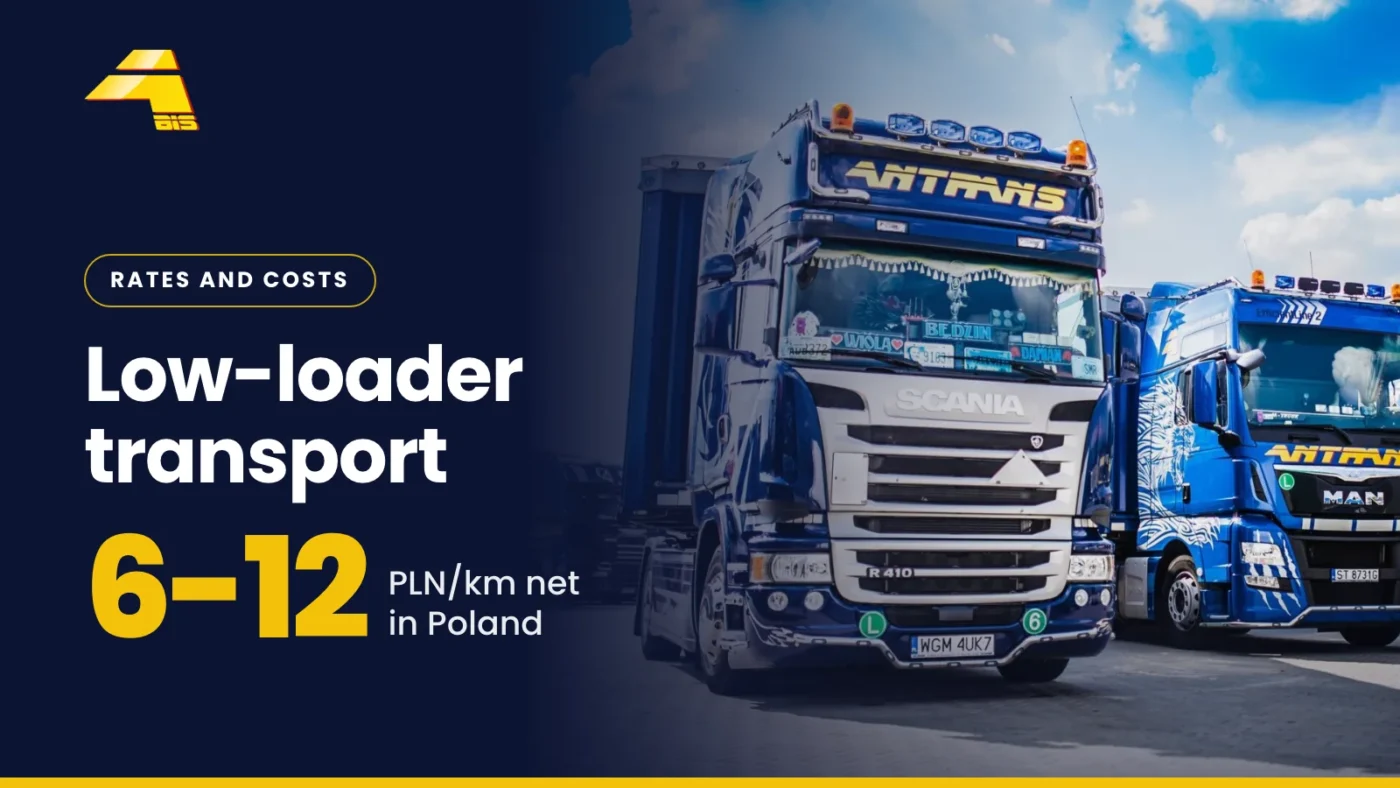
In 2026, low-loader transport within Poland costs on average 6-12 PLN net per km. For oversize loads that need permits and a pilot vehicle, the rate goes above 12-15 PLN/km. International low-loader transport is usually priced as a package or at 1.2-3 EUR/km, depending on the destination and the load specification.
What low-loader transport costs in a particular case depends on many variables: the weight and dimensions of the load, the trailer type, the length of the route, whether permits are needed and the current e-TOLL rates (e-TOLL is Poland’s electronic road toll system). In this article you will find a rate table by load type and route, a rundown of additional costs, the impact of the February 2026 e-TOLL increases, a calculation formula with three examples and tips on choosing a reliable carrier.
Low-loader rates per km: table by load type and route (2026)
This is the most common question when planning an order: how much does low-loader transport cost for a specific load? Below are two tables with current price ranges, one for domestic and one for international transport.
Table 1 - Domestic low-loader transport in Poland, net rates per km (2026)
| Load type | Rate per km | Notes |
|---|---|---|
| Construction machinery (excavator, loader) | 6-10 PLN/km | standard, no permit |
| Agricultural machinery (combine harvester, forage harvester) | 7-10 PLN/km | seasonal: higher rates in spring and autumn |
| Steel structures, precast elements | 8-12 PLN/km | often requires a permit |
| Oversize transport with a permit | 10-15 PLN/km | + cost of the permit and pilot vehicle |
| Express / night transport | +20-40% on the base rate | depends on vehicle availability and the deadline |
| Short route under 50 km | minimum charge 800-1,500 PLN/trip | not calculated per km |
* Net rates for 2026. Every order is quoted individually. The final price depends on weight, dimensions, the deadline and vehicle availability.
Table 2 - International low-loader transport, indicative rates (2026)
| Destination | Indicative rate | Pricing basis |
|---|---|---|
| Central Europe (CZ, SK, HU, RO) | 1.2-1.8 EUR/km | rate per km or package price |
| Western Europe (DE, NL, FR, BE, AT) | 1.8-2.8 EUR/km | mostly package pricing |
| Scandinavia (SE, NO, FI, DK) | 2.5-3.5 EUR/km | often a lump sum for the whole route |
| United Kingdom | 2.5-3.5 EUR/km + ferry | ferry cost charged separately |
* Net rates for 2026. Every low-loader order needs an individual quote. Permit costs in each transit country must be added to the amounts shown.
What is low-loader transport and when is it used?
Low-loader transport means carrying loads on trailers with a lowered deck that sits just 35-90 cm above the road surface, whereas a standard semi-trailer has its deck at about 120-150 cm. This makes it possible to carry loads that are too tall for standard vehicles while staying within the legal limit of 4 metres for the overall height of the combination.
When is low-loader transport most often the right choice? For moving construction machinery (excavators, loaders, road rollers, cherry pickers), agricultural machinery (combine harvesters, forage harvesters, sprayers, large tractors), industrial equipment (forklifts, overhead cranes, generators, tanks), special structures (precast concrete elements, steel components, wind turbine blades) as well as special vehicles and damaged trucks. If a load is too tall for a standard tarpaulin trailer, a low-loader is often the only option.
The 4-metre limit: If the load and trailer together exceed 4 m in overall height, the journey requires a permit for an abnormal (non-standard) vehicle. This is one of the key factors that push up the price of low-loader transport.
Types of low-loader trailers and their payload
What low-loader transport costs depends directly on which trailer the load requires. Trailer types differ in operating cost, availability and loading capability.
Table 3 - Types of low-loader trailers, specifications and uses
| Trailer type | Deck height | Max weight | Typical use |
|---|---|---|---|
| Semi (semi-low-loader) | ~86 cm | up to 40 t | excavators, loaders, agricultural machinery |
| Tiefbett (true low-bed) | ~35 cm | up to 30 t | tall machinery, generators, tanks |
| Low-deck platform | ~105 cm | up to 15 t | smaller equipment, forklifts |
| Tele (extendable) | ~86 cm | up to 60 t | turbine blades, steel structures over 15 m |
| Trailer with steerable axles | ~86 cm | up to 50 t | urban jobs, narrow streets, construction sites |
* An extendable trailer or one with steered axles costs more to run, which translates directly into a higher rate per km.
What affects the price of low-loader transport? 8 key factors
It is hard to say what low-loader transport will cost in a specific case without knowing the following variables. Each of them can raise or lower the final price by 20-50%.
1. Route length. The longer the route, the lower the rate per km, because fixed costs (loading, pilot vehicle, the truck’s return journey) are spread over more kilometres. Routes under 50 km are charged at a minimum rate of 800-1,500 PLN. Routes of 200-500 km: 6-10 PLN/km. Over 500 km: 5-8 PLN/km.
2. Weight and dimensions of the load. A load within the standard limits (up to 40 t GVW, under 4 m high, under 2.55 m wide) does not need a permit. Exceeding any of the limits means a category I-V permit under Polish rules, a pilot vehicle and waiting time, which raises the price of low-loader transport by 20-50%.
3. Trailer type. A straight platform (semi) is the cheapest. A Tiefbett costs more because of its higher operating costs. A multi-axle extendable trailer with steerable axles is the most expensive option and is used for extreme loads. The choice of trailer follows from the dimensions and weight of the load.
4. e-TOLL charges in 2026. On 1 February 2026, e-TOLL rates in Poland rose by 40-42% and the tolled road network grew by another 645 km. Heavy low-loader combinations with a GVW of 40-60 tonnes fall into the highest charge band. e-TOLL on a 300 km route can cost 400-800 PLN and is always added to the invoice.
5. Movement permits. Category I-III permits cost 200-800 PLN and are issued within 3 working days. Category V costs 500-1,600 PLN, with a waiting time of 14-30 days. The detailed categories and fees are published by GDDKiA (the Polish General Directorate for National Roads and Motorways) on its website. For international transport, each transit country requires a separate permit costing 500-2,000 EUR.
6. Pilot vehicles and escorts. A pilot vehicle on a domestic route costs 500-1,500 PLN. A police escort, required for extreme dimensions or night-time motorway runs, adds another 800-2,000 PLN to the total cost of low-loader transport.
7. Seasonality. The construction peak from April to October and the harvest in July and August are periods of high demand for low-loaders. Out of season, rates are 10-20% lower and vehicles are easier to get.
8. Deadline and vehicle availability. The base price applies when you book 1-3 working days in advance. Express transport or a job carried out within 24 hours raises the rate by 20-40%. In regions where specialist trailers are scarce, the price goes up regardless of the deadline.
Additional costs in low-loader transport: what the per-km rate leaves out
One of the most common reasons for a gap between the quote and the invoice is that additional costs were left out. You only see what low-loader transport really costs once you add up all the items.
Table 4 - Additional costs in low-loader transport (2026)
| Item | Indicative cost | When it applies |
|---|---|---|
| Loading / unloading | 300-800 PLN | when a crane, or a ramp not provided by the shipper, is used |
| Domestic permit (cat. I-III) | 200-800 PLN | permitted limits exceeded |
| Domestic permit (cat. IV-V) | 500-5,000 PLN | large and extreme dimensions |
| Pilot vehicle (domestic route) | 500-1,500 PLN | required by law or by the carrier |
| Police escort | 800-2,000 PLN | extreme dimensions, night-time motorway runs |
| Foreign permit | 500-2,000 EUR/country | international transport of an abnormal load |
| Cargo insurance | 0.05-0.15% of the value of the goods | optional, recommended for machinery worth over 200,000 PLN |
| Waiting time / vehicle detention | 200-600 PLN/day | loading or unloading takes longer than agreed |
| e-TOLL road tolls (PL) | depends on route and GVW | added to the invoice on every order |
| Empty return kilometres | included or +30-50% of the rate | one-way routes far from the carrier’s base |
* Always ask for an all-in quote. A per-km rate without a breakdown of additional costs tells you nothing about the real total cost of the order.
e-TOLL 2026 and low-loader prices: what has changed?
None of the popular articles on low-loader transport looks directly at how e-TOLL 2026 affects costs in this segment. Yet for low-loader combinations with a GVW of 40-60 tonnes, the change is felt more than for standard trucks.
New e-TOLL rates resulting from the annual indexation have applied since 1 January 2026. On 1 February 2026, further increases of 40-42% came into force, depending on the Euro emission class and the road category, and the tolled network grew by 645 km to about 5,869 km in total. Current rates and a journey cost calculator are available directly in the e-TOLL system at etoll.gov.pl.
A practical example of the impact on low-loader prices: a 50 t GVW combination, Euro 5, on a 300 km route (e.g. Silesia to the Tri-City around Gdańsk). Before the increase, e-TOLL came to about 300-400 PLN. Since 1 February 2026, the same journey has cost about 420-565 PLN, an increase of 40%. On a 300 km route, that means an extra 0.40-0.55 PLN/km from e-TOLL alone.
Vehicles that meet the Euro 6 standard pay lower rates than older ones. A modern fleet means a genuinely lower e-TOLL cost on every order, so it is worth asking the carrier which emission standard its vehicles meet.
Important: Low-loader combinations with a GVW above 40 t may be subject to additional charges for excessive axle load. This is a separate item in the cost estimate, not directly linked to e-TOLL rates.
How to calculate the cost of low-loader transport: formula and 3 examples
The simplest way to check what low-loader transport costs in practice is to use the formula below and plug in your own figures.
Total cost = (rate per km × number of km) + sum of additional costs
Example 1 - construction machine without a permit (standard):
18 t excavator, Kraków to Wrocław (approx. 270 km), semi-low-loader, load within the limits.
Rate 8 PLN/km × 270 km = 2,160 PLN, loading and unloading 600 PLN, e-TOLL approx. 320 PLN.
Total: approx. 3,080 PLN net. Effective rate: approx. 11.40 PLN/km.
Example 2 - oversize machine with a permit and a pilot vehicle:
Telehandler, 3.2 m wide, Gdańsk to Poznań (approx. 310 km).
Rate 10 PLN/km × 310 km = 3,100 PLN, category III permit: 600 PLN, pilot vehicle: 1,000 PLN, e-TOLL approx. 400 PLN.
Total: approx. 5,100 PLN net. Effective rate: approx. 16.45 PLN/km.
Example 3 - short urban route:
Forklift, transfer within Silesia, 35 km.
Minimum charge (route under 50 km): 1,200 PLN net.
Effective rate: approx. 34 PLN/km.
The takeaway: the effective per-km cost of low-loader transport rises dramatically on short routes and for loads that need permits. That is why you should always ask for an all-in total price, not just the base rate per km.
Low-loader vs other types of transport: cost comparison
When planning a budget, it helps to know what low-loader transport costs compared with the alternatives and when it is the only option available.
Table 5 - Per-km rates for different types of domestic transport in Poland compared (2026)
| Transport type | Rate per km (domestic) | When to choose it |
|---|---|---|
| Tarpaulin trailer (curtainsider) | 4.5-7 PLN/km | palletised goods, height under 2.7 m |
| Open flatbed | 5-9 PLN/km | long items that do not need an enclosed body |
| Refrigerated trailer | 7-10 PLN/km | food, pharmaceuticals, temperature-controlled goods |
| ADR transport | 9-12 PLN/km | dangerous goods |
| Low-loader | 6-12+ PLN/km | machinery, tall and heavy loads |
| Oversize (abnormal load) | 10-15+ PLN/km | weights and dimensions beyond the limits, permits |
* Net rates for 2026 for domestic transport on 200-500 km routes.
Low-loader transport is the only option in three situations: the load is more than 2.5 m tall and on a standard trailer would exceed the 4 m overall height limit; the load is too heavy for a standard combination (more than the 24 t payload of a tarpaulin trailer); or the machine drives onto the trailer on its own wheels or tracks and needs a ramp or loading ramps. For more on the limits and rules for abnormal vehicles, see the GDDKiA page on abnormal load movements.
How to choose a low-loader transport company: what to look for
The price of low-loader transport is only one parameter. The carrier’s experience, the scope of its insurance and transparent pricing matter just as much. Below is a checklist to help you choose.
Own trailer fleet. Check whether the company has its own trailers (semi, Tiefbett, tele, steerable axles) rather than just brokering the job. An own fleet means direct responsibility and better control over the schedule.
Experience with similar loads. Ask for references for moving machines in the same weight class. Transporting a 5-tonne forklift and a 40-tonne excavator are completely different logistics operations.
Permits handled in-house. A good carrier obtains the permit itself. If a company tells you to sort out the paperwork on your own, treat it as a warning sign.
OCP and cargo insurance. Carrier’s liability insurance (OCP) is mandatory. For machinery worth more than 200,000 PLN, ask about additional cargo insurance. A low OCP limit (below 0.5 SDR/kg) can mean a grossly inadequate payout if the load is damaged.
A comprehensive all-in quote. The price should include the rate per km, e-TOLL, loading, permits and a pilot vehicle (if required). A per-km rate without the other items is useless when comparing offers.
Vehicle lead time. Usually 1-3 working days. With category I-III permits: 2-5 days more. With category V: from a week to several weeks. It is worth asking about this when you request the quote.
The industry body representing carriers and transport employers in Poland is Transport i Logistyka Polska (TLP), the Polish employers’ association, which publishes, among other things, reports on costs in the sector.
Red flags: a per-km rate quoted without explaining what it covers; no OCP, or cover of only 0.5 SDR/kg; a company with no fleet of its own acting purely as a broker; no way of issuing a CMR consignment note for international transport.
Get a low-loader transport quote: free and ready within 24 hours
What low-loader transport costs in your specific case depends on too many variables to give a fixed figure without analysing the order. The fastest route to an accurate offer is to contact a freight forwarder who knows the specifications of their fleet and the legal requirements for your load.
We have our own fleet of low-loader trailers (semi, Tiefbett, tele), obtain permits for oversize transport in-house and handle domestic and European transport (including Scandinavia). The quote is free and ready within 24 hours. Contact us - tell us the route, the weight and dimensions of the load and your planned date, and we will prepare an all-in offer with no hidden surcharges.
Useful articles: How to start a transport company in Poland in 8 steps | Finding transport orders: 5 effective ways to win new loads | Funding for road transport: grants for transport businesses | Transport documents in road haulage in 2026
FAQ: the most common questions about finding a transport company
Below you will find clear answers to the key questions about how manufacturing companies choose a carrier. We cover legal checks, assessing offers, negotiating terms and building long-term cooperation, all of which will help you find a transport company that fits your logistics needs safely and effectively.
How much does low-loader transport cost per km in Poland in 2026?
Low-loader transport costs on average 6-12 PLN net per km for standard domestic orders. For loads that need a permit and a pilot vehicle, the price of low-loader transport goes above 12-15 PLN/km. Routes under 50 km are charged at a minimum rate of 800-1,500 PLN per trip, regardless of the number of kilometres.
Does low-loader transport always require a permit?
Not always. A permit is only required when the vehicle and load exceed the permitted limits: 4 m in height, 2.55 m in width, 16.5 m in length (combination) or 40 t gross weight. Many low-loader jobs, such as an excavator under 20 t that is up to 2.5 m wide and up to 3.5 m tall, are carried out without any permit at all. The freight forwarder assesses this at the quote stage based on the load specifications.
What does the price of low-loader transport include besides the rate per km?
You only find out what low-loader transport really costs once the additional costs are added. On top of the rate per km come e-TOLL charges (depending on the GVW of the combination and the route), loading and unloading (300-800 PLN), a permit for an abnormal vehicle (200-5,000 PLN depending on the category), a pilot vehicle (500-1,500 PLN) and, on one-way routes, empty return kilometres. Always ask for an all-in quote.
What is the difference between low-loader and oversize transport?
Low-loader transport refers to a type of trailer with a lowered loading deck. Oversize (abnormal load) transport is a legal category covering journeys in which the vehicle and load exceed the permitted dimension and weight limits. The two terms often overlap, but they are not the same thing. Moving an excavator on a low-loader is not automatically an oversize movement, as long as the load stays within the limits. Only exceeding the limits makes it an abnormal load movement that requires a permit.
How long do you have to wait for low-loader transport?
The standard lead time for a vehicle is 1-3 working days. For loads that need a category I-III permit, add another 2-5 days to obtain the documents. Category V means waiting anywhere from a week up to 30 days if the route requires an infrastructure assessment. During the construction season (April to October), specialist trailers are harder to come by, so it is worth booking transport in advance.
Does the per-km rate for low-loader transport fall on longer routes?
Yes, that is economies of scale at work. Fixed costs such as the pilot vehicle, loading or the truck’s journey to the pick-up point are spread over more kilometres, which lowers the effective rate per km. Under 50 km, the minimum charge works out at an effective 20-40 PLN/km. On 100-200 km routes, low-loader transport costs 8-12 PLN/km. Over 300 km: 6-9 PLN/km. That is why, if you are planning several jobs close to each other, it is worth considering combining them into one longer run.

Managing Director | Antrans BiS, Olkusz
Sebastian Szklarczyk has led the development of Antrans BiS, a transport company operating throughout Europe, for more than 15 years. He started as Head of the Freight Forwarding Department, gaining practical experience in organising international transport and managing a vehicle fleet on European routes.
As Managing Director, he is responsible for the strategic management of a company handling more than 21,000 transport operations a year on its main routes: Poland-Italy, Poland-Germany, Poland-Austria, Spain, the Benelux countries and Scandinavia. Under his leadership, Antrans BiS has expanded its fleet to 220 vehicles, including its own and partners’ vehicles, and achieved an on-time delivery rate of 98%.
Specialisms: international FTL transport throughout Europe, automotive and FMCG logistics, optimisation of European routes, road traffic regulations and driving bans in the EU, and transport documentation (CMR, VAT-UE, INTRASTAT).
On the Antrans BiS blog, he shares practical knowledge about international freight forwarding, transport regulations and the business aspects of running a transport, freight forwarding and logistics company in different European countries.